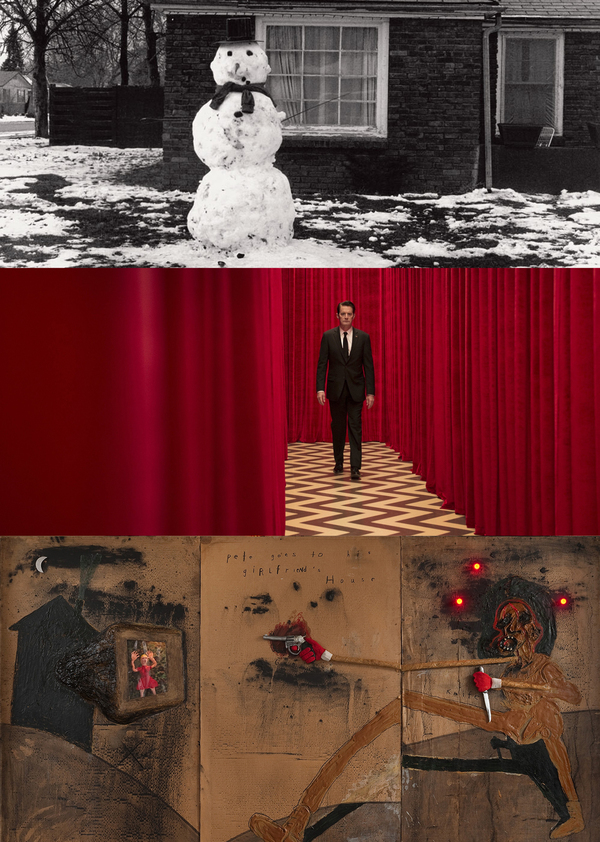
I realized that beneath the surface lies another world, and if I dig deeper—even more worlds. In the blue sky and the flowers there is goodness, but everything is accompanied by another force—wild pain and decay.
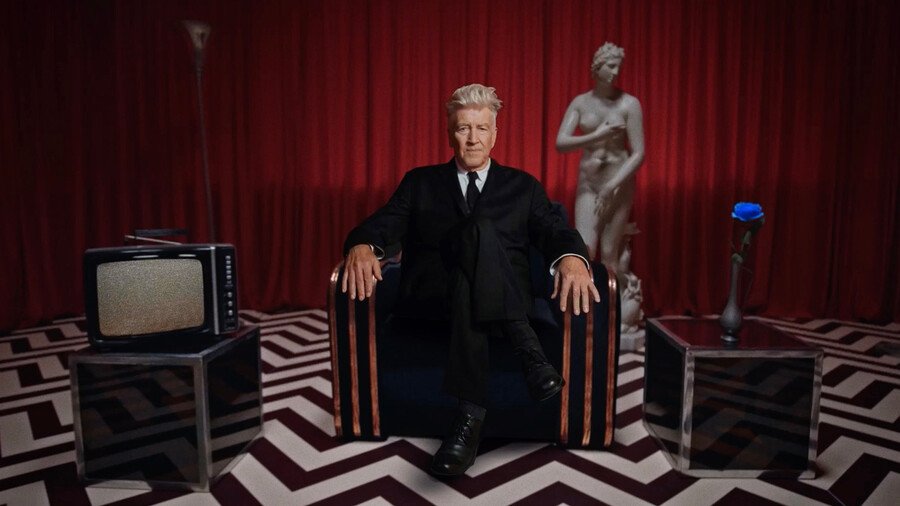
David Lynch, film still
Navigation Menu
Research Concept
I. Theoretical Framework: Kant, Rosenkranz, Žižek
II. Surface and Subsurface: Idyl as a Mask
III. Formless and Deformed: The Matter of the Uncanny
IV. The Comic Sublime: Absurdity, Kitsch, the Comical
V. Loss of Distance: From Screen to Room
Conclusion
Concept
While many know David Lynch primarily as a director, he considered himself an artist in the broadest sense of the word. He studied painting in Boston and at the Pennsylvania Academy of the Fine Arts. His first film, «Six People Are Infected» (1967), was created during his second semester at the Academy and was an animated piece depicting six figures sequentially convulsing to the sound of a siren—thus, he brought painting to life. Throughout his life, alongside his filmmaking, Lynch sought his identity across a variety of mediums, ranging from graphics and photography to music and furniture.
This is where the theme selection comes from. Studying the various mediums David Lynch employed allows us to test one of the course’s core questions—the boundaries of the beautiful. Classical aesthetics conceived of beauty through measure, harmony, order, and benevolence, while considering the ugly to be their absence. With Lynch, it is the opposite: what is considered ugly is not a lack of form or harmony, but its underside, and it manifests through the same techniques that create beauty. This ambivalence is visible not only in the frames of his films but also in the texture of the canvas or in photography; therefore, it is independent of subject matter and editing and belongs to the very way of seeing. For me, as an artist, this is particularly important, because with Lynch, one can trace how one aesthetic premise consistently transitions from one medium to another.
Art allows for the existence of the grotesque only when it is combined with the beautiful. Yet, within this correlation, the grotesque is capable of producing a powerful impact.
I selected material from David Lynch’s works across all mediums he engaged with: early animation and short films, painting and mixed media, lithography, photographic series, comics, furniture and interiors, music albums, films, and the Twin Peaks series. I was less concerned with the «strangeness» of the work and more interested in locating where the beautiful and the grotesque converge within a single image or transition into one another. Each image had to serve as evidence of a specific mechanism of ambivalence.
The research structure is not built by media or by Lynch’s chronological creative progression; I decided instead to follow a path of increasing ambivalence.
First, the grotesque hidden beneath the idyll is examined (Section II), followed by the openly grotesque (III), then its mixture with the comedic (IV), and finally the sublime (V), where the viewer loses their safe position, literally finding themselves inside the space created by Lynch. In each section, I have attempted to showcase works across different media to demonstrate that the mechanism remains the same, regardless of form or tools. In the final section (VI), the pervasive techniques are assembled into a kind of morphology.
A still from David Lynch’s short film
In the course of this research, I relied on three theoretical sources. The first text I referenced is Immanuel Kant’s «Critique of Judgment, ” which is necessary to understand the ineffable nature of aesthetic experience [1]. This ineffability explains why Lynch’s works function more powerfully than they can be interpreted, and why he consistently refused to explain their meaning. The second text is Karl Rosenkranz’s „Aesthetics of the Ugly“ [2], the first systematic work to consider the ugly as an independent category. Finally, Slavoj Žižek’s book „The Art of the Laughable Sublime“ [3] will be useful for discussing the intersection of beauty and ugliness: according to Žižek, in Lynch’s work, „the darkness is truly dark, ” and the viewer loses „a safe distance“ [4]. Supplementary sources will include the exhibition catalogs „Air in Fire“ (Cartier Foundation, 2007) and „Someone in My House“ (Bonnenfanten Museum, 2018–2019), as well as Lynch’s autobiography „Room of Dreams“ and a selection of his interviews.
The core question of this research is: how does David Lynch capture the beautiful and the grotesque across different mediums in a state of irresistible ambivalence, and why is this state experienced specifically as an aesthetic experience rather than mere repulsion?
The research hypothesis posits that in Lynch’s work, the beautiful and the grotesque are viewed as two sides of the same coin, and the transition between them is determined by shifts in distance and volume rather than by changing the subject matter itself. When beauty is taken to an extreme, it devolves into kitsch—becoming both humorous and uncanny. The grotesque, when contained within forms of compassion, music, or material, acquires characteristics of the beautiful. Most interestingly, this mechanism is not tied to a single medium; it functions equally across canvas, black-and-white photography, and film. Therefore, ambivalence in Lynch is a property of vision, a mode of thought, and a breadth of consciousness—and form, like material, plays an intermediary role here.
I. Theoretical Framework: Kant, Rosenkranz, Žižek
The question of whether the ugly can be a subject of aesthetic experience, as ancient as aesthetics itself, was addressed differently. In this work, three answers are important to me, each shedding light on a different facet of David Lynch’s art. Immanuel Kant, in the «Critique of Judgment» (1790), showed that judgments of the beautiful are not based on the concept: «beautiful is that which pleases everyone without concept» [1], but that «beauty is the form of purposiveness of an object, perceived in it without a concept of purpose» [2]—that is, a form that seems meaningful even though we cannot grasp its meaning. This kind of experience usually arises from the free play of imagination and reason, in which we draw no conclusions. This is precisely why it is so difficult to summarize Lynch’s work—it operates on the level of form before the viewer has time to grasp what it is about. Pure phenomenology. It is telling that when asked to interpret one of his paintings, Lynch himself responded, «It’s just what you see» [3].
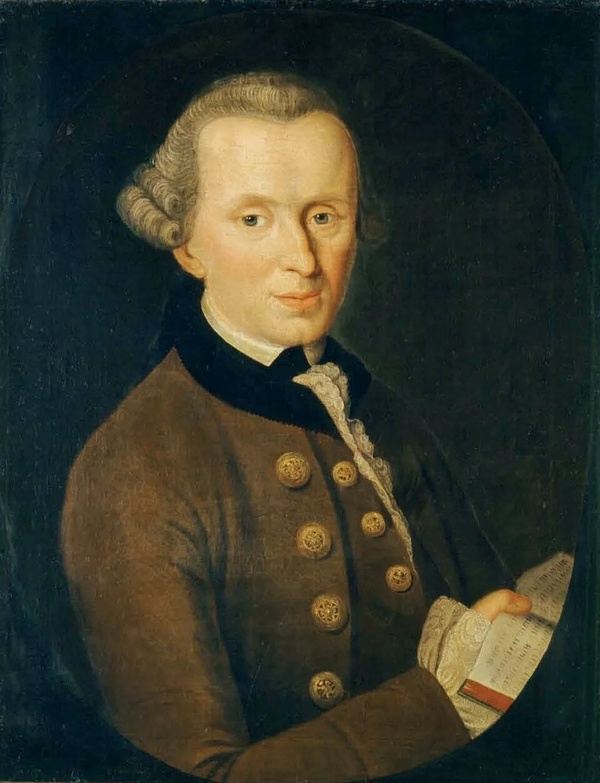
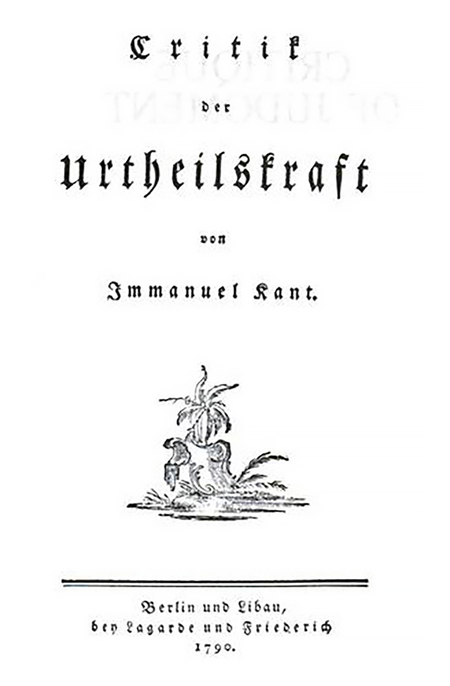
From left to right: Immanuel Kant, Portrait by Johann Gottlieb Becker, Title page of the first edition of «Critique of Judgment»
Kant offers a second thought that reveals the potential for a more comprehensive analysis of Lynch’s art. He writes that exquisite art is capable of beautifully representing things that are «ugly and repulsive» in nature—such as disease, the aftermath of war, or natural disasters. However, there is one caveat, one single thing that destroys aesthetic pleasure—disgust [4]. Furthermore, Kant describes the sublime as a pleasure born from fear or awe when we encounter something immense or grandiose, yet we ourselves remain safe [5]. Thus, the boundary between the repulsive and the boundary of safe distance are constantly tested in Lynch’s work.
The beautiful constitutes the positive precondition for the existence of the ugly, while the comic is a form in which the ugly is liberated from its negative character through confrontation with the beautiful.
If Kant sets the framework, Karl Rosenkranz provides the tools for its detailed analysis. His «Aesthetics of the Ugly» (1853) is the first book entirely dedicated to the ugly as an independent aesthetic category. Rosenkranz considers the ugly to be «negatively beautiful»: it exists as a distortion, destruction, or the reverse side of beauty [6]. In his text, he proposes a classification: formlessness (amorphousness, asymmetry, disharmony), incorrectness, and, as a terminal form, grotesqueness. It is important that for Rosenkranz, the ugly can also lead to the beautiful, for example, through caricature and the comic. This schema allows one to define specific types of the ugly in painting, photography, and the cinema of Lynch, and to understand why they almost never remain purely ugly.
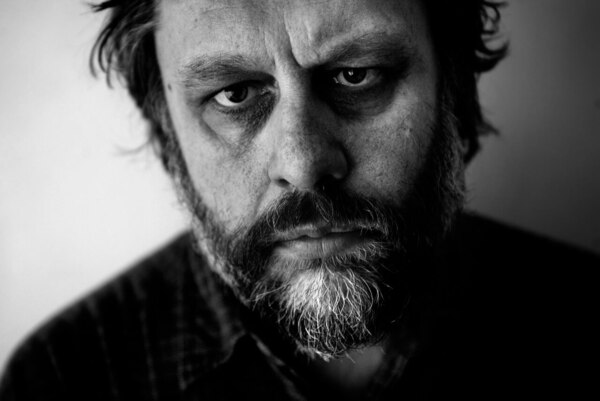
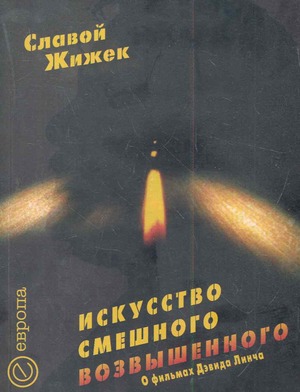
Left to right: Slavoj Žižek, Cover of the Russian edition of «The Art of the Funny Sublime. On David Lynch’s film ‘Lost Highway’»
The third theoretical pillar of this research is Slavoj Žižek and his work, «The Art of the Funny Sublime» (2000, Russian translation 2011). According to Žižek, in Lynch, «the darkness is truly dark. The light is truly unbearable, ” and the space of fantasy reaches such a tension that the viewer „loses the safe distance“ [7]. It is here, Žižek argues, that the sublime converges with the absurd: an image pushed to its limit of intensity brushes against the ridiculous. Žižek notes that in cinema, the only focal point is the structure of desire, not the materiality of the image—its texture, color, or objecthood. Lynch, as an artist, often presents ambivalence materially: in the brushstroke on a canvas or the curve of a chair. Therefore, I use Slavoj Žižek to precisely describe the effect, but I search for the mechanism of this effect in the visual material across all of Lynch’s mediums. Next, we proceed to analyze ambivalence in the art of David Lynch.
II. Surface and Underside: Idyl as a Mask
The first and most «subtle» form of ambivalence in Lynch is tied to the image of the grotesque hidden beneath the beautiful. His idylls are over-polished: the colors too vibrant, the houses too neat, the smiles too wide. Beauty here isn’t a lie, but it is suspiciously fragile, and beneath it always lurks something strange and repellent. In Karl Rosenkranz’s terms, the grotesque resides directly inside the beautiful; it doesn’t oppose it by being its negative counterpart.
The main objects and spaces of this ambivalence are the home and the yard—the American suburb. Lynch spoke directly about this: «I love houses, I love the idea of the inside and outside… there can be horror inside, or it can be very good» [8]. This motif runs through photography, comics, lithography, painting, and film, making it convenient to use as a preliminary hypothesis test: if the mechanism of «surface and underside» is consistent across all media, then it belongs not to the film’s plot, but to the artist’s gaze itself.
David Lynch. «Blue Velvet.» 1986. Prologue scene: red roses by a white fence
The film «Blue Velvet» (1986) opens with slow-motion shots: red roses against a white fence, a blue sky, a fire truck with a waving firefighter. The colors in the frame are saturated like a 1950s advertising poster, and the beauty is perceived as a postcard cliché. This excess causes the viewer to become unsettled even before anything has happened.
David Lynch, «Pitch Goes to His Girlfriend, ” 2009
The title alludes to an ordinary, almost romantic scene, yet the painting depicts Pita holding a knife and a pistol. The naive, almost childlike rendering contrasts sharply with the subject matter, creating a sense of unease. This blend of childhood innocence with the threat of violence leaves the viewer unsure whether to laugh or to fear.
David Lynch, «Someone Is In My House,» 2014. Lithograph on Korean paper