At the Edge of Vision
Color, Form, and Space in 11th and 12th Century Miniatures
Medieval miniatures fascinated me with the sheer volume of events that could be contained on a single page. On some pages, figures are positioned within architectural forms, while on others, the image is divided by vibrant horizontal bands. Crucially, the illustrations do not appear as a mere collection of isolated pictures; the viewer’s gaze gradually moves from one section to the next. The work explores the various techniques artists use to organize this visual movement.
The project features two manuscripts: the Bamberg Apocalypse, dating to around 1010, and the Beatus of Cardinas, dating to around 1180. The first manuscript is housed in the State Library of Bamberg, and the leaves of the second are held at The Metropolitan Museum of Art in New York. These works are separated by about a century and a half, so I do not assume the differences are attributable to a single artistic choice. The dates, titles, and repositories were sourced from the catalogs of the respective libraries and museums.
The main question of this project is: how do artists use color, borders, and the placement of figures to delineate different parts of a narrative on a page? I hypothesize that borders and colored sections help distinguish episodes, while the repetition of poses, lines, and figures connects them into a unified image. However, one strip is not always equivalent to a single event. Sometimes a figure crosses a boundary, and sometimes the composition is built without conventional strips.
This idea cannot be tested with just one sheet. Therefore, I am comparing miniatures from two manuscripts with similar subject matter, as well as pages where the image organization noticeably differs. For example, two versions of the first and fifth trumpets, scenes with the Lamb, and images of angels are placed side-by-side. The thematic similarity allows for a more precise examination of how each artist manipulates the space of the page.
I selected thirteen images from Beatus of Liébana and thirteen different miniatures from the Bamberg Apocalypse. These are independent folios, created by different workshops at different times. The images are displayed one by one on screen. Adjacent examples sometimes relate to the same narrative to allow for a comparison of two compositions, but no folio is repeated in its enlarged form.
Both collections are restricted to digital images available in institutional collections. The Liébana folios are separated from the original manuscript, while the Bamberg Apocalypse is shown within the context of a book. Due to this, the field of view, text placement, and photographic conditions vary. When comparing the images, I account for these differences and do not assume that the size of the photograph equals the size of the original. The Liébana table is included as an exception—it displays the work of the frame and repetition without the typical multi-figure scene.
The work is divided by visual tasks. First, I examine the center and the frame, followed by the architecture, the placement of figures across levels, and the direction of the gaze. Finally, complex examples and a table are presented. This order helps to compare similar images without turning the study into a narrative retelling of religious events.
On each page, I first look at where the image’s boundary lies and how the figures are arranged. Then, I compare the color, the repetition of poses, and the lines that separate one part of the scene from another. The information on Cardelieu was verified using Metropolitan Museum of Art cards and a museum study, while details about the Bamberg Apocalypse were sourced from the digital catalog of the Bavarian State Library and the Bamberg State Library. References are provided at the end. My observations regarding the direction of the gaze remain a suggestion for reading the images, not definitive proof of the artists’ intentions.
Contents
1. Frame and Center 2. The City as Sign 3. One Sheet, Multiple Levels 4. Guiding the Gaze 5. Various Ways to Organize a Page
1. Frame and Center
I’ll start with sheets where a border and a central axis help immediately locate the key information.
Unknown Spanish master. «Lamb at the foot of the cross.» Circa 1180. Tempera, gold, and ink on parchment. Metropolitan Museum of Art, New York.
What is visible: a lamb at the foot of the cross
The cross divides the image into four sections. The objects at the top and the figures at the bottom are arranged so that the gaze is drawn back to the center. The blue background unifies the upper portion, while the green highlights the space near the ground.
Unknown master. «The Lamb on the Throne.» Bamberg Apocalypse, folio 13v. Circa 1010. Miniature on parchment. State Library of Bamberg.
Comparison of two leaves
Here, the Lamb occupies the upper tier of the throne. Two figures are positioned below. Compared to the leaf from Cardini, the center is emphasized not by a long vertical cross, but by the rectangular throne and the symmetry of the surrounding figures.
Unknown Spanish Master. «Christ in Glory with Angels.» Circa 1180. Tempera, gold, and ink on parchment. The Metropolitan Museum of Art, New York.
What is visible: Christ in glory and angels
The central figure is emphasized by its placement between two angels and architectural forms. The symmetry helps quickly identify the main subject, even on a page with dense columns of text.
Unknown Master. «Christ on the Celestial Throne.» Bamberg Apocalypse, folio 10v. c. 1010. Miniature on parchment. Bamberg State Library.
Comparison of two sheets
In the Bamberg miniature, the figure is placed within an oval shape, while the surrounding groups are assembled on the sides. Here, the central form and the repetition of figures perform a similar function, but the composition is arranged differently from the architectural frame in Cardin.
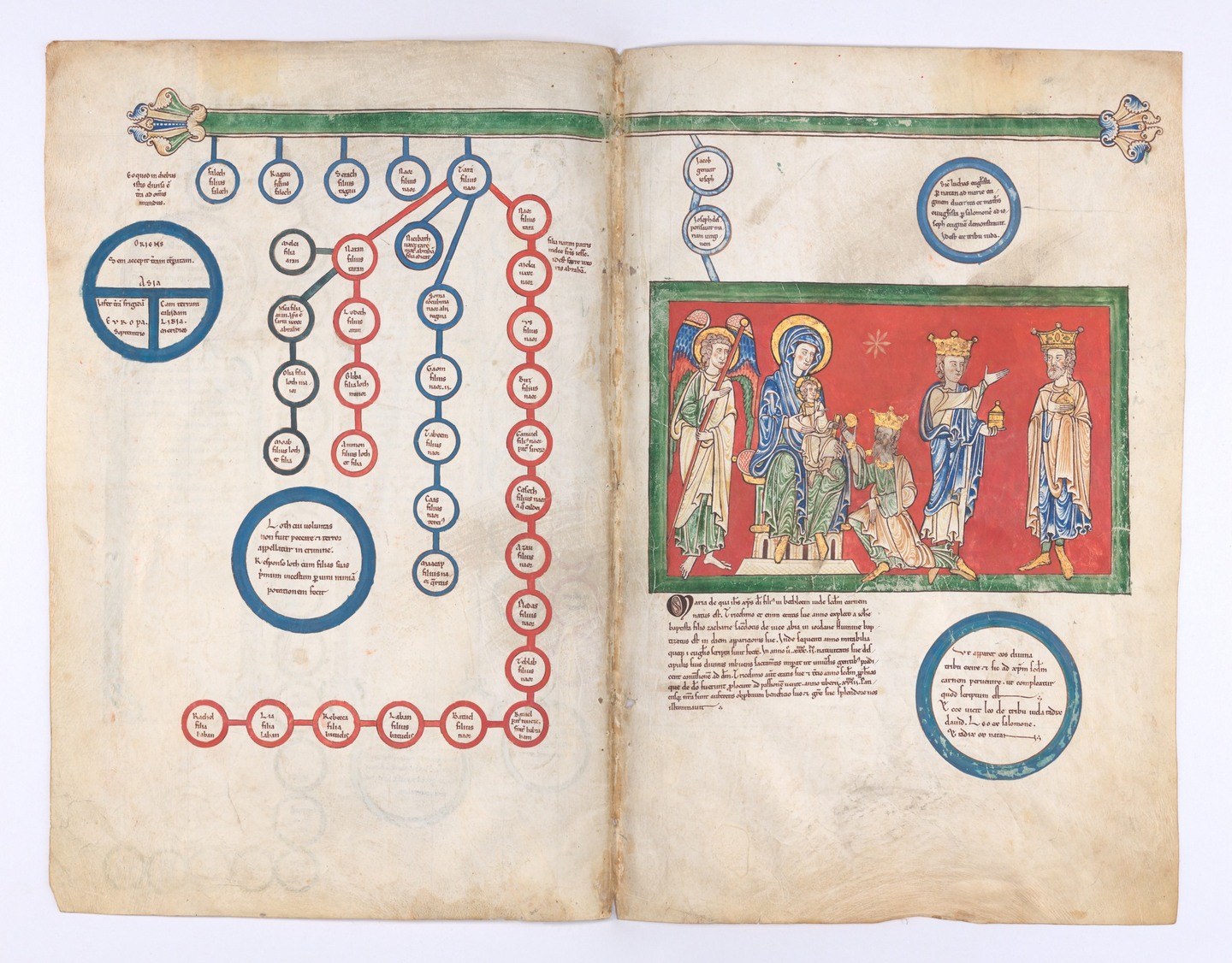
Unknown Spanish Master. «Genealogy and Adoration of the Magi.» Circa 1180. Tempera, gold, and ink on parchment. The Metropolitan Museum of Art, New York.
What is visible: a genealogy and the adoration of the Magi
On the facing page, the circles of the genealogy neighbor the rectangular scene of adoration. Here, the page connects two modes of narration: a network diagram and the depiction of an event.
Unknown Master. «John Receives a Revelation.» Bamberg Apocalypse, folio 1r. Circa 1010. Miniature on parchment. Bamberg State Library.
Comparison of two sheets
On the other sheet of the Bamberg Manuscript, the action is shown without a genealogical chart. The figures occupy diagonal corners of the frame, and the empty gold field between them makes the depiction particularly striking.
2. The City as Sign
Two similar images allow a comparison of how figures and architecture divide the page.
Unknown Spanish Master. «Angel of the Church in Sardis and John.» Circa 1180. Tempera, gold, and ink on parchment. Metropolitan Museum of Art, New York.
What is visible: the angel of the church in Sardis and John
The figures are placed next to a multi-story depiction of the city. The verticality of the buildings makes the city recognizable, even though the artist does not strive to show it from one single, conventional perspective.
Unknown Master. «The First Commission to John.» Bamberg Apocalypse, leaf 4v. Circa 1010. Miniature on parchment. Bamberg State Library.
Comparison of two sheets
In the Bamberg version of the building, the elements are separated and placed on both sides of the figure. A comparison with the Kadeny sheet shows different ways of utilizing the city: either as a compact architectural group or as several distinct structures.
Unknown Spanish Master. «Angel of the Church in Philadelphia and John.» Circa 1180. Tempera, gold, and ink on parchment. Metropolitan Museum of Art, New York.
What is visible: the angel of the Church in Philadelphia and John
The composition resembles the leaf with the angel of the Church in Sardis from the same manuscript: the figures stand near the building, and colored sections help differentiate parts of the image. This allows for a comparison of the two cities in Laodicea, followed by an examination of how architecture functions in the Bamberg Apocalypse.