Navigation
- Concept
- The Mountain as a Threat
- The Mountain as a Goal?. Conclusion ?. Bibliography ?. Image Sources
Concept
In my visual research, I compare graphic representations of mountains from the 18th century to the present day. I define the mountain image as how it is rendered and what it communicates to the viewer. Graphics from different eras were created for different purposes, and each piece reveals how people of that time perceived mountains.
Observing old and new graphics featuring mountains, I noticed that previously they were depicted as much grander, more imposing, and more perilous. Contemporary works appear differently, and the shift is discernible even when depicting the same peak across different centuries. This sparked my interest—what caused the depiction of mountains to change so drastically, and when did this transformation occur?
The visual material consists of graphics aimed at a mass audience—specifically engravings, posters, packaging, and logos. Because these were reproduced in series, they allow us to assess the general perspective on mountains rather than the viewpoint of a single artist. I do not consider photographs or painting because my focus is exclusively on the mountains rendered through graphics. I select and compare the objects for analysis based on four criteria: the threat to the person in the frame, the mountain’s scale in relation to that person, light and color, and the degree of artistic simplification. Using these criteria, one can place an engraving side-by-side with a logo and observe how the mountain was intended to be presented to the public.
I drew upon scholarly books and articles concerning the history of mountains and mountaineering, the memoirs of the climbers themselves, and archival descriptions of graphics from museum collections. This research helped me understand when and why perspectives on mountains shifted. The mountaineers' books reveal how those who climbed the mountains wrote about them and which events they considered significant. In the museum descriptions, I found dates, author names, and commissioners.
The work consists of two parts, and the boundary between them traces the first ascents. In the first part, I illustrate how mountains were depicted while people feared them and mountaineering had not yet developed. The second part is dedicated to the graphic arts that emerged after people began scaling the peaks. In it, I track which techniques from the old imagery have survived and which have vanished. Within both parts, the progression follows the order of creation, allowing the changes to be visible gradually.
How has the image of the mountain evolved in graphic design, and what do these changes reveal about humanity’s relationship with mountains?
My hypothesis is that previously, mountains were depicted as a threat to humanity. As people began scaling the peaks, they transformed into a goal, and the sense of danger gradually disappeared from the imagery. Today, mountains are presented as safe and desirable—something one wishes to conquer. The more accessible the mountain became, the simpler and calmer its image grew, and the detailed depiction evolved into a symbol.
Mountain as a Threat
Vasar, Chortov Most, 1723.
The first thing that catches the eye is the height. The cliffs drop off at the edge of the image, and there is hardly any sky. The people are shown far away, as small figures, in comparison to the mountains in the frame. The entire composition suggests the vast scale and danger of the mountains to the viewer, and the title, «Devil’s Bridge,» only confirms this.
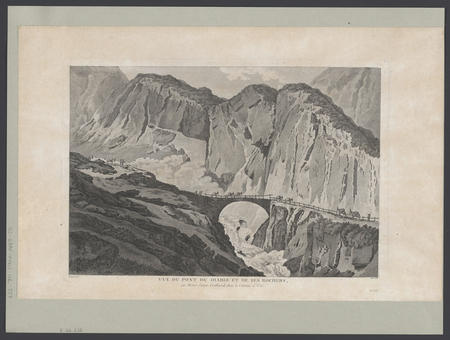
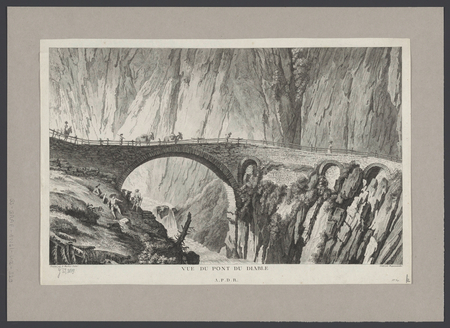
1. Peron and Na, View of the Devil’s Bridge and its Rocks, circa 1780–1786. 2. Le Barbier and Decevoyville, View of the Devil’s Bridge, circa 1780–1786.
The same bridge half a century later, in a French album of views. The rocks are just as dark and imposing, but the location seems more dramatic than perilous. People begin to admire the danger, even from a distance.
Pars and Vullet, Devil’s Bridge in the Canton of Uri, 1783.
With the English authors, the gorge is revealed more broadly; the mountain is depicted as majestic and massive, and the stream below is turbulent. People appear as tiny dots against such a natural power, which creates a sense of awe in the viewer.
Wolf and De Curtis, Lauterau Glacier, 1785–1794.
In the depiction of the Lauterår Glacier, the sense of scale plays a crucial role. At first glance, it might seem like there is a pile of small rocks in the foreground against a backdrop of mountains; however, when the viewer notices the people in the frame, it becomes clear just how enormous these rocks are. There are gaps between them, which immediately creates tension because it is unclear how stable this entire structure is.
In 1786, two local residents first climbed Mont Blanc, and the history of mountaineering is traditionally dated from this ascent.
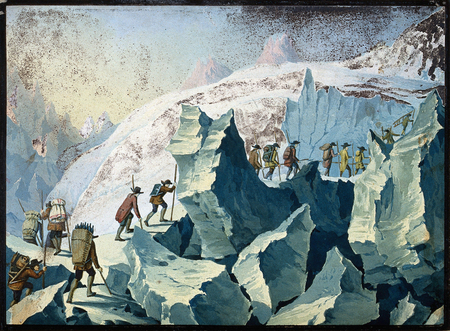
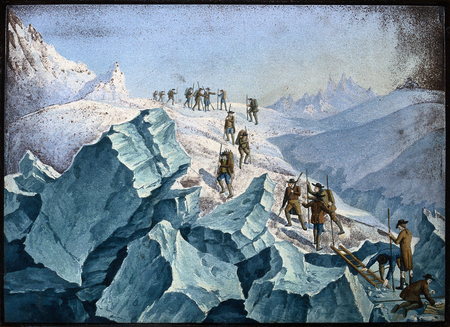
1. Wöhler and Mechel, Mr. Rousseau’s Ascent of Mont Blanc, 1790. 2. Wöhler and Mechel, Mr. Rousseau’s Descent from Mont Blanc, 1790.
Here, people are already heading purposefully toward the summit. A chain of figures stretches between the crevices, and it seems that one wrong move could cost a person their life. The composition is now changing; people are beginning to take up more space in the frame because climbs are underway, and the mountaineers are starting to challenge the mountain peaks.
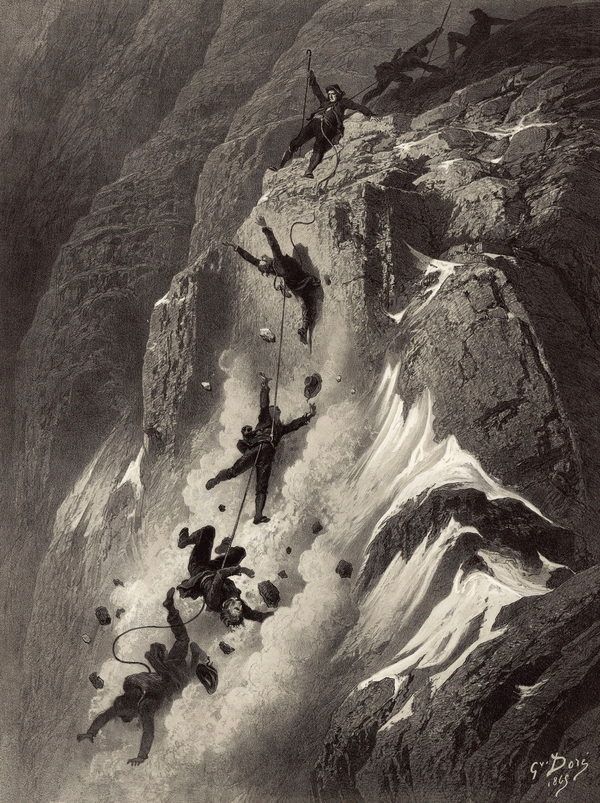
On July 14, 1865, seven people first ascended the Matterhorn, the last major unconquered peak in the Alps. During the descent, one person fell, dragging three others with him, and the rope connecting them to the rest snapped. I will discuss three works dedicated to this tragedy next.
Pajo, Catastrophe of July 14th on the Matterhorn, 1865.
A printmaking work based on a sketch by correspondent Pajo appeared in the magazine three weeks after the disaster. The steep slope, sharp rocks, and falling figures convey the danger that the mountains posed to people. The artist showed how merciless nature can be to those who dared to approach it.
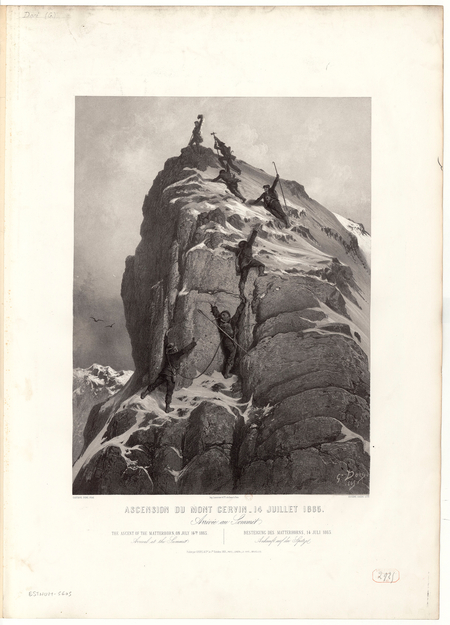
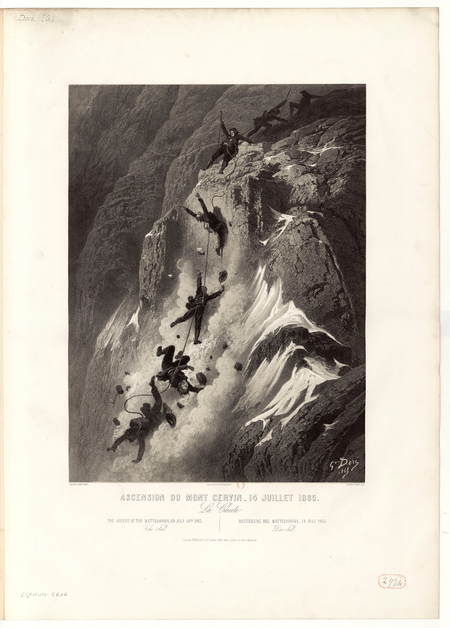
1. Durere, Arrival at the summit of the Matterhorn, 1865. 2. Durere, Fall, 1865.
Dore narrates the tragic story of mountaineers on the Matterhorn through two lithographs. In the first, people celebrate having finally reached the mountain summit, with bright sky visible behind them. In the second, everything changes—the mountain is tonally darker and higher, and in the center of the composition, we see the people falling down. The ascent did not make the mountain safer; rather, it showed the true cost of the journey upward.
The Mountain as a Goal
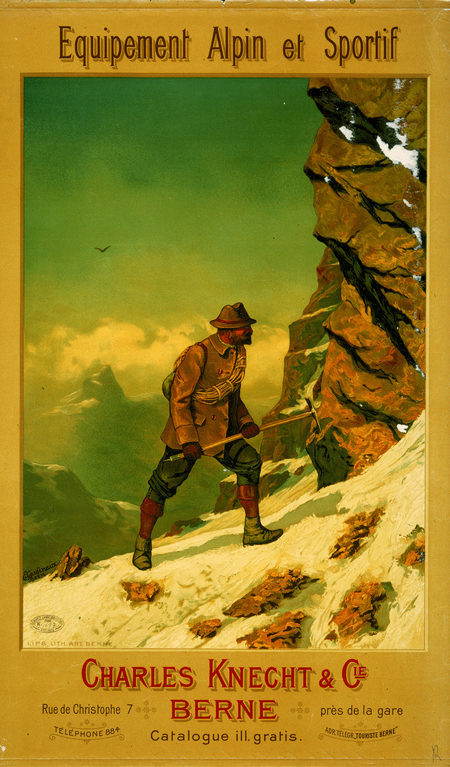
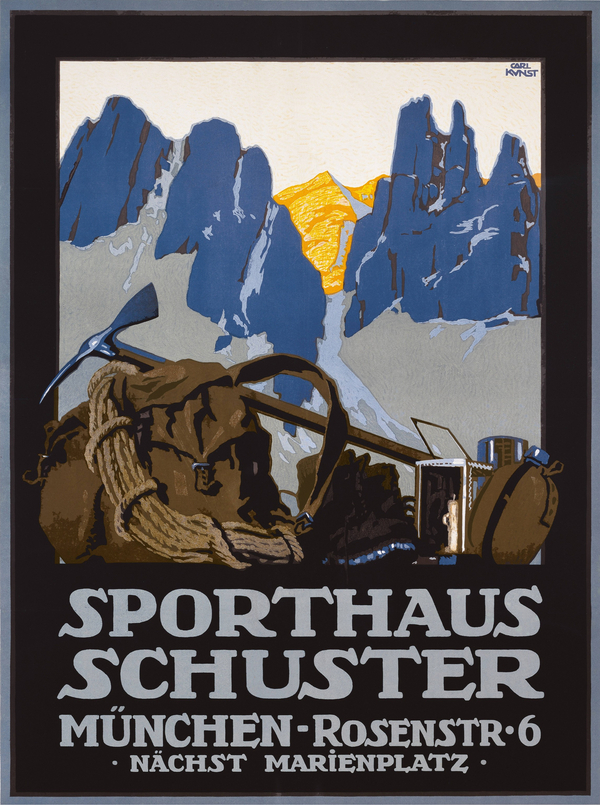
1. Climbing, Alpine, and Sporting Equipment, c. 1900. 2. Art, Sporthaus Schuster, c. 1912.