Concept
The topic, «The Image of the Cat in Soviet Animation, ” was chosen due to the opportunity to trace the transformation of a single artistic archetype across several decades and to identify the characteristics of its visual representation in different periods of domestic animation. The cat is one of the most common characters in Soviet cartoons; however, its artistic interpretation can vary depending on the specific work. It may function as a fairy-tale hero, an independent animal, a representative of a specific social status, a child, a family member, or a carrier of moral values. This diversity allows us to view the cat as an archetype through which various notions of human character, behavior, and relationships are reflected.
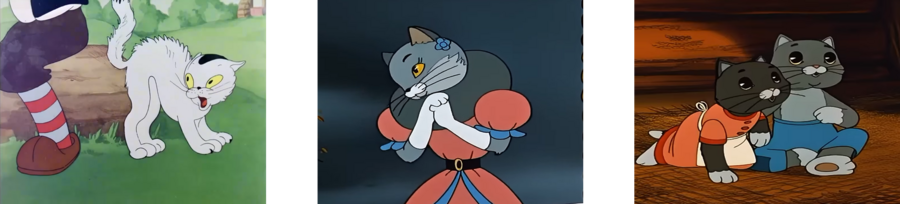
Brumberg Valentina, Brumberg Zinaida. «Puss in Boots» 1938 / Amalrik Leonid. «Cat’s House» 1958
Soviet animation constitutes a significant part of the national cultural heritage and merits scholarly investigation. Animated works reflect shifts in artistic styles, methods of character depiction, and principles for conveying human qualities through animal figures. Furthermore, studying a specific character across a chronological scope allows us to trace the evolution of cultural perceptions associated with that image. The cat, in particular, presents a compelling subject due to its multifaceted nature. In different works, it may embody cunning, freedom, independence, kindness, practicality, or intellectualism. Despite the widespread recognition of Soviet cartoons featuring cats, their visual representations are rarely examined within a unified comparative system spanning several decades of animation. Therefore, this research aims to systematize the visual material and identify the patterns of the cat’s transformation, taking into account the character’s artistic, inherent, and narrative characteristics.
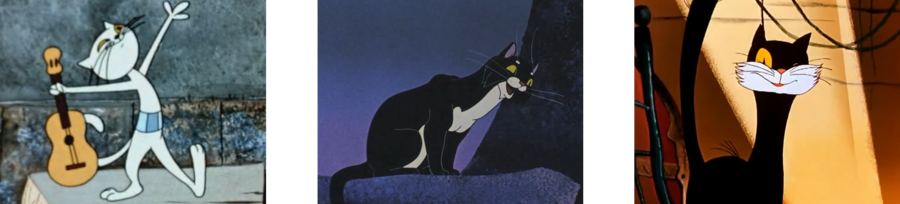
Brumberg Valentina, Brumberg Zinaida. «Puss in Boots» 1968 / Snezhko-Blotskaya Alexandra. «The Cat That Walked Alone» 1968 / Lev Atamanov. «Puppy named Gav» 1976–1982.
The focus of this research is the question: «How has the image of the cat in Soviet animation evolved, and how have its character and social role changed?» To answer this, it is necessary to examine the visual portrayal of the character and how the individual qualities of the hero were revealed. It is also important to determine how the cat’s role in the plot shifted—from a fairy-tale assistant and independent animal to a participant in human society, family relationships, and daily life.
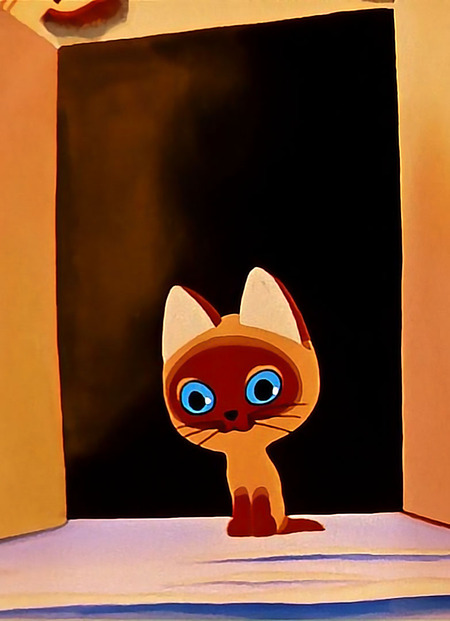
Lev Atamanov. «Kitten Named Gav» 1976–1982 / Anatoly Reznikov. «Leo the Cat’s Television Show» 1979 / Vladimir Popov. «Three from Prostokvashino» 1978
I hypothesize that the image of the cat in Soviet animation gradually expanded and became more complex. It evolved from a traditional fairy-tale character into an independent protagonist with distinct psychological traits, a defined social standing, and its own behavioral model. While in earlier works the cat primarily served as a carrier of folkloric themes—such as cunning and ingenuity—in subsequent cartoons, its character was increasingly linked to human relationships, moral values, daily responsibilities, and personal independence. It is suggested that the diversity of feline characters in Soviet animation reflects an expanding conception of how an animal character could be used to explore various human archetypes.
The primary principle for material selection will be a chronological approach, allowing us to trace the evolution of the cat’s image from the late 1930s to the 1980s. The study includes the animated films Puss in Boots (1938), Kitty’s House (1958), Puss in Boots (1968), The Cat Who Walked Alone (1968), The Kitten Named Gav (1976–1982), the Proskvashino trilogy—Three from Proskvashino (1978), Vacations in Proskvashino (1980), Winter in Proskvashino (1984)—as well as the animated series about the adventures of Leopold the Cat (1975–1987). The selection of these works is driven by the diversity of characters they present and the opportunity to trace different artistic interpretations of a single animal. Each animated film demonstrates a distinct type of image.
Navigation Menu
- The Fairy-tale Image of a Cat
- The Cat Between Fairy Tale and Reality
- The Cat as an Individual
- Conclusion
- References
Fanciful image of a cat
One of the earliest examples of the cat archetype in Soviet animation is the 1938 film «Puss in Boots, ” created by Valentina and Zinaida Brumberg based on the fairy tale of the same name by Charles Perrault. In this work, the cat is portrayed as a traditional fairy-tale hero, imbued with cleverness and ingenuity. Here, the cat serves as the main assistant to its master, enabling him to achieve wealth and a high social standing.
Valentina Brumberg, Zinaida Brumberg. «Puss in Boots» 1938
The character’s visual identity is constructed by combining recognizable feline traits with human characteristics. The cat walks on two legs and wears clothing and footwear. The boots and hat are particularly significant, transforming an ordinary animal into a folkloric and iconic figure. He actively interacts with his environment, makes independent decisions, deceives opponents, and uses various tricks to achieve his goals. Despite this, the cat does not lose its animal nature; rather, the combination of feline cunning and human intellect forms the foundation of his persona. The feats the cat performs—such as tricking the Beast or feigning wealth—represent the triumph of intellect over brute force. The animated film’s visual narrative supports an ideological message that L.M. Lyutaev and O.V. Garykin also highlight in their research. The true «miracle» of the Soviet era lies in human ingenuity, resourcefulness, and labor. The cat functions as a mediator for social change, whose «magic» is the visualization of rational action.
Valentina Brumberg, Zinaida Brumberg. «Puss in Boots, ” 1938.
Thus, in the 1938 cartoon, the cat functions primarily as a fairytale character whose individuality is defined by its narrative role. While it is a human assistant, it possesses greater initiative and autonomy than its owner.
In the 1958 cartoon, «The Cat’s House, ” created by Leonid Amalrik based on Samuel Marshak’s work, the image of the cat takes on a more pronounced social character. Unlike Puss in Boots, the main character is not a fairy-tale helper. She is portrayed as a wealthy mistress living in a lavish home, hosting guests, and striving to maintain a certain social standing.
The cat’s outward appearance reflects her social status. Her clothing, accessories, manners, and surroundings form the image of an affluent and self-assured member of society. The spacious rooms, opulent furnishings, and luxury items become an extension of the character’s visual identity.
Amalrik Leonid. «Cat House» 1958
The contrast between the Cat and her poorer relatives becomes particularly salient. If the protagonist is surrounded by luxury, the kittens are depicted as needy and defenseless characters. Their visual design is deliberately simplified and devoid of rich attire, emphasizing their poverty and humble living conditions. The space they inhabit contrasts with the Cat’s opulent home—it is small, yet cozy. The artists imbue the kittens with kindness, hospitality, and a lack of resentment.Initially, the Cat refuses to help her relatives because her own status and the opinions of others are more important to her. After a fire destroys her home, the protagonist finds herself in a situation where her former social standing loses meaning. Those she considered friends refuse to help her, while the kittens welcome her into their modest home. This marks a transformation not only in the plot but also in the moral essence of the Cat’s character. She re-evaluates her relationship with those around her and realizes the importance of mutual aid.
Amalrik Leonid. «Cat’s House» 1958.
In this work, the cat serves as a vehicle for depicting human social relationships. The visual transformation of the heroine—from a haughty mistress dressed in finery to someone who has lost everything but gained moral clarity—can function as a moral element. The cartoon condemns individualism, petty materialism, and hoarding, helping young viewers form a proper social model of behavior.
Amalrik Leonid. «Koshkin Dom» 1958
In early Soviet animation, the cat began to be depicted as an anthropomorphic fairy-tale hero, wherein feline qualities merged with human capabilities.
Over time, the image of the cat moves beyond that of a traditional fairytale hero and takes on social significance. The character’s appearance and the surrounding environment become tools for conveying its position in society. Thus, as early as the 1950s, the cat is used not only as a bearer of specific animal or folkloric traits but also as a character through whom human relationships and moral problems are revealed.
The Cat Between Fairytale and Reality
In 1968, Valentina and Zinaida Brumberg created a new adaptation of Charles Perrault’s fairy tale, «Puss in Boots.» Revisiting this story thirty years later allows viewers to trace the evolution of artistic approaches to the same character. While the core narrative remains intact, the visual interpretation of the hero receives a fresh reading.
The cat remains an inventive and enterprising character, using intellect and cunning to elevate his master’s status. However, his portrayal is perceived as more distinctly comedic and artistic. The cat’s external appearance retains the primary attributes of the fairytale archetype—the boots and the hat. The cat functions as a kind of actor within the fairytale setting, playing roles, misleading other characters, and controlling the situation.
Valentina Brumberg, Zinaida Brumberg. «Puss in Boots» 1968.
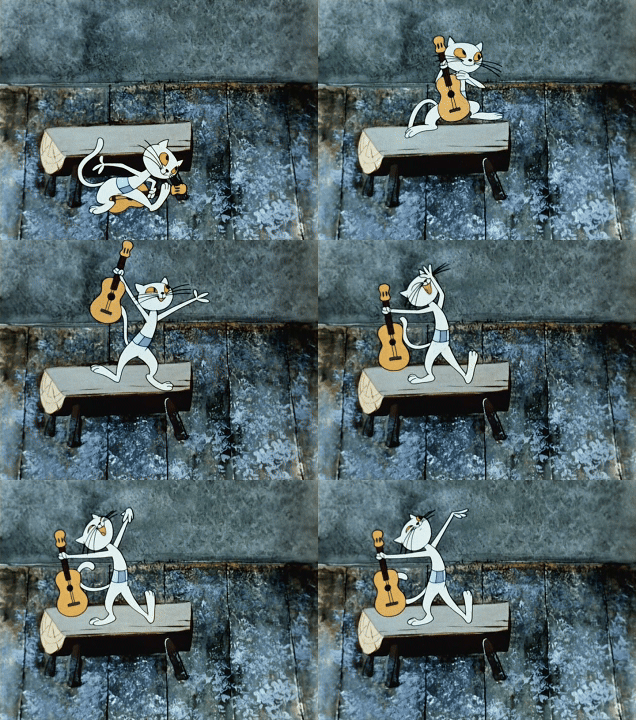
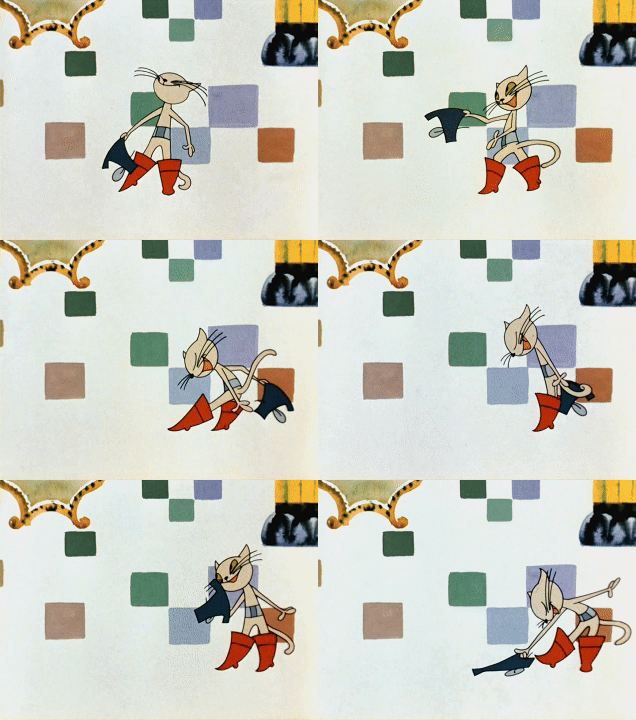
Valentina Brumberg, Zinaida Brumberg. «Puss in Boots» 1968.
Comparing the two screen adaptations allows us to examine how the artistic language shifts while retaining the same literary source material. If the 1938 version seems to focus primarily on the hero’s fairy-tale function and ingenuity, the 1968 version shows a more pronounced expression of comedy, artistry, and character expressiveness. This demonstrates that the cat’s archetype can retain its core qualities while simultaneously acquiring new artistic characteristics.