Navigation:
- Introduction7. Conclusion
Introduction
For centuries, religious doctrines have sought to make the invisible visible—to convey concepts of the divine, eternity, and the order of the world through systems of signs and ornamentation. But why were repeating patterns, strict symmetry, and complex geometric interweavings used specifically to express sacred ideas? And what role does not only the meaning of the symbol, but also the form itself—which is capable of influencing human perception—play in this process?
Islamic religious art is rich with complex geometric constructions and continuous compositions. In Christianity, the leading ornamental motifs are the grapevine, interwoven patterns, and rosettes, while in Buddhism, the arrangement of elements around a center relates to concepts of sacred order.
However, the impact of ornamentation is not limited to the recognition of symbols. Repetition creates a visual rhythm, symmetry allows the viewer to perceive a complex composition as a unified whole, and interlacing lines compel the eye to follow the pattern. These properties can evoke a sense of order, complexity, or infinity—a feeling that gains additional symbolic meaning within a religious context.
The starting point for this research was Ernst Gombrich’s book, The Sense of Order (1979). In it, the author addresses the psychology of decorative art and examines ornament through the patterns of visual perception, repetition, and the organization of forms. I found particularly interesting the idea that the perception of a pattern is related not only to recognizing individual elements but also to discovering the patterns between them. Humans notice rhythm, anticipate the continuation of a recurring motif, and react to disruptions in established order.
This approach allows one to ask how such visual patterns were utilized in religious art and how the formal characteristics of ornamentation could have amplified the perception of sacred ideas.
If a person is capable of perceiving order and rhythm before decoding the meaning of a symbol, then the very structure of a religious ornament can become a means of conveying meaning.
For this research, I have chosen ornamental systems where the connection between form and religious content is particularly distinct. The visual material will comprise the geometric patterns of the Alhambra, Byzantine mosaics from Ravenna, the interlacing designs of the Book of Kells, Gothic rosettes, botanical motifs from Indian temple carving, and the ornamental structures of Buddhist mandalas.
The same geometric principle can appear in completely different artistic traditions. However, the similarity of form does not necessarily imply the congruence of meaning. This very contradiction becomes one of the main challenges of the research. Thus, the study will not focus on finding a universal meaning for religious symbols, but rather on investigating how historically developed ornamental forms function as mediators between a religious idea and human visual perception.
Hinduism: The Geometry of Sacred Order
Hindu art evolved over many centuries, paralleling changes in religious beliefs and rituals. Its ornamentation cannot be reduced to a mere collection of ancient symbols: some motifs originated from earlier artistic traditions, others gained popularity with the development of temple architecture, and their meaning depended on the context and method of use.
Dashavatara Temple, Deogarh, India
The origins of Hinduism are tied to several religious and cultural traditions of the Indian subcontinent. One of the most significant was Vedic culture, which developed during the 2nd–1st millennia BCE. Its primary sources are the Vedas—collections of hymns and ritual texts.In Vedic religion, sacrifices performed using specially constructed altars held great importance. However, the richly decorated Hindu temples we know today emerged much later. Early surviving stone temple structures date primarily to the first centuries CE, with a particularly vital phase in the development of temple architecture occurring during the Gupta era, the 4th–6th centuries.
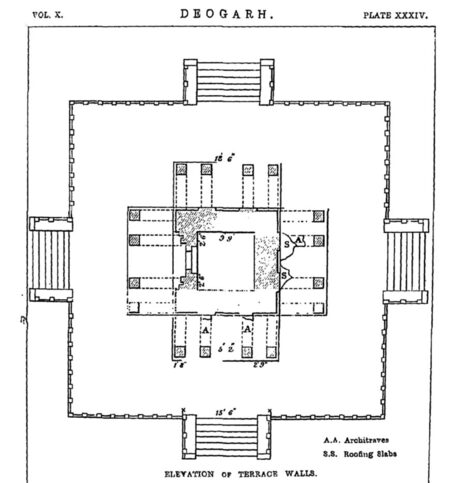

Sketch by British archaeologist Alexander Cunningham depicting the temple plan, 1880

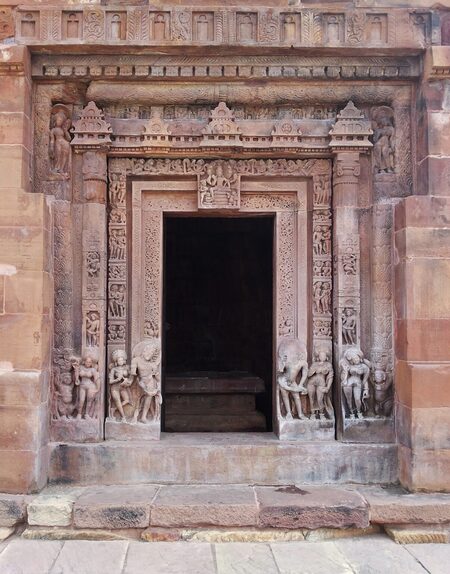
Entering the Dashavatar Temple, Deogarh, India
Gradually, religious practice became increasingly intertwined with permanent architectural space. The temple unified the image of the deity, the ritual act, sculpture, and decorative motifs. Ornament became part of this system: it was placed on walls, columns, entrances, and architectural frames, shaping the visual environment around the sanctuary.
Lingaraj Temple Complex
In Hindu temples, the garbhagriha occupies the central space—the inner sanctum where the main deity image or another object of worship is housed. Mandapas, halls designed for gatherings and ritual activities, may adjoin it. In North Indian architecture, a shikhara tower typically rises above the sanctuary.
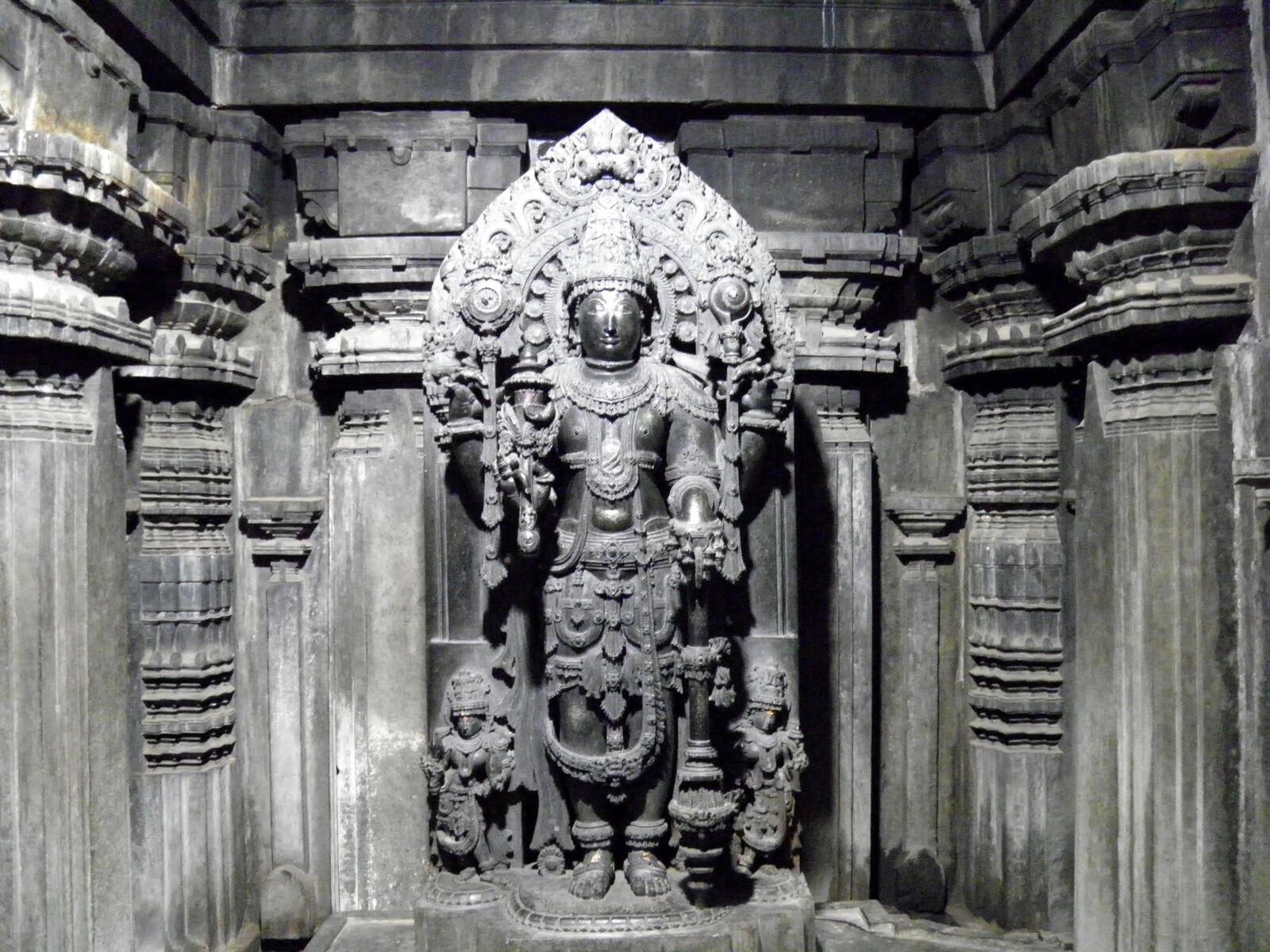
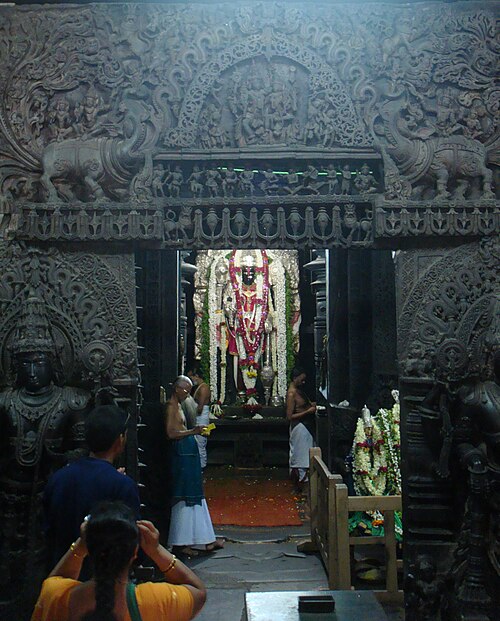
Hoysaleshwara 12th Century. Stone shrine featuring a shivalinga and carved entrance. Chennakesava 13th Century. Dark stone garbhagriha depicting a deity.
Chennakkesava 13th Century. Dark stone garbhagriha depicting a deity.
The distribution of images is as important as the architectural form. On the outer walls of temples, sculptures of deities, mythological scenes, and auspicious decorative motifs were placed. Vegetal scrolls, flowers, and other repeating elements could fill the spaces between figures, emphasize architectural divisions, and create continuous decorative friezes.

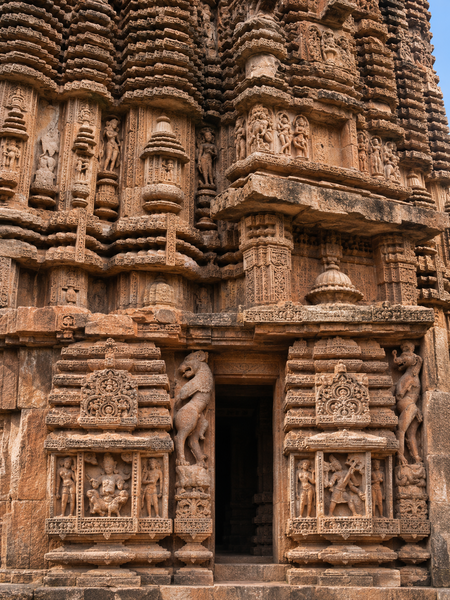
Lingарадja Temple Complex
In sacred architecture, ornamentation begins to function not merely as decoration for an individual element, but as an integral part of the larger space. Repetitive motifs unify the walls, columns, and sculptural figures into a cohesive composition, and their placement helps to delineate the architectural boundaries and significant areas of the temple.
Ornamental Techniques
1/ Lotus — one of the most pervasive motifs in Indian art. It appears in Hindu, Buddhist, and Jain traditions, so it cannot be considered a symbol of only one religion.In Hindu iconography, the lotus is associated with several deities. Brahma is often depicted seated upon a flower that emerges from Vishnu’s navel; Lakshmi may stand or sit on a lotus while holding flowers in her hands. In these depictions, the plant becomes an integral part of the religious image, rather than merely a decorative element.