Contents
Introduction1. The Historical Origins of Pachisi 1.1. The Emergence of Pachisi in Ancient India. 1.2. Rules and Characteristics of the Traditional Game Pachisi. 1.3. The Cultural and Social Significance of the Game in Indian Society.2. The Evolution and Global Diffusion of Pachisi 2.1. The First Modifications and Spread of Pachisi Beyond India. 2.2. Adaptation and Alteration of the Original Rules.3. The Genesis and Development of Ludo 3.1. The Creation of Ludo and its Connection to Pachisi. 3.2. Commercialization and Popularization of the Game.4. Comparison of Pachisi and Ludo 4.1. Similarities and Differences in Rules. 4.2. Comparison of Game Boards and Their Elements.5. The Evolution of Ludo and Pachisi in the Modern World 5.1. The Appearance of Digital Versions and Mobile Applications. 5.2. The Contemporary Popularity and Role of Both Games in Culture.ConclusionBibliography
Introduction
This study is dedicated to one of the most renowned board games in history—Pachisi and its subsequent evolution into Ludo. The primary focus is on the historical origins of Pachisi in ancient India, its cultural and social significance, and the transformation of the game over time to the appearance of the modern Ludo version.The main objective of this research is to analyze the historical, cultural, and gameplay features of both games, including their origins, rules, game board, materials, and design elements. Special attention is given to the changes that occurred when Pachisi was adapted into the Ludo format, as well as the diffusion and popularization of both games in various countries. Thus, this study will allow us to trace the evolution of these board games, identify their similarities and differences, and understand the influence Pachisi exerted on the development of modern tabletop games.
The Historical Origins of Pachisi
The Emergence of Patchisi in Ancient India
Pachisi does not have a precise date of origin because ancient documentation is imprecise, and historians adhere to various theories regarding its emergence. Among these is the suggestion that the game might have originated in China, as well as the theory that its true origins trace back to the 7th century. This version is based on artistic depictions and historical accounts that mention Chaupar—an ancient Indian game still played today. Special dice are used for this game, allowing players to achieve a maximum of 25 points.The most compelling research appears to indicate that Pachisi already existed in India by the 16th century. One of the most well-known historical mentions involves Emperor Akbar, ruler of the Mughal Empire, who showed a keen interest in such forms of entertainment. According to Sadurni (2020), Akbar ordered the construction of a full-sized game board in his palace for playing a traditional variant known as Chaupar. This board was in the shape of a cross, and instead of typical pieces, sixteen women from his harem were used—divided into four teams and distinguished by the color of their attire. The objective of the game was to advance toward the center of the playing board, where the Emperor presided over the game’s progression.Over time, similar games spread to the poorer segments of Indian society. In these settings, the playing boards might be crafted from painted or embroidered fabrics, small colored stones were used instead of tokens, and cowrie shells were employed to determine moves, replacing modern dice.The name «Pachisi» derives from the Hindi words pacisi or pacis, which mean «twenty-five.» This name relates to the maximum number of points that could be scored in a single roll of cowrie shells, which were traditionally used in the game instead of modern dice (Sadurni, 2020).
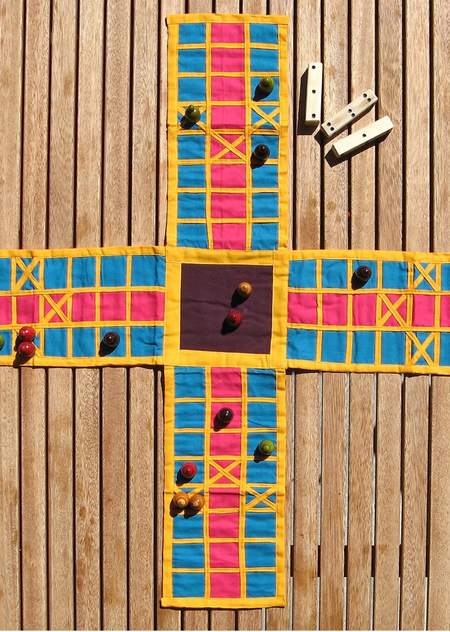
Figure 1. The actual Pachisi game board. Source: Wikipedia.
Rules and Features of the Traditional Pachisi Game
As previously mentioned, the game gained significant popularity during the reign of Emperor Akbar. Although the version played in the palace used women from his own harem as game pieces, the focus will now shift to the rules and characteristics of the board game version that spread among the poorer segments of Indian society.Pachisi features a game board embroidered onto fabric, with the playing area shaped like a cross. At the center is a large square called Charkoni, which serves as the starting and ending position for the pieces. The four arms of the board are divided into three columns of eight cells each. During play, the players' pieces move along these columns. Twelve cells are specifically designated as safe spots (locks): four are located at the end of the central columns of each arm, and the other eight are located four cells closer to the center than the end of the outer columns of each arm. A piece cannot be captured by an opponent while it is on a safe spot.
At the beginning of the game, participants divide into two teams of two people. Players on each team are designated by yellow and black colors and compete against the team designated by red and green colors. Each of the four players must move four tokens on the cross-shaped game board. The team that first manages to bring all eight tokens of both of its players into the central home after completing the full route wins.Six cowrie shells are used for the game with each roll, functioning as modern dice. Each roll allows only one token to move. The player throws the shells from their hand, and the number of shells that land opening up determines how many spaces the token can advance.Game Start: All tokens begin the game in the center of the game board (Charkoni).Exiting and Moving: Players move their tokens onto the game board and advance them along the arms of the cross counter-clockwise, completing a full circuit around the board to return to the center.Safe Spaces: There are special spaces where tokens cannot be captured by opponents.Blocking: Players can create barriers by placing two tokens on the same space.Objective: The team that first manages to return all eight tokens of both of its players to the center of the game board (Charkoni) wins.
Figure 2. Pachisi game board. Source: Wikipedia.
The Cultural and Social Significance of Play in Indian Society
Pachisi is much more than just an amusement in India. This game has spanned centuries and various social strata, evolving across different facets of society. It stands as an important symbol of Indian history, spirituality, strategy, and social life.
Pachisi retains great cultural significance because its origins are even tied to tales from the sacred epic, the «Mahabharata"—one of the greatest and oldest works of world literature and a foundational text of Hinduism. The epic consists of approximately 100,000 verses (shlokas), organized into 18 books (parvas), and is seven times longer than the «Iliad» and the «Odyssey» combined.
This epic narrates the story of a war between two families: the Pandavas and the Kauravas. During a game of Chaupar, the prince Shakuni, belonging to the Kaurava clan, uses cursed dice to win a game and seize the wealth of the Pandavas. This event ultimately triggers the war between the two families.
The game is also connected to mythology, as the Hindu tradition holds that the god Shiva and his consort Parvati played Pachisi to pass the time, using the game as a metaphor for the creation of the world and the movement of the universe.Furthermore, Pachisi symbolizes destiny and karma. The use of cowrie shells symbolizes chance and divine intervention, while the movement of the pieces reflects human decisions and the consequences of our actions throughout the life cycle.Pachisi also became a unifying element across different social strata because, unlike other games exclusive to the royal elite, it spread among the residents of the poorest Indian villages.
On the other hand, the game became a symbol of royal power and architecture during the reign of Emperor Akbar, who commissioned the construction of massive game boards made of red and white marble in the courtyards of his palaces in Agra and Fatehpur Sikri. Even today, the outlines of the game board upon which Akbar played in 1570—when the city served as the capital of the Mughal Empire—can be seen in the latter city. All of this attests to the deep-rooted presence of the game within Indian society.
This is precisely why Pachisi remained a significant pastime throughout history, uniting entire families during festivals such as Diwali. The game fostered communication, strengthened family bonds, and facilitated the oral tradition of stories being passed from grandparents to grandchildren.
Its legacy also extended beyond India, allowing the game to gain global popularity.
Furthermore, traditional textile game boards evolved into a form of artisanal craft, as they are regarded as true works of textile art. They were adorned with intricate embroidered patterns, and in many regions of the country, they were included as part of a bride’s dowry.
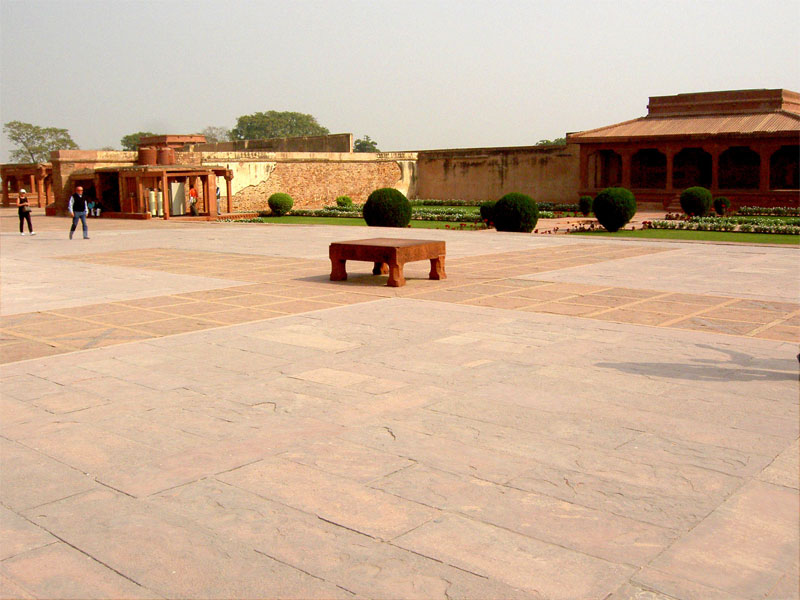
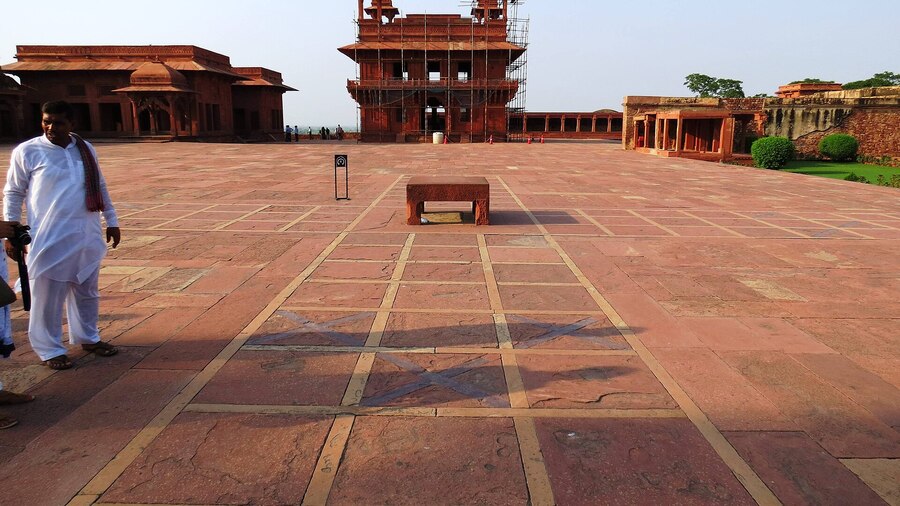
Figure 2. Fatehpur Sikri Garden with remnants of a giant Pachisi board. Source: Wikipedia.
The Evolution of Pachisi and the Spread of the Game Worldwide
Early changes and the spread of Patachisi outside of India
It is difficult to state with certainty exactly how Pachisi spread across the world, as there are several competing theories. One theory suggests the game may have disseminated through Muslim territories, where residents were already familiar with other board games, such as chess. Another hypothesis links its emergence in Europe to contact between East and West, particularly through trade and cultural exchanges between these regions. It has also been suggested that the game might have reached Western Europe via the Iberian Peninsula, though there is insufficient evidence to support this theory or establish its exact date of arrival.
Conversely, in the 16th century, Jesuit missionaries Antonio de Montserrat and Rudolfus Aquaviva were engaged in missionary work in India and participated in the religious mission at the court of Emperor Akbar. The history of Pachisi is associated with them, according to which both missionaries supposedly became interested in the game board because of its cross-like shape. However, this account of their reaction and the explanations they received from local people lacks sufficient historical corroboration to be considered a reliable event.
The most substantiated theory for the emergence of the game in Europe is that British travelers and colonizers contributed to its spread across the continent in the 19th century after becoming familiar with it on the Indian subcontinent. The game evolved and ceased to be Pachisi. Its dissemination extended far beyond Great Britain; it reached other European and American countries, where it acquired various names while retaining a mechanical similarity to the original game.The United States became the first country where Pachisi began to be sold in the latter half of the 19th century. In 1870, Selchow & Righter acquired the rights to the game, and in 1874, they registered the trade name Parcheesi. This version, which proved successful in the American market, retained the core features of the Indian game, although certain modifications were made to the rules and materials—for example, the use of two dice instead of traditional cowrie shells.For many years, Parcheesi remained the best-selling game until, in 1938, another American company, Transogram, released an original version of the game under the name Game of India, and later—Pa-Chiz-Si: The Game of India.To this day, traditional Pachisi game boards survive in various collections. They serve as significant material evidence of the game’s existence and development in India, as well as its subsequent spread and adaptation in other parts of the world, as previously mentioned.
Adapting and modifying original guidelines
Despite numerous adaptations made to Pachisi over time, the core game mechanic has remained largely unchanged: participants must move their pieces along a game track, capture opponents' pieces, and strive to reach the finish line. However, different versions have introduced changes to the game board layout, the materials used, and movement rules.
One of the primary differences among these adaptations is the number of dice used and the method of determining moves. Traditional Pachisi uses six cowrie shells, the results of which dictate how many spaces a piece can move. Other versions have replaced this system with standard dice. Furthermore, some rules related to capturing pieces, safe spaces, and the conditions for pieces leaving their starting positions have been altered.
Among the most well-known adaptations is the American version of Parcheesi, which retained most of the original Pachisi structure but substituted cowrie shells for two dice. Additionally, some changes were made to the rules. The Spanish version, Parchís, and other European variants also saw modifications to the game board and gameplay conditions.
The most noticeable change was replacing the six cowrie shells with a single die, which simplified the system for determining piece movement. The game board also changed: instead of the traditional cross-shaped woven cloth, there was a square printed board featuring four colored tracks leading from the starting areas to the center. The pieces, which in the original Pachisi could be made from wood and other materials, began to be manufactured in a simpler, standardized way for mass market appeal. However, one of the most significant transformations was the creation of the game Ludo in England at the end of the 19th century.
The Emergence and Development of Ludo
The Creation of Ludo and its Connection to Pachisi
Ludo, whose name translates from Latin to «I play,» originated as a Western adaptation of Pachisi after the game gained popularity in Great Britain. Initially, Ludo was favored by the royal family and the aristocracy. Over time, significant changes were made to the original game board and rules to make it more accessible and simple, although its core mechanics remained intact.
In Pachisi, players participate in teams of two, with each player controlling four pieces. In Ludo, however, each participant plays individually, and up to four players can take part. Furthermore, the system for capturing pieces and movement was simplified: when a piece lands on a square occupied by an opponent’s piece, the opponent’s piece is usually returned to its starting area, and certain path squares are considered safe. Generally, six points must be rolled on the die to get a piece out of the starting area.
Thus, Ludo retained the essential elements of Pachisi: moving pieces along a path, capturing opponents' pieces, and reaching the finish line. However, some of the initial rule complexity was eliminated. The substitution of traditional materials, the simplification of the movement system, and the alteration of the game board allowed the game to be easier to produce, distribute, and learn. In this way, Pachisi gave rise to a Western version that achieved widespread popularity and eventually became one of the most recognized family board games in many countries around the world.
Commercialization and popularization of play
As previously mentioned, the Western adaptation of Pachisi led to the emergence of various versions of the game, including Ludo. In England, Alfred Collier patented a version called Royal Ludo in 1891. Later, around 1896, a simplified version named Ludo appeared.At that time, the early Western versions of the game were primarily intended for adult entertainment and were popular among the aristocracy. Bets could also be placed during games, making the game an alternative form of entertainment amidst the popular card games of the era. It is said that Queen Victoria became a great fan of Pachisi—which was already called Ludo by then—though this fact lacks historical confirmation.