Navigation Menu
- Research Concept
- Historical Context: Mobile Life of Central Asian Peoples
- Mobile Household Items of Uzbekistan
- Transformation of Mobile Household Items of Uzbekistan
- Mobile Household Items of Kyrgyzstan
- Reinterpretation of Mobile Household Items of Kyrgyzstan
- Mobile Household Items of Kazakhstan
- Transformation of Mobile Household Items of Kazakhstan
- Heritage of Central Asian Mobile Life in International Fashion Collections
- Conclusion
- Bibliography
Concept
The visual research focuses on reimagining traditional household objects from Uzbekistan, Kyrgyzstan, and Kazakhstan within contemporary fashion design. These regions have historically been connected to the Great Silk Road, hosting nomadic and settled cultures where textiles played a vital role not only in shaping daily life but also in facilitating movement and everyday routines.
Particular attention is given to items related to mobility: woven knots, sling bags, felt carpets, yurt coverings, and other textile artifacts. Their construction was dictated by the need to transport possessions, protect individuals from the environment, store belongings compactly, and establish temporary shelters.
The study examines traditional mobile domestic items from Central Asia and their interpretation in modern designer collections. The research explores not only the adoption of national ornaments but also the transference of structural principles, materials, folding methods, tying techniques, and volume formation into contemporary garments.
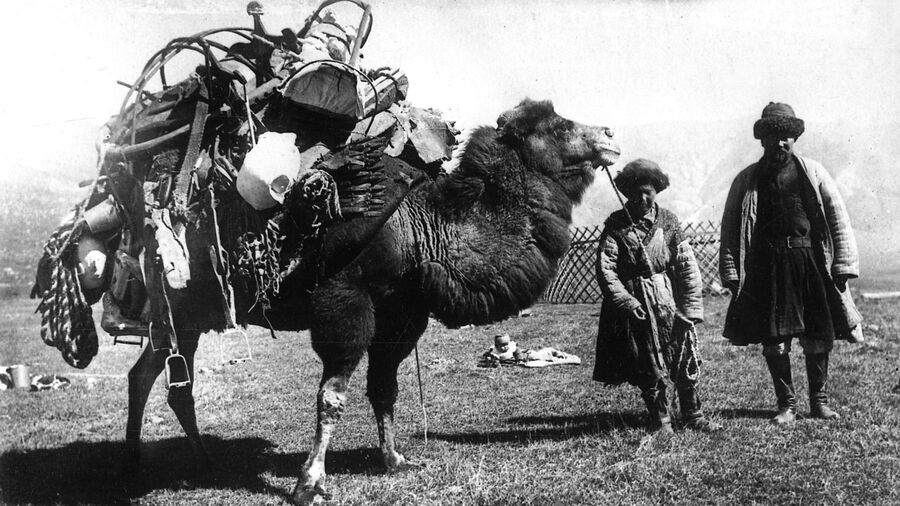
Historical snapshot of nomadic life in Central Asia, likely early 20th century. Central State Archive of Photo-Phonodokuments of the Kyrgyz Republic.
Main Research Question: How are objects originally designed for organizing mobile life transformed into clothing and accessories, and what properties and cultural meanings do they retain when transitioning into contemporary fashion?The research hypothesis is that traditional household items become not only visual sources of inspiration for designers but also the foundation for new methods of shaping form. In the transformation process, an object may lose its initial utilitarian function while retaining its structure, material, or symbolic meaning. Meanwhile, local brands may reference tradition through personal and collective memory, whereas international fashion houses more often incorporate its elements into a new aesthetic context.
LALI, Artisanal Treasures Collection, Uzbekistan Fashion Week, 2024. Photo: Ilya Semendeev / UFW.
The analytical section of the study is structured geographically. The first chapter is dedicated to Uzbekistan, the second examines Kyrgyzstan, and the third focuses on Kazakhstan. The concluding chapter investigates how international brands engage with the textile heritage of Central Asia. The primary methodology employed is the visual comparison of historical artifacts related to the mobility of Central Asian peoples and contemporary fashion imagery. This comparison is conducted based on form, material, construction, function, and the nature of decorative solutions.For the theoretical component of the research, materials from academic and cultural journals, museum archives and collections, along with articles and interviews with historians, ethnographers, and researchers of traditional Central Asian life, are utilized. To analyze contemporary design interpretations, materials from fashion publications such as Vogue and Elle, designer interviews, official brand websites, and collection archives are consulted. These sources allow for a comparison between the historical functions of domestic items and their reinterpretation in modern fashion.Thus, the research aims to demonstrate how objects of mobile daily life, originally created to solve everyday practical tasks, become part of the modern visual language of fashion and acquire new structural and cultural meanings.
Historical Context: Mobile Life of Central Asian Peoples
Central Asia has historically been a region of interaction between nomadic and settled cultures. This traditionally includes the territories of modern-day Kazakhstan, Kyrgyzstan, Uzbekistan, Tajikistan, and Turkmenistan. Turkic and Mongol nomadic peoples played a significant role in the history of the region, their way of life shaped by natural and climatic conditions.
Vast steppes, mountainous regions, deserts, and semi-deserts defined the characteristics of settlement and economic activity. One of the primary occupations of the nomadic peoples was pastoralism, which required regular seasonal migrations between pastures in search of water and feed for livestock. Depending on the natural conditions, various forms of nomadic and semi-nomadic lifestyles developed.
«Syr-Daryi Region. Kyrgyz Relocation, ” 1865–1872. From „Turkestan Album.“
The Great Silk Road played a significant role in regional development, connecting Central Asia with China, the Middle East, and Europe. These trade routes fostered interaction between nomadic communities and sedentary urban cultures, facilitating the exchange of goods, technologies, and artisanal traditions. The constant need for movement influenced the organization of daily life and the material culture of nomadic peoples. Their way of life required adaptation to changing natural conditions, seasonality, and limited means of transporting possessions.
S. M. Dudin. «Inside a Kazakh Yurt.» Semipalatinsk Region, 1899.
The interior space of a traditional nomadic dwelling was characterized by flexibility and multifunctionality. It served simultaneously as a place for rest, food preparation, dining, socializing, and storage. Most furnishings were placed along the walls, leaving the center open for daily activities. The organization of the space was intrinsically linked to the mobile lifestyle.
Objects of Uzbek Daily Life
In the traditional culture of Uzbekistan, household items were shaped by the influence of both sedentary and nomadic lifestyles. Textile products played a particularly important role, being used for storing belongings, transporting personal items, and furnishing spaces. Their construction was intrinsically linked to practical needs: items had to be folded compactly, protected, moved, and quickly deployed when necessary. Knotting, folding, wrapping, and creating soft volumes became the fundamental principles of organizing mobile domestic life.
Navigators of the 19th–20th Centuries, Uzbek Collection
In Uzbekistan, the tugun, khurjun, napramach, torba, and khalta were used as household items for carrying and storing belongings. The tugun (shown in the photo on the right) was a textile knot used for carrying goods; the khurjun was a double pouch for pack animals; the napramach was a soft textile container for storing possessions; and the torba and khalta were bags of various sizes for daily necessities. These items could be folded, tied, hung, and transported without the use of rigid frames.
Left: Khurjun, Uzbekistan, late 19th century. Right: Paul Nadar, «Bazaar in Samarkand,» 1890.
Among mobile interior items were the kurpacha, buzdhom, and syuzane. The kurpacha—a soft quilted mattress for seating and sleeping; the buzdhom—a woven cloth for wrapping clothes and bedding; and the syuzane—an embroidered decorative blanket used to furnish living spaces. Their defining characteristic was their multifunctionality and their ability to transform the organization of a space.
Left: Kurpa. Uzbekistan, circa 1950. Cotton, hand-pieced quilting. Right: Suzanne, Shahrisabz, circa 1800.
The components of portable dwellings included the kur, baskur, and okbash. The kur and baskur were long woven strips used to secure and connect the elements of the yurt, while the okbash were textile coverings that protected and decorated individual parts of its wooden structure. These items provided fastening and protection for the elements of the collapsible dwelling, and they were easily removable, foldable, and transportable during migrations.
Left: Woven sash for a yurt. Uzbekistan, 1900–1925. Wool, patterned weaving. Right: Reconstruction of a traditional Central Asian yurt in a museum exhibit. Samarkand, Uzbekistan.
The Transformation of Everyday Mobile Objects in Uzbekistan
Uzbek designers approach traditional everyday objects not only through patterns and colors, but also through their construction, materials, and modes of use. Textile knots, quilted coverings, and embroidered fabrics are becoming the foundation for contemporary bags, dresses, and outerwear.
J. Kim
The J.Kim brand merges Uzbek, Korean, and Russian cultural elements. For this research, we specifically chose imagery related to the everyday textiles of Uzbekistan: the tugun, traditional fabrics, and kurpach. The Tugun bags maintain the principle of the traditional woven wrap: volume is created by soft fabric, and the handles are formed from tied ends. Floral prints and bright fabric combinations evoke the daily textile culture.
J. Kim, Blossoming Summer, 2021
In his collections, J.Kim frequently references Uzbek domestic textiles, reinterpreting traditional fabrics and ornaments. For instance, in the Fall-Winter 2023 collection, the Bale Jacket blends a voluminous silhouette with slits, ties, and vibrant textile inserts featuring the pattern of traditional Uzbek kurpach.
Left: J.Kim, photo for Vogue, 2019. Right: J.Kim, Fall/Winter 2023 collection (FW23), Bale Jacket.