
Navigation
- Concept, Research Question, and Research Hypothesis
- Chapter 1. How the Development of E-commerce Led to the Emergence of Financial Ecosystems
- Chapter 2. How Advertising Transforms Financial Instruments into Symbols of Freedom, Benefit, and Pleasure
- Chapter 3. Financial Freedom as a Tool for Stimulating Consumption
- Conclusion
- Bibliography
- Image Sources
Concept
Justification for Topic SelectionE-commerce has transformed consumer habits, turning marketplaces into ecosystems that integrate goods, payments, and financial services. These financial services help platforms reduce transaction costs and stimulate greater consumer demand. In advertising, these features are linked to convenience, pleasure, and the ability to satisfy desires immediately. This raises a contradiction: financial autonomy is presented through increased consumption. The research examines the advertising campaigns of Ozon Bank and Yandex Split to visually demonstrate how the functional benefits of financial products are converted into emotional advertising promises and what perceptions of the modern consumer are shaped through visual techniques.
Visual Material Selection
The study features advertising campaigns from 2021–2025, including digital and out-of-home ads, video clips, animation, landing pages, brand identity, and original artwork. Interfaces help compare advertising claims with actual payment methods, while original design clearly illustrates key data. Selection criteria include a confirmed date and a reliable source, textual comparability, and the presence of an advertising mechanism.
Table of ContentsThis research is composed of three chapters. The first is dedicated to changes in consumer habits, the development of e-commerce, and the emergence of financial ecosystems. The second analyzes the advertising techniques of Ozon Bank and Yandex Split, through which financial tools are linked to images of freedom, benefit, and pleasure. The third chapter examines the contradiction between the promise of financial independence and the stimulation of consumption, by comparing advertising messages with the terms and conditions of financial products. The work concludes with a summary of the main research findings, a bibliography, and sources for visual materials.
Research Question
How do Ozon Bank and Yandex Split advertising present financial autonomy through stimulating greater consumption using visual techniques?
Research Hypothesis
Advertising financial services using visual techniques shifts the emphasis from expense control to purchasing accessibility. Using Ozon Bank and Yandex Split as examples, we can trace two approaches: presenting spending as an opportunity to save, and installment payments as a way to acquire what you want without having to pay the full amount upfront.
Chapter 1. How the Growth of E-commerce Led to the Emergence of Financial Ecosystems
Fig. 1. Volume of e-commerce in Russia and number of online orders in 2025. Original graphic. Source: Data Insight [9].
In recent years, e-commerce has become a familiar part of daily life in Russia. Marketplaces allow users to search and compare products, read reviews, arrange shipping, and pay for purchases all in one platform.
Fig. 2. Bank acquisitions by Ozon and Yandex in 2021. Original graphic. Source: Kommersant [2] and Yandex [15].
In 2021, Ozon and Yandex acquired their own banks. This allowed the companies to reduce payment expenses and develop financial products within their ecosystems. Instead of relying on third-party banks, customers gained the ability to use the platforms' payment services, which offered more favorable conditions for purchasing goods.
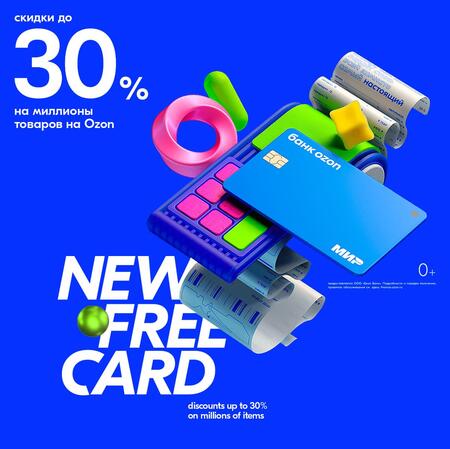
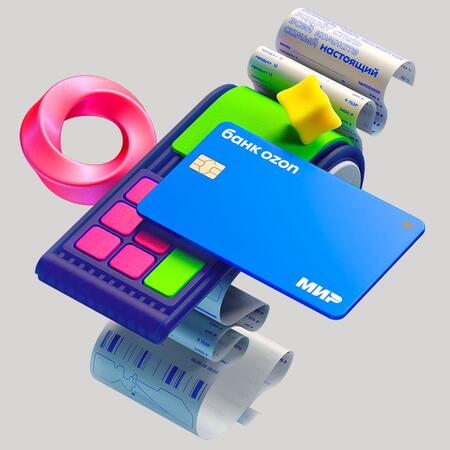
Fig. 3. Promotional mockup for Ozon Bank featuring discounts of up to 30% when paying with a card. Fig. 4. 3D rendering of an Ozon Bank card and point-of-sale receipts.
In December 2021, «Ozon Account» was launched, and in July 2022, the new Ozon Card arrived. Cardholders could purchase items on the marketplace with discounts of up to 30% and receive refunds of up to 10% of their purchases in three selected categories outside the marketplace.
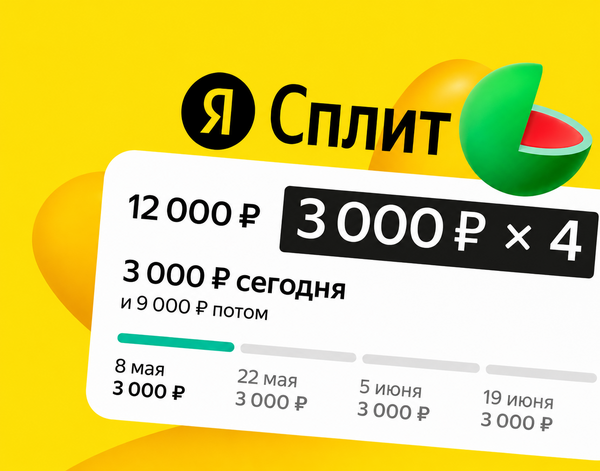
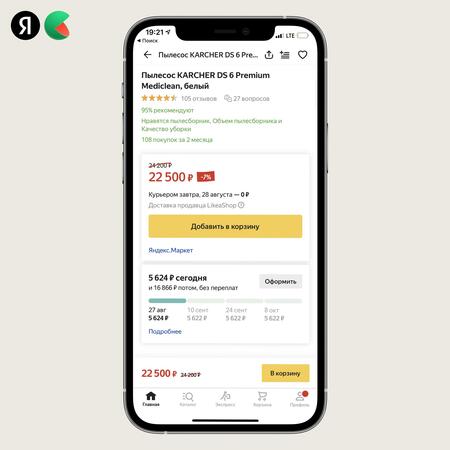
Fig. 5. Promotional illustration for Yandex Split showing payment divided into four installments. Image quality has been enhanced using AI; the image content remains unchanged. Fig. 6. Yandex Market interface proposing to divide the purchase payment into four installments.
On August 30, 2021, Yandex introduced the «Split» service. When placing an order, the buyer would pay 25% of the item’s cost, with the remaining three payments distributed over the following six weeks. Meanwhile, the seller received the entire amount upfront.
If the Ozon Card allows the cost of the item to be reduced through a discount and cashback, Split reduces the total amount needed to complete the order. In the first case, the buyer saves on the price; in the second, they spread the expenses over time.
The development of e-commerce has given rise to financial ecosystems where banking services have become tools to incentivize purchases and expand consumer capabilities.
Chapter 2. How Advertising Transforms Financial Instruments into Symbols of Freedom, Benefit, and Pleasure
In the essay «Rhetoric of the Image» (1964), Roland Barthes writes: «the ‘fixation’ of meaning is a form of control over the image.» Text enables the viewer to select a specific interpretation of the image. This principle allows us to trace how the combination of advertising phrasing and graphic elements links financial products to benefit and freedom of choice.
Fig. 7. Promotional layout for Ozon Bank featuring offers for discounts and cashback up to 30%.
One technique involves typographic hyperbole. In Ozon Bank’s advertising, the number 30 occupies a significant portion of the composition. The maximum discount size becomes the main advertising focus, while the conditions for obtaining it remain secondary.
Fig. 8. Yandex Split outdoor advertising on Profsoyuznaya St., 127B, Moscow. Image quality was enhanced using AI; the image content remained unchanged.
Yandex Split uses cost installment: instead of the full price of an item, the size of a single payment is shown in large font. Four smaller amounts look more accessible than a single lump-sum payment, even though the total price of the item does not decrease as a result.
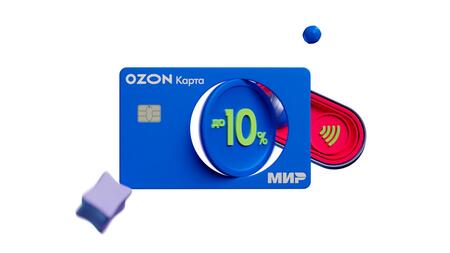

Fig. 9. Ozon Maps promotional 3D graphic with a cashback offer of up to 10%. Fig. 10. Yandex Split promotional layout offering to split payment over four months without extra fees.
The next concept is subjective metaphor. In Ozon Bank’s animation, a coin rotates inside a card, literally demonstrating a refund. In Yandex Split’s advertisement, the product takes center stage: the financial service becomes a means to acquire an item immediately, while the need for subsequent payments moves to the background.
Fig. 11. Promotional 3D graphic for Ozon Bank featuring a card, coins, and a benefit doubling symbol.