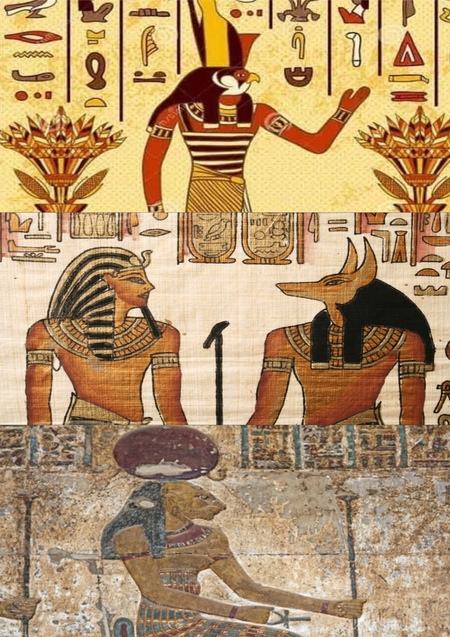
The fusion of the human body with the animal head is a graphically complex task. Simply joining different anatomical parts results in an illustration with a noticeable seam, resembling an unkempt collage. The masters of Ancient Egypt must have devised a technique to visually integrate the human and animal forms into a single, monumental figure.
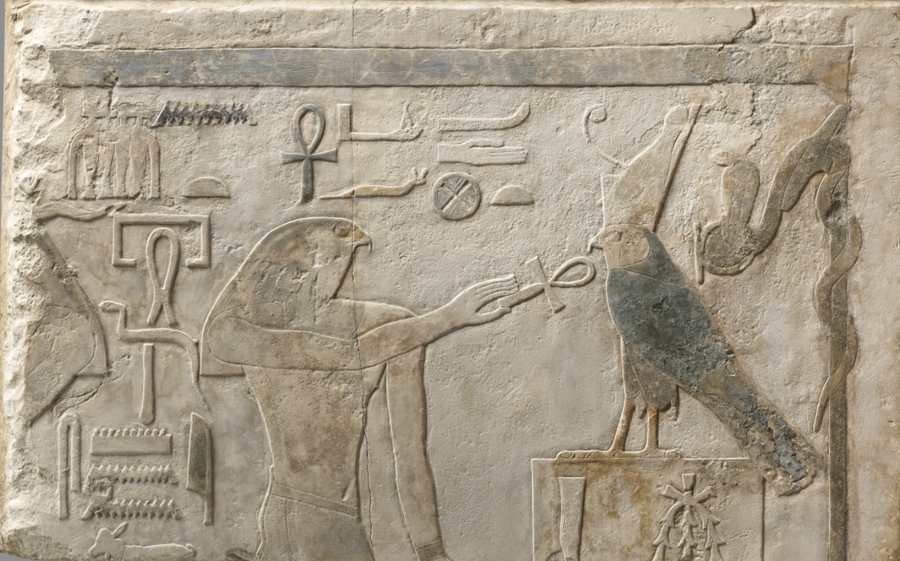
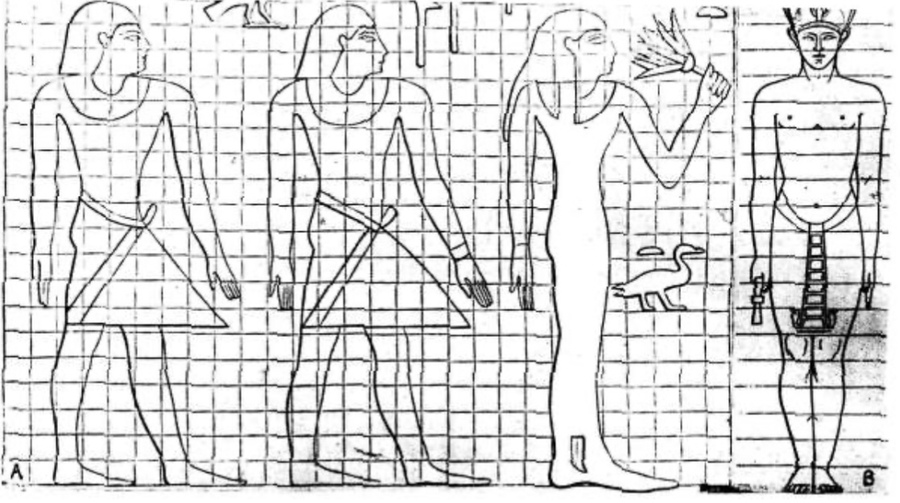
The foundation of ancient Egyptian art is the modular grid. This grid established clear proportions for the body and head, allowing the substitution of a human head with an animal head without disrupting the figure, resulting in a harmonious composition.
The primary masking technique employed was a system of visual adapters that obscured the point of connection. The «ushekh» necklace, the massive crowns, and the three-piece wig function as graphic commentators. They completely conceal the juncture of the head and body, resulting in a unified figure.
The semi-circular, substantial necklace, «usekh,» acts as a smooth transition piece. It covers the lower part of the neck, visually softening the contrast between skin and the texture of wool or feathers.
When comparing different types of deities, a universal principle of the canon becomes apparent: regardless of the animal’s anatomy—be it the elongated snout of a jackal, the arched beak of an ibis, the predatory profile of a falcon, or the rounded muzzle of a lioness—the line of the shoulder girdle and the posture of the torso remain strictly constant. Individual characteristics of each species are adapted to a single body module by altering the volume of the mane and the tilt of the neck.
Due to the animals' beaks and elongated muzzles, there is a strong forward momentum. To prevent the figure from looking visually unbalanced, artists depicted tall crowns or sun discs. These elements are precisely what balance that tilt.
The Pschent crown (a combination of the crowns of Upper and Lower Egypt) serves a crucial compositional function. The sharp, projecting falcon beak introduces a risk of visual tilting in the figure. The massive verticality of the crown, with its diagonal projection backward, completely compensates for this lean, restoring the central axis of the figure’s balance.
Creating a tight frame, the three-part wig lies with two strands across the chest and one down the back.
Introducing wide horizontal wings and multi-tiered feathers creates an additional spatial grid around the head. The feather lines echo the horizontal bands of the «usekh» collar, causing the bestial/avian profile to rigidly integrate into the ornamental framework and lose its natural randomness.
The sharp diagonal of the beak meets the straight line of the shoulders. By using the round shape of the eye and the smooth curve of the neck, the artists compensate for the contrast, resulting in a balanced profile.