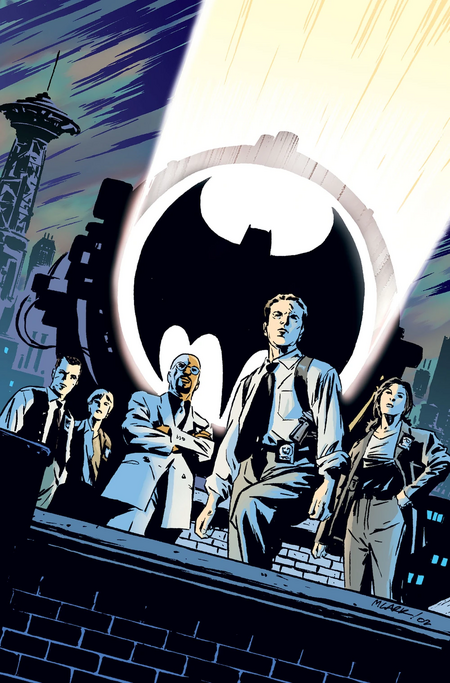
Concept
Batman comics hold a unique position within the superhero genre: while many heroes confront corrupt authority, Batman possesses no inherent superpowers, relying instead exclusively on physical conditioning, wealth, discipline, and personal ideology. This makes Wayne not just an external force, but a reflection of society itself and its demand for justice.

«Batman: Year One» #1, 1988, DC Comics The moment Bruce Wayne’s parents died
Gotham, in turn, is not merely a setting for events but also a metaphorical construct reflecting real-world political dysfunction, where municipal power and the police system are in decline. Thus, studying Batman comics allows us to explore how civic anxiety, distrust of authority, systemic corruption, and the drive for vigilantism are visually and narratively constructed.
The research centers on three seminal comic books that established the foundation of the modern Batman canon: Frank Miller and David Mazzucchelli’s Batman: Year One, along with its sequels, Batman: The Long Halloween and Batman: Dark Victory, by Jeff Loeb and Tim Sale. For a more comprehensive analysis, early issues of Detective Comics and Batman were added to this corpus, although other works are also referenced. The visual material was selected based on its relevance to political critique, its depiction of municipal and police systems, and how the figure of Batman is constructed in relation to the law. The study is built upon an analysis of the imagery of Gotham’s political elite, the mafia, the police department, and state institutions as unstable systems—whose failures shape both the city’s crime rate and the protagonist’s role within it.
The selection of textual sources was primarily based on their inclusion of an analysis of Batman’s character within the context of the legal system and his relationship with political institutions. Articles describing the phenomenon of vigilantism in the reality of 1920s America were also chosen; their analysis helped broaden the understanding of the hero and the system depicted in the comic books.
The research hypothesis is that Batman comics construct a multi-layered critique of institutional power, presenting the hero as a figure whose lawbreaking simultaneously reinforces his status. Vigilantism arises from a collapse of public trust in political and police structures, yet its methods rely on forms of violence that inevitably replicate the very problems he seeks to eradicate. Nevertheless, Batman’s methods are constrained by his strong moral principles, which positions him not as a criminal, but as a hero striving to uphold the unrealized ideals of a failed system.
The structure of the study comprises three interconnected parts: it begins with Gotham’s political leadership and its systemic corruption, transitions to the police department and the tension between law and justice, and concludes with a discussion of Batman as an extra-systemic actor shaped by the system’s shortcomings. Thus, the research moves from the general to the specific, allowing us to trace how institutional weakness gives rise to the conditions for vigilantism.
Political Structures. Gotham’s Shadow Politics
The political reality of Gotham, where both the police and Batman operate, is shaped by a deeply warped urban system where authority and criminality form a single entity. Traditionally, in DC comics, Gotham City is depicted as a city in a state of constant institutional decay: a corrupt political elite, criminalized districts, and a blurred line between the legitimacy of power and the police structure create an environment in which state institutions are unable to fulfill their primary function—protecting citizens. In this context, the emergence of Batman is not an anomaly, but a logical consequence of the rift between power and the populace.
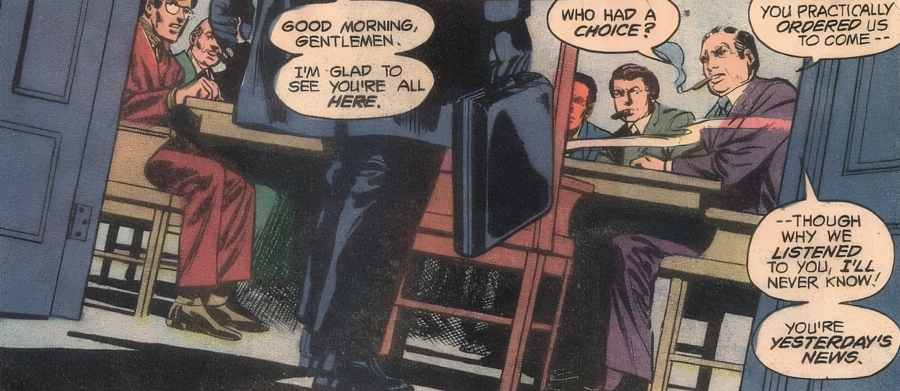
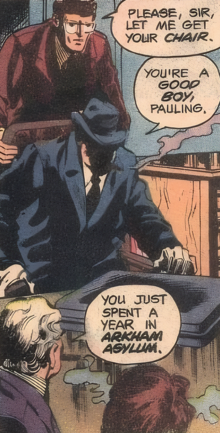
«Batman» #341, 1981, DC Comics
Corruption within Gotham’s political system is not an anomaly; it is a fundamental prerequisite for the function of state institutions. This is particularly evident in the storyline from the comic book «Batman» #341, which highlights the manipulability of the electoral process. Official candidates like Hill and Reeves are merely «puppets,» while real political decisions are made by «shadow» actors unseen by the general electorate. The concealment of criminal figure Rupert Thorne reflects how true power resides with those who remain unseen and unknown to ordinary citizens.
«Batman» #341, 1981, DC Comics «Gentlemen, it’s very simple, a right man is my man»
Thus, the political chaos of Gotham is not merely a consequence of crime—it is its structural foundation. Criminals participate in shaping state institutions, ensuring the constant reproduction of corruption and institutional instability. Power in the city changes frequently, but not through the mechanism of democratic rotation, but through sudden crises, violence, bribery, or the elimination of competitors, which exacerbates the instability of the political system itself.
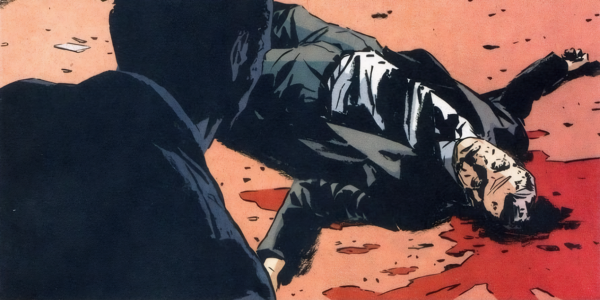
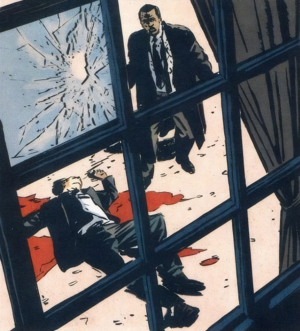
«Gotham Central» #12, 2003, DC Comics The moment of Daniel Dickerson’s murder, the mayor of Gotham City
Gotham City
«Gotham Central» #5, 2003, DC Comics
Gotham’s aesthetic emphasizes the constant pressure under which its residents live: narrow alleys, unlit industrial zones, massive buildings in a modern Gothic style. The weather is another significant symbolic element—perpetual rain, fog, and nocturnal smog visually dissolve the city’s boundaries, erasing the distinction between moral order and chaos.
«Gotham Central» #11, 2003, DC Comics
«Batman: Year One» #3, 1988, DC Comics
The mansions of the Mayor, Falcone, and Wayne, located outside the city limits, represent a spatial opposition to Gotham. They symbolize order, stability, and tranquility—values the city cannot sustain. These spaces serve as havens for the elite: the upper class seeks not merely to distance themselves from Gotham’s chaos, but also to shed the social responsibility that accompanies their political and economic status.
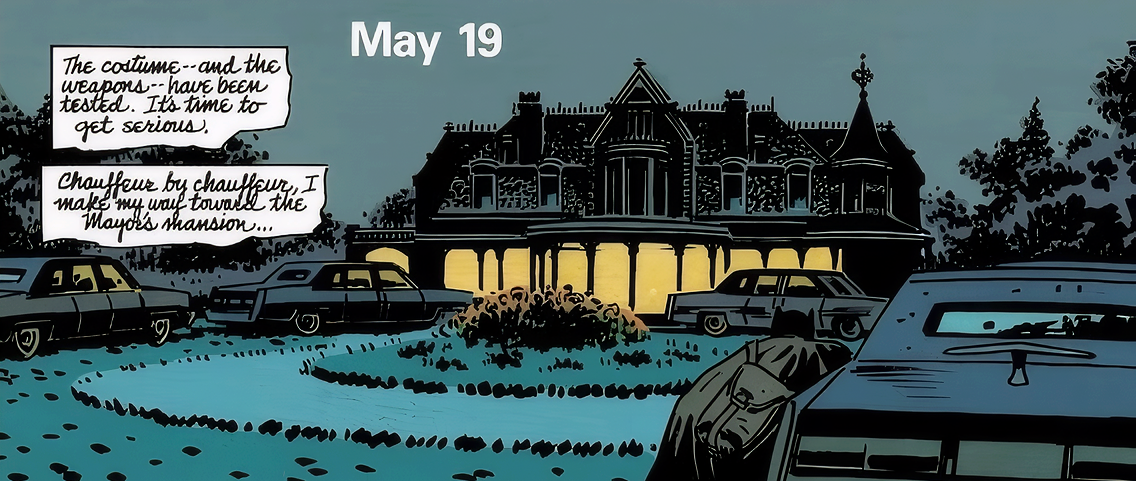
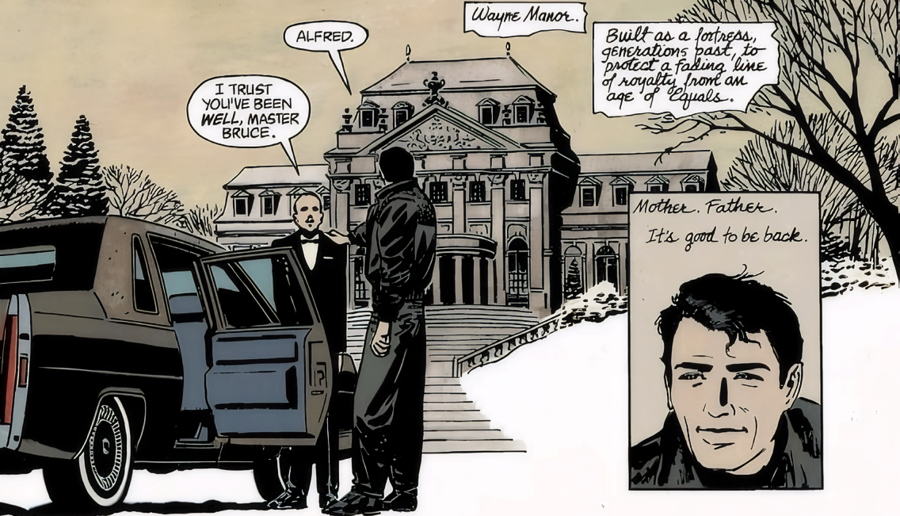
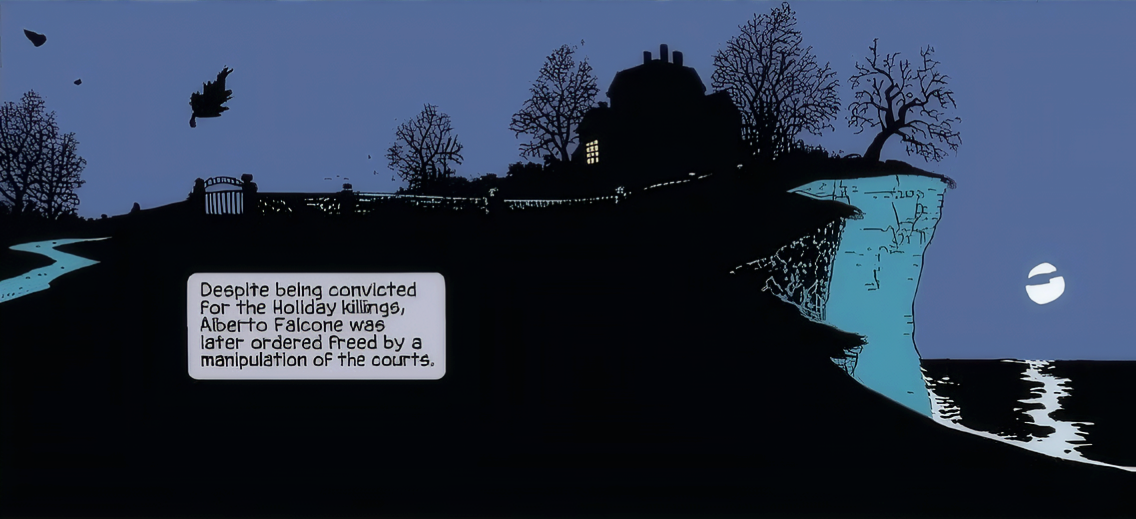
«Batman: Year One» #1, 1988, DC Comics «Batman: Dark Victory» #2, 1999, DC Comics «Batman: Year One» #2, 1988, DC Comics
«Gotham Central» #9, 2003, DC Comics
The visual verticality of the city serves as a metaphor for social stratification and inequality—the penthouse units atop skyscrapers, situated «above» Gotham, elevate the elite over the masses. Meanwhile, the urban underbelly, Southern and Central Gotham, as well as the areas surrounding Robinson Park, are depicted as zones of high crime, social distress, and lack of control. This environment shapes a particular type of protagonist—one forced to adapt to brutality and develop their own survival strategies, exemplified by Selina Kyle.
«Batman: Year One» #2, 1988, DC Comics «Finally, the worst. East end»
The park, which became the site of a fierce confrontation between the Gotham City SWAT team and Batman, documents another important pattern: Gotham is constantly transforming into a battleground between governmental agencies and figures operating outside the law. Urban space is not neutral; it serves as the arena for conflict between various forms of power.
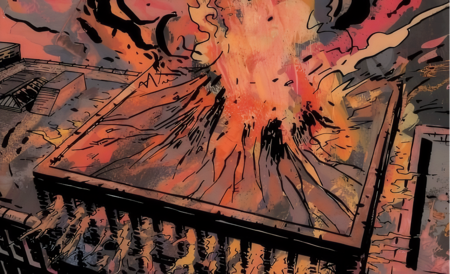

«Batman: Year One» #2 and #3, 1988, DC Comics
«Batman: The Long Halloween» #12, 1996, DC Comics
Arkham Asylum—an institution intended to ensure societal safety and rehabilitate mentally ill criminals—has devolved into the most vivid symbol of systemic failure. The asylum’s grim, Gothic architecture forewarns of the horrors unfolding within; this is a place that does not rehabilitate—it circulates evil. Inmates constantly attempt escapes, and the legal regime within Arkham’s walls is unpredictable.
The symbolic meaning of Arkham Asylum can be interpreted as a confirmation that the biggest criminals—Gotham’s near-monsters—are created by society itself. It is a reflection of the system’s internal chaos.
«Detective Comics» #503, 1981, DC Comics
The examined elements—corruption, shadow power, a gothic atmosphere, social stratification, and failing institutions—shape the image of Gotham as a socio-political organism whose decay makes the emergence of a vigilante inevitable.
This unstable political system creates conditions where the Gotham Police fluctuate between being a tool for corrupt officials and rare pockets of professional integrity, embodied by Gordon and his close circle.