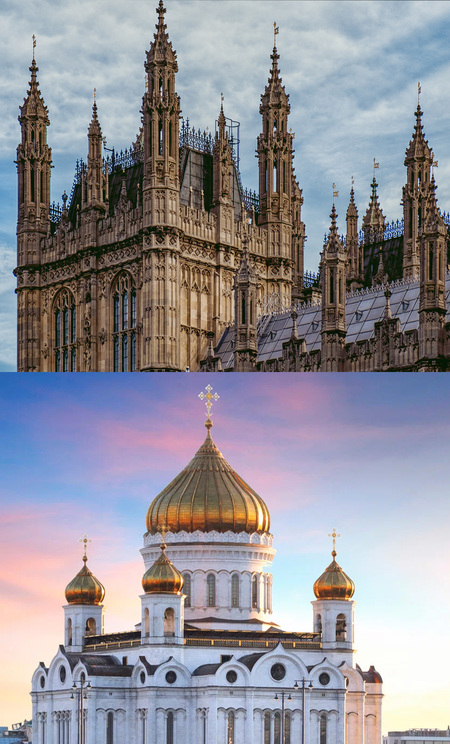
ISSUE STATEMENT
Christian churches are highly diverse and can be confidently divided into Catholic and Orthodox. But why didn’t Orthodox architecture adopt Gothic styles, unlike Catholic architecture?
CONCEPT
The absence of Gothic architecture in Orthodox church building is not a gap in development, but rather a consequence of a different theological logic and a dramatic historical rupture. Gothic architecture emerged from a Western experience of God as a transcendent goal toward which the soul moves through effort and overcoming. The space of a cathedral opens upward—spires, rib vaults, and flying buttresses work to pull the gaze and thought beyond the earthly realm. The Orthodox church is built around an inverse intuition: heaven is not far away, but within the world, and the church is a place of human encounter with God, not a surge toward Him. The Byzantine dome encloses the space above the worshippers, rather than opening it into infinity; the Pantocrator Christ in the dome encompasses everyone, whereas in the Western basilica, the emphasis is placed on human ascent.
The historical divergence intensified this split. The Mongol invasion in the mid-13th century cut Russian lands off from the broader European cultural process in which Gothic architecture was developing; pre-Mongol church traditions solidified as sacred models rather than as material for experimentation. The idea of «Moscow—the Third Rome» further canonized the Byzantine heritage, transforming it into a protective standard. Gothic architecture only appeared in Russia in the 18th–19th centuries as Neo-Gothic—a commissioned trend rather than an organic line of development.
The liturgical structure completed the picture. The Orthodox iconostasis evolved from a Byzantine altar screen into a solid wall of images that does not «conceal» the sanctuary but instead structures a hierarchy of meanings and the order of heavenly ranks, causing the viewer to pause before the mystery. The Catholic cathedral, conversely, leans toward transparency and narrative: its stained glass and sculpture are directed toward the human as a spectator and participant. Underlying this is the difference between the apophatic stance—approaching God through the renunciation of exhaustive imagery—and the cataphatic stance, which allows for rich visual didactics. The Russian onion dome unites both impulses: inwardly, it remains a closed vault, but outwardly, it presents the image of prayerful fervor directed toward the cross.
VISUAL RESEARCH
The comparison is made across four visual axes: verticality, altar boundary, light, and facade. Three representative monuments have been selected: Chartres Cathedral (Gothic), the Hagia Sophia of Constantinople (Byzantine), and the Assumption Cathedral of the Moscow Kremlin (Rus').
Chartres Cathedral of the Virgin Mary
Hagia Sophia Cathedral
Cathedral of the Dormition of the Most Holy Theotokos
1. Verticality. In Chartres, the spires and buttresses create a vector that draws the gaze beyond the confines of the building; the eye has nothing to «catch» on—the space is open.
1. Verticality. In Sofia, the dome closes the composition: the gaze rises and pauses on the Pantocrator; the space is resolved.
1. Verticality. Uspensky Cathedral offers a dual effect: externally, the onion domes read as a flame soaring upward, yet internally, the same dome remains a closed vault.
Conclusion: Gothic builds vertically as an ascent, while Orthodoxy builds as a gathering.
2. The Altar Boundary. At Chartres, the altar is separated only symbolically—the nave space is visible all the way to the apse, and the stained-glass windows guide the gaze toward the light.
2. The Altar Screen. In Sofia, the altar screen is low, but in the Dormition Cathedral, the iconostasis transforms into a solid wall of images: the gaze pauses on an icon, behind which lies mystery.
Conclusion: the Western temple is transparent inward, while the Orthodox one is hierarchical from the front.
3. Light. Chartres: the light is intense, colored, spilling through enormous stained-glass planes and telling a story.