RESEARCH CONCEPT
The creativity of Johann Hauser holds a special place in the history of European Art Brut in the latter half of the 20th century. His drawings are instantly recognizable by their tense contours, intense color hatching, distorted human figures, and unique depiction of familiar objects. Women, animals, airplanes, rockets, stars, and geometric shapes become part of an artistic world where conventional rules of proportion and spatial representation cease to apply. Hauser was born in Bratislava in 1926. In 1949, he ended up at the Gugging psychiatric institution near Vienna, where, in the late 1950s, he began drawing with the assistance of doctor Leo Navratil. Since 1981, the artist has lived and worked at the Gugging Artists' House. His work attracted the attention of Jean Dubuffet, Arnulf Rainer, and other artists; between 2016 and 2017, Museum Gugging organized a retrospective that brought together over two hundred works.
However, when examining his work, a question arises that biographical details cannot answer. Why are such disparate images—the human body, an animal’s head, an airplane, or a star—perceived as works created by a single author? What unites them, beyond the recognizable manner of applying colored pencil? The research focus is not so much on listing the subjects as it is on uncovering the principles of their visual construction. A female figure might consist of a vast mass of hair, a small face, and several conventional lines indicating the body. An airplane might be reduced to a fuselage and two colored wings. An eye can exist without a face, becoming an independent image. In all these cases, the subject’s recognizability is preserved, but the need for its realistic reproduction disappears. The key research question is: how does Johann Hauser maintain the subject’s recognizability while transforming its proportions, silhouette, color, and internal structure? The research hypothesis is that Hauser’s individual artistic language is built upon recurring visual operations: isolating the object on paper, emphasizing a characteristic detail, compacting the color surface, and graphically designating the form. It is these elements that allow the artist to transform diverse subjects into expressive forms that approach signs.
The question of the boundary between image and sign also plays a crucial role. A sign implies a certain stability of form—it can be recognized through several characteristic elements. Hauzer’s drawings often operate similarly, yet they retain an individual texture, line intensity, and unpredictable proportions. They do not become impersonal pictograms because their expressiveness is determined by the physically noticeable process of drawing. The intended outcome of this study is to demonstrate that Hauzer’s creativity can be viewed as a coherent system of visual solutions, rather than merely a collection of art brut works that arose outside formal art education. His drawings exhibit a unique way of transforming reality: from a complex object to a characteristic form, from a form to an expressive silhouette, and from a silhouette to an autonomous graphic sign.
INDEX I. The Female Figure as a System of Attributes II. The Human Between Form and Sign III. Face, Gaze, and Graphic Intensity IV. The Animal as a Recognizable Form V. The Machine as Silhouette and Color Construction VI. Geometry, Celestial Motifs, and the Autonomy of the Sign
CHAPTER I. THE FEMALE FIGURE AS A SYSTEM OF SIGNS
«Big Yellow Woman, ” 1969, I. Hauser.
The female figure occupies a central place in Hauser’s work. In these pieces, the artist does not adhere to the principles of anatomical accuracy. Body parts may change scale, transition into one another, or take on a distinctly decorative quality. Yet, the image retains its recognizability: a few established features—the head, hairstyle, bust, and silhouette—are sufficient. The role of hair is particularly significant. In certain drawings, it becomes not merely a detail of the head, but a large, independent graphic mass. The repeated lines transform into a rhythmic element capable of occupying almost the entire page.
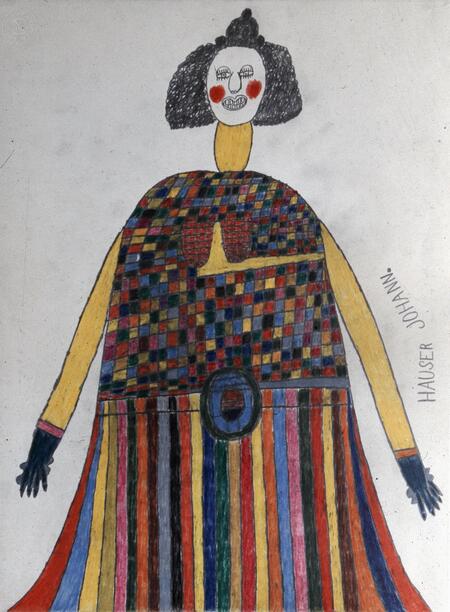
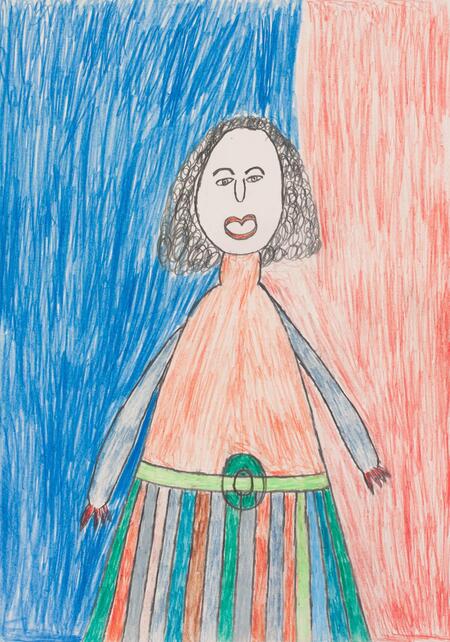
«Female Figure in Plaid Clothing,» date unknown, I. Hauser / «Woman,» date unknown I. Hauser.
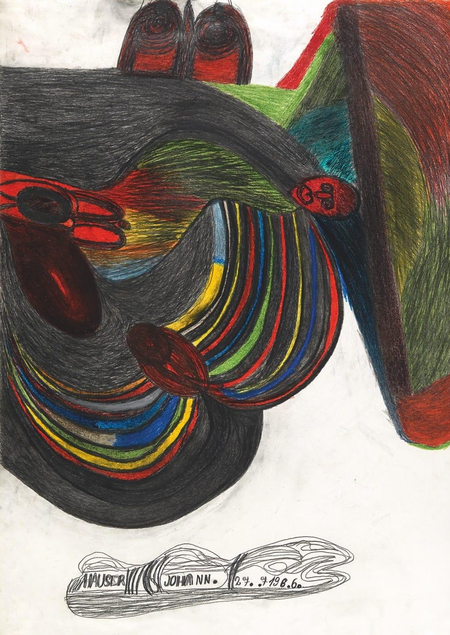
In «The Large Yellow Woman, ” the hair forms a stretched golden mass that visually competes with the body. In „The Beautiful Woman, ” the hair is also organized by repeating long lines, but the face is highlighted by a sharp red patch. In both cases, the female image is constructed through the contrast between dense color zones and smaller graphic notations. The surface of the figure is organized differently in the work featuring checkered clothing. The dress is covered with rectangles of various colors, creating a resemblance to a textile grid. The numerous cells almost conceal the body beneath a decorative rhythm. The face, conversely, remains relatively free of color. The main visual event is not the facial expression but the juxtaposition of filled and unfilled space. In the painting „Woman“ with a blue and reddish background, the artist also avoids volumetric construction of the figure. The vertical division of color establishes a flat composition, and the female figure becomes its central axis. „Nude Woman in a Hat“ presents a particularly interesting case. Here, the traditional figure almost dissolves among arched multicolored stripes, dark loops, and intersecting forms. The title helps identify the subject, but the drawing itself demands prolonged viewing. Recognition is no longer instantaneous; the viewer must gradually assemble the image from the complex graphic structure.
«Nude Woman in a Hat,» 1986, I. Hauser.
CHAPTER II. THE HUMAN BETWEEN FORM AND SIGN
«Untitled» (Bishop and the Devil), date unknown, I. Hauser.
«Man and Woman,» date unknown, I. Hauser.
In some of Hauser’s drawings, the human figure undergoes an even more radical reduction. Sometimes, a single attribute is enough to recognize a character, and other times, only a geometric form remains of the person. This chapter explores how the artist substitutes a detailed depiction of the body with a minimal set of visual characteristics.
«The Mother of God with the Child Christ and the Star of Bethlehem, ” 1968, I. Hauser.
In the work «Bishop and Devil, ” each character is defined by several easily recognizable details. The bishop is identified by his mitre and staff; the devil by his horns, pointed ears, and tail. The bodies are depicted with extreme simplification, yet their association with specific archetypes is undeniable. It becomes apparent here that, for character identification, the attribute is more significant than the proportions of the human body. The artist essentially employs the principle of the pictogram, although the drawing retains the unevenness and immediacy of the hand-drawn line. In the piece „Man and Woman, ” an even more radical reduction of form occurs. The sheet features two rhomboid shapes that differ in color and placement. Without a title, a viewer would hardly be able to confidently determine that the piece represents a man and a woman. This work illustrates the vital relationship between the image and the text: meaning arises not only from within the drawing but also through the designation provided by the title.
Character as a Color Body
Two elongated figures, differentiated by color, density, and placement, are featured in the Grand Palais exhibition photography. Their upper sections resemble heads, while their lower sections look like vessels, mechanical components, or bodies with unusual proportions. Ambiguity becomes a crucial expressive characteristic here. The viewer simultaneously perceives both human figures and abstract forms. The drawing does not allow for a definitive single interpretation. The situation is different in religious narratives: familiar symbolism helps to organize the image. Hauser maintains the characters' recognizability through traditional signifiers but reinterprets them in his own style. The depiction of a human being can be reduced to an attribute, a mass of color, or a geometric shape. In this case, recognizability is not necessarily provided by the image itself—sometimes it emerges through the title and cultural context.
«Two Anthropomorphic Figures”—the title and date require clarification, I. Hauser.
«Angel Between Heaven and Hell,» 1966, I. Hauser.
CHAPTER III. IDENTITY, VISION, AND GRAPHIC INTENSITY
«Eye,» circa 1970, I. Hauser.
If the female body in Hauser’s drawings often takes the form of a large color mass, the face, conversely, might be constructed from a small number of details. The eyes, mouth, nose, and hair form a system of contrasts where an individual element gains disproportionately great significance. The gaze plays a particular role. The eyes are not necessarily depicted realistically, but they are capable of organizing the perception of the entire composition.
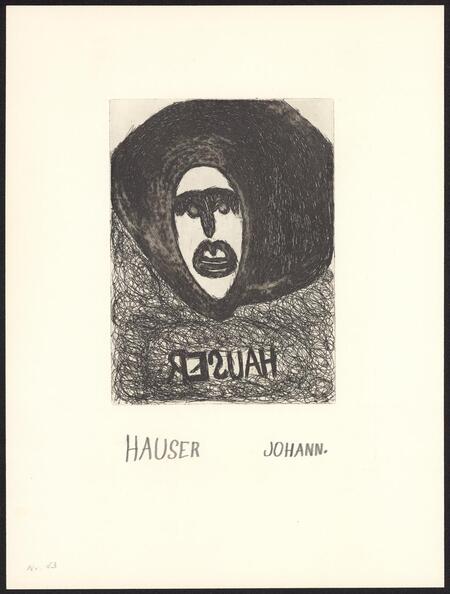
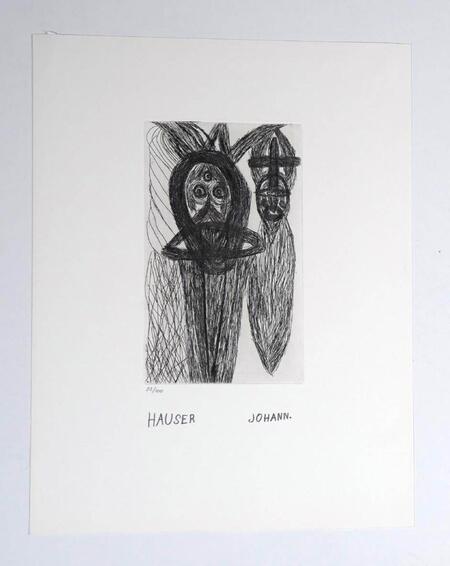
«Man,» 1974, I. Hauser / «Crowned Heads, date of original undetermined,» I. Hauser.
The Eye as a Center of Image In the 1969 portrait, the head is encircled by numerous diverging lines. These resemble rays emanating from the face, causing it to be perceived not only as the center of the human figure but also of the entire composition. The contours almost vanish amidst the dense charcoal hatching; the gaze stands out against the black mass. In «The Eye, ” circa 1970, the artist employs an opposite solution. Instead of a complex system of lines, a single elongated red form appears, featuring a blue iris and a green center. The eye does not belong to a specific character—it becomes an independent object. Comparing these drawings reveals two ways to intensify viewer attention. In the first instance, the eye functions as part of a complex composition; in the second, it completely dominates the page. The Face as a Mask in „Crowned Heads“ The faces are unified with elongated dark forms. Their expressiveness is determined not by individual features, but by the contrast between the rounded eyes, the headwear, and the dense linear texture. The image approaches a mask. Facial features do not so much describe a specific individual as they allow for the instant recognition of a character’s presence. Material is also important. The black hatching here is not limited to designating hair or shadows; it fills the space around the figures, connecting the image and the background. Chapter Conclusion: In Hauser’s work, the face becomes a system of expressive accents. The eye can be separated from the body, and the portrait can be transformed into a mask. Recognizability is maintained with minimal detail, while the graphic texture amplifies the emotional impact.
CHAPTER IV. THE ANIMAL AS A RECOGNIZABLE FORM
«Elephant,» 1975, I. Hauser.
Animal imagery helps to test the extent to which Hauser’s artistic techniques are dependent on a specific subject. In the drawings of lions, elephants, and sharks, one can find the same figure isolation, emphasis on a particular detail, and dense color filling as in human representations. However, the methods for recognizing animals differ: the trunk, mane, fin, teeth, tail, and characteristic silhouette become especially important.
«Fish,» 1973, I. Hauser.
«The Lion’s Head,» I. Hauser.
Character Over Anatomy In «Lion’s Head, ” the massive mane is constructed from dense black lines encircling a yellow face. The viewer recognizes the animal through the mane, muzzle, and teeth. However, the head lacks realistic volume—it can be perceived as a flat mask framed by graphic elements. Hauser uses a similar principle in the two elephant images. The rounded body becomes a large color field, while the trunk and tusks serve as the primary identifying features of the species. The eye is particularly prominent. In one piece, it is surrounded by thin black lines; in another, it transforms into a circular, contrasting element. In terms of construction, these eyes are related to the independent eye illustration examined in Chapter 3. This comparison shows that Hauser can alter color and level of detail without destroying the image. Several structural features are sufficient to recognize the animal. This links the animal images to technical drawings: a shark and an airplane can both have similar elongated bodies and side protrusions. But while the shark is recognized by its fins and mouth, the airplane is defined by its wings and tail assembly. Chapter conclusion: The animal images confirm the stability of Hauser’s artistic techniques. Form is reduced to silhouette and distinct features; color and line emphasize the independence of the drawing.