
Categories
- Concept
- Martin Ramirez: Life and Work
- Martin Ramirez’s Artistic Language
- Key Themes in His Work
- Space in Ramirez’s Works
- Martin Ramirez in the History of Art Brut
- Conclusion Bibliography Image Sources
Concept
The work of Mexican artist Martin Ramirez (1895–1963) is examined within the context of marginal and non-institutional art of the 20th century. Without formal art training, Ramirez developed a recognizable graphic language based on the repetition of lines, geometric forms, and an unusual construction of space. He spent a significant portion of his life in psychiatric institutions in California, where he continued to paint. The relevance of this study lies in tracing how a limited range of subjects forms the basis of an independent artistic system. Architecture, tunnels, railroads, riders, and landscapes constantly reappear in Ramirez’s works, yet they vary in scale, composition, and methods of depicting depth. Comparing these variations reveals the principles of spatial organization.
The aim of this study is to determine the methods of spatial construction in the works of Martín Ramírez and to identify the role of recurring motifs in shaping his artistic language. The key research question is: how do recurring architectural and spatial motifs form Ramírez’s independent artistic world, connecting reality, personal experience, and imagination? The hypothesis is that the space in Ramírez’s drawings is not merely a depiction of specific locations. Instead, it forms an autonomous visual system in which familiar imagery is transformed through rhythm, geometrization, repetition, and changes in perspective. Arches, tunnels, and railroad tracks simultaneously function as narrative elements and means of organizing the composition. The visual investigation is built upon a comparison of the works and their fragments. The group of architectural images examines the transition from recognizable buildings and structures to conventional spatial structures, where line becomes a formative element. In the drawings of trains and railroad tracks, depth, direction of movement, and the rhythm of repeating contours are analyzed. The depictions of riders and animals allow for the tracing of the connection between the scale of the figure and the surrounding space. The research methods include formal-compositional analysis, visual comparison of works, and the study of museum catalogs, archival materials, and scholarly publications. Images are selected based on the presence of common motifs, the diversity of spatial solutions, and the possibility of direct comparison. During the analysis, established facts, research interpretations, and personal visual observations are distinguished. The foundational sources include materials from the American Folk Art Museum, the Smithsonian American Art Museum, and the Museo Reina Sofía. The structure of the study involves a progression from the biographical context to the examination of recurring themes, followed by a comparison of compositional techniques and patterns of spatial organization. A separate consideration is given to the evolution of Ramírez’s works: from sketches created outside a professional artistic environment to pieces held in museum collections. The illustrations are organized as a sequence of visual evidence—each group reveals a specific principle of image construction.
Chapter 1. Martín Ramírez: Life and Work
Martín Ramírez González (1895–1963) was a self-taught Mexican artist whose work gained recognition within the contexts of Art Brut and outsider art. Lacking formal artistic training, he developed a unique visual language based on repeating lines, architectural motifs, and unconventional spatial organization.
Unknown Artist. Martín Ramírez. Late 1920s. Photograph. Martín Ramírez Legacy Archive. Image quality enhanced using artificial intelligence.
Martin Ramirez was born on January 30, 1895, in Rincon de Velasquez, near the city of Tepatlán, Jalisco, Mexico. The following day, he was baptized at the parish church of San Francisco de Asís in Tepatlán. The childhood and youth of the future artist were spent in the rural setting of the Los Altos de Jalisco region of Mexico. His early life was connected to agriculture and the traditional lifestyle of the Mexican province.
Chris Hernandez. «San Francisco de Asís Church in Tepatitlán» (Parroquia de San Francisco de Asís, Tepatitlán de Morelos). February 25, 2022. Jalisco, Mexico. Photography.
On May 31, 1918, he married María Santa Ana Navarro Velázquez. Their family had four children: three daughters and one son. In 1923, Ramirez acquired a small parcel of land on credit. Two years later, he traveled to the United States to work, leaving his family in Mexico. On August 24, 1925, Ramirez left Mexico. For the next five years, he worked on railways and in the mines of Northern California. In the late 1920s, he sent letters to relatives, sometimes supplementing them with small sketches in the margins. These are the earliest documented evidences of his graphic work. The Great Depression complicated Ramirez’s situation. By early 1931, he found himself in severe life circumstances, having lost stable work and housing. On January 9 of that year, he was detained by the San Joaquin County police in California. Ramirez was in a disoriented state and barely spoke English, which made communication with those around him difficult. The police concluded that he was incapable of caring for himself. After his arrest, Ramirez was sent to Stockton State Hospital, a psychiatric facility, where he was initially diagnosed with «manic-depressive disorder.» From this point forward began a long period of his residency in psychiatric institutions, which lasted until the end of his life. The move marked a significant shift in his circumstances. Ramirez found himself situated between two countries and cultural environments—Mexican rural life and American industrial landscapes. Subsequently, his work would feature images of trains, railroad tracks, Mexican riders, and Catholic architecture.
Photographer not specified. Martín Ramírez at Work. Date of shoot not specified. Photograph.
In medical documents, the initial diagnosis listed was manic-depressive disorder. In 1933, doctors recorded a different diagnosis—dementia praecox, catatonic form, a historical diagnostic term later associated with the category of schizophrenia. Throughout the 1930s, Ramirez was hospitalized in Stockton.
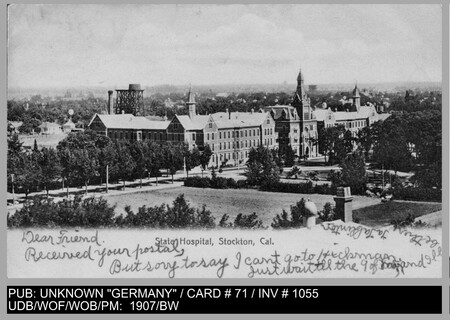
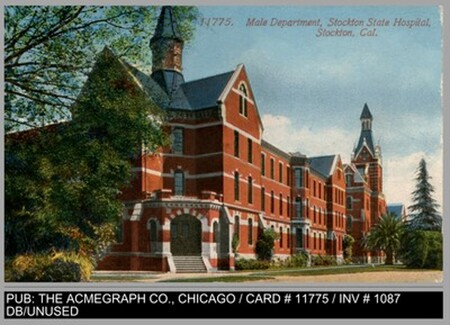
1. Artist unknown. State Hospital, Stockton, CA. Circa 1910. Postcard. Holt-Atherton Special Collections, University of the Pacific Library. 2. The Acmegraph Company. Male Department, Stockton State Hospital, Stockton, CA. Circa 1910. Postcard.
While at Stockton State Hospital, Ramírez left the institution without permission several times: in 1932, 1933, and 1934. In the latter instance, he returned on his own. Subsequently, the artist remained within the system of California psychiatric facilities. In 1948, Martin Ramírez was transferred from Stockton State Hospital to DeWitt State Hospital in Auburn, California, where he remained until his death in 1963. It was during this period that artistic activity became one of his primary pursuits. Here, Ramírez created large-format drawings, experimented with available materials, and gradually developed a recognizable system of graphic images.
Photo by unknown author. «Martín Ramírez at DeWitt State Hospital» (Martín Ramírez en DeWitt State Hospital). 1952. Auburn, California, USA. Photograph from the family archive, provided by Agustina Ramírez Navarro.
After seeing the artist’s drawings, Tarmo Pasto—a professor of psychology and art at Sacramento State College—became interested. He provided Ramirez with art supplies, collected his work, and facilitated its public recognition. An archival photograph from 1954 captured the artist with Pasto, both holding one of his large drawings.
Percel Followell. «Martín Ramírez and Tarmo Pasto at DeWitt State Hospital.» 1954. Auburn, California, USA. Archival photograph. Courtesy of the Estate of Martín Ramírez and Ricco/Maresca Gallery.
For a long time, Ramirez’s history was known primarily through medical records and testimonies from people who observed his work. In some early publications, he was depicted as someone who had completely lost the ability to speak and was disconnected from his relatives. However, research by Victor M. Espinoza and Christine E. Espinoza, published in connection with the 2007 retrospective, allowed these details to be re-examined. The researchers found that Ramirez maintained written contact with his family, and the common perception of his complete muteness did not align with the documentarily reconstructed biography.
Ramirez’s first known graphic works appeared in the late 1920s—in letters he sent to relatives in Mexico. However, he began drawing regularly in the mid-1930s, after being admitted to Stockton State Hospital. His artistic practice developed outside of formal professional education and traditional art circles. For his work, Ramirez used accessible materials, including pencils, chalk, paper, and self-developed substrates.
Martin Ramirez. «Untitled (Three Volkswagen Vans).» c. 1948–1963. Charcoal and pencil on joined sheets of paper. 58,1 × 76.2 cm. Blanchard-Hill Collection. Photograph provided by Phyllis Kind Gallery, New York.
In the center of the composition are three small vans stacked one above the other. They are surrounded by a system of repeating arched lines, reminiscent of archways or tunnels. The symmetrical arrangement of these elements creates a clear rhythm, and a wide, dark blue band across the top of the drawing unifies the composition. In this work, recognizable objects of everyday life are combined with an abstract space constructed from repeating geometric forms. This principle of image organization has become a characteristic feature of Ramirez’s work, visible in his drawings of trains, architectural structures, and natural landscapes.
Martin Ramirez. «Untitled (Black and White Standing Figure).» c. 1950–1955. Graphite, tempera, chalk on paper. 61 × 44.5 cm. Ricco/Maresca Gallery, New York.
In the work «Untitled (Black and White Standing Figure), ” Ramirez depicts a person within a conceptual architectural space. The central figure is surrounded by repeating lines that form a semblance of an arched frame. The contrast between the simple depiction of the human form and the complex graphic structure surrounding it emphasizes the characteristics of the compositional design.
Untitled (Inner Courtyard). Martín Ramírez (1895–1963). Auburn, California. c. 1953. Pencil and colored pencil on paper with fragments. 40 ½×36 inches. Anthony Petullo Collection.
In this work, Ramirez’s individual artistic language is clearly evident: parallel lines create an illusion of spatial depth, architectural elements organize the composition, and the depictions of animals and vehicles are incorporated into a unified system. The drawing shows how the artist transforms recognizable subjects into a complex spatial construction. This elongated composition demonstrates another principle of spatial organization—repeating lines form large structures reminiscent of railway tracks and tunnels. Space is created not so much through conventional perspective as through the density, direction, and rhythm of the graphic elements. It is precisely these kinds of works that make Ramirez an important artist for studying visual language and unusual ways of depicting depth.
Chapter 2. Martin Ramirez’s Artistic Language
One of the defining characteristics of Ramirez’s artistic practice was the use of unconventional materials. The artist worked with pencils, chalk, watercolors, and various paper supports. Limited access to art supplies compelled him to construct the drawing surface independently. He joined individual sheets using adhesives made from accessible products. This method of working allowed him to create large compositions from paper fragments that were not originally intended for artistic use. The most striking example is the work Untitled (Madonna in Landscape with Cars), circa 1951, held at the Library of Congress in the U.S. Its foundation consists of 22 fragments of postal correspondence, adhered with a homemade glue. During restoration, specialists determined that Ramirez utilized starch-based products, including bread, oatmeal, and potatoes.
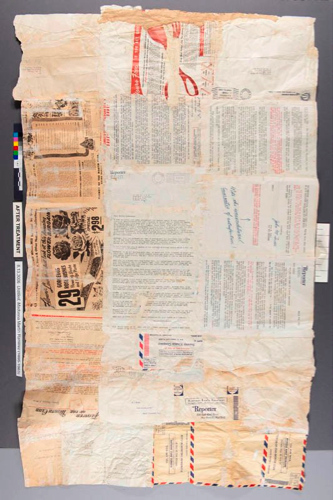
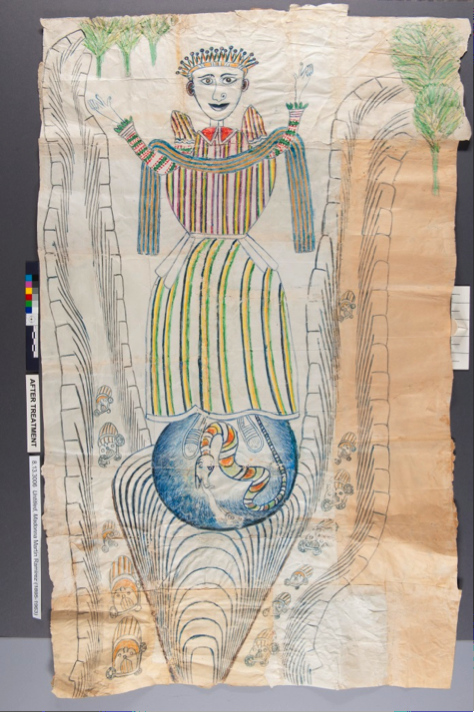
1. Martin Ramirez. «Untitled (Madonna in a Landscape with Automobiles)». 1951. Drawing on joined pieces of postal paper. Library of Congress, Washington. 2. Martin Ramirez. Reverse side of the work «Untitled (Madonna in a Landscape with Automobiles)». 1951. Joined pieces of postal correspondence. Library of Congress.
In this piece, the artist utilizes brown paper, graphite, and tempera. The restrained color palette focuses attention on the composition and the character of the lines. This work exemplifies one of Ramirez’s approaches using a limited set of artistic materials.