Navigator
- Concept
- The Hero and the Rebel: Power, Challenge, and Overcoming
- The Seeker and the Sage: Freedom and Knowledge
- The Creator and the Magician: Imagination and Uniqueness
- The Caregiver, The Lover, and The Innocent: Intimacy, Comfort, and Desire
- Conclusion
Concept
In contemporary visual culture, advertising functions not merely as a means to showcase a product, but as a tool for constructing a cohesive brand identity. The advertising message develops its own character and begins to be perceived almost as a persona. Its tone can vary—from tense and confrontational to calm and engaging. These qualities are conveyed through visual presentation, as individual image elements collectively form an overall impression of the brand’s character. To grasp this logic, it is important to briefly define the concept of an archetype.
An archetype can be viewed as a stable image or a behavioral model that recurs within culture, making it easily recognizable. It is not a specific character, but rather a type of role associated with a particular way of acting and perceiving the world. According to Carl Gustav Jung, archetypes are understood as deep images of the collective unconscious that manifest in myths, fairy tales, art, and other cultural narratives [9].
Archetypes begin to function in advertising because a brand also strives to be perceived as a recognizable entity with a distinct character. People remember an image—one that possesses a role, tone, and value—more easily than an abstract product quality. Therefore, archetypes, which are initially tied to human behavioral models, can be applied to brands.
The main focus of this research is how an abstract archetype becomes visible. It does not appear in advertising in a finished form; rather, it is perceived through the visual tone of the image, the narrative situation, and the overall presentation style. Consequently, it is important not only what is being advertised but also the character assigned to the brand.
By what visual and narrative means does advertising transpose archetypal human behaviors onto a brand, shaping its recognizable character?
Hypothesis: The archetype in advertising is formed through the connection between the narrative and the visual image. The narrative establishes the basic situation and the hero’s role, while the visual presentation makes this role recognizable through a shared emotional mood. Because of this, the advertising image begins to be perceived as a brand character that can be associated with a specific archetype.
The material selection principle is tied to how explicitly the archetypal image is expressed in the advertisement. For analysis, we select advertising campaigns and videos where the brand’s character is conveyed not only through the slogan but also through visual dramaturgy. The material is curated so that each chapter features different types of archetypes, and the examples do not repeat the same visual approach.
The research logic is structured around four groups of archetypes. Chapter one examines the Hero and the Rebel, concepts linked to strength, challenge, and overcoming obstacles. Chapter two analyzes the Seeker and the Sage, who value the journey, freedom, discovery, and knowledge. Chapter three shifts focus to the Creator and the Magician, associated with imagination, transformation, and uniqueness. Finally, the Caregiver, Lover, and Innocent are grouped together in chapter four, because advertising in this category most often taps into intimacy, comfort, trust, desire, and emotional safety.
The theoretical framework for this study is based on the works of Carl Gustav Jung, as well as the contributions of Margaret Mark and Carol Pearson, which help explain why archetypal logic can be applied to brands. Additionally, sources on advertising and archetypes in advertising communication are utilized to explore how these archetypes manifest in visual identity, positioning, and brand perception.
The Hero and the Rebel: Power, Challenge, and Overcoming
The first cluster of archetypes is built around intense action and pushing beyond the familiar. The Hero and the Rebel are similar in that both are connected to overcoming adversity, but they do so in different ways. The Hero typically operates through discipline and a focused drive toward a goal, while the Rebel achieves this through rejecting norms, abruptness, and overtly breaking the rules.
Nike’s «Find Your Greatness London» showcases the Hero archetype without the typical grandiosity of professional sports. The video is built on an alternation of various athletic situations where professional athletes and ordinary people find themselves in the same frame, and the visual presentation relies on dynamic editing and a sense of constant action. Because of this, heroism is linked not only to victory but also to personal composure, which can manifest on any scale. The brand is perceived as a mentor, supporting the viewer and making the Hero archetype feel more accessible.
Nike. «Find Your Greatness London, ” 2012. Commercial video.
The Nike «Just Do It» video maintains the same heroic logic, but the motivational text resonates more powerfully. The athletic scenes set a visual backdrop of perseverance, while the words transform the advertisement into a direct address to the viewer—a moment where the brand acts as a voice of support amidst doubt.
Nike. «Just Do It, ” 2020s Advertising video.
Under Armour’s «I Will What I Want» campaign with Misty Copeland constructs heroism through resistance to external judgment. The contrast between the fragility of the ballet body and immense inner strength is particularly striking. The camera captures the body in tension, which causes the advertisement to shift the Hero archetype from one of external victory to one of inner will. In this instance, the brand speaks not of a beautiful outcome, but of the right to act contrary to others' opinions.
Under Armour. «I Will What I Want» (with Misty Copeland), 2016. Commercial video.
Following the examples of heroic overcoming, Diesel’s «Be Stupid» shifts the theme of strength toward the Rebel. Here, what matters is not discipline, but the refusal to conform. The advertising is built on a provocative logic where «stupidity» becomes a form of freedom. Visually, this manifests through absurd situations, daring poses, and the feeling of deliberately violating proper advertising norms. Such a brand is perceived as a provocative character—it doesn’t teach the viewer to be composed; rather, it invites them to choose absurdity over neat correctness.
Diesel. «Be Stupid,» 2013. Advertising campaign / video.
In the Kenzo campaign «Kenzo World, ” the Rebel is revealed through the heroine’s abrupt liberation. She leaves the restrained space of the formal event and begins to move erratically and uncontrollably. The advertisement shatters the conventional perfumery aesthetic of smoothness and glossy seductiveness, imbuing the brand with an explosive character.
Kenzo. «Kenzo World, ” 2016. Commercial video. Directed by Spike Jonze.
Balenciaga × Adidas portrays the Rebel through the collision of sportswear with the office environment, as well as through the subjects' on-screen demeanor. The clothing choices already seem to defy business norms, but the advertisement further amplifies this effect with relaxed poses or a sense of disarray in the surroundings. The characters act as if the rules of formal space do not restrict them, meaning the campaign’s rebellious nature is perceived not only through the garments but also through their manner of presence.
Balenciaga × Adidas, 2022. Promotional video.
Aviasales. «Cabin Crew, ” 2025. Promotional video.
At Aviasales, the rebellious spirit emerges through ironic intonation and a refusal of conventional tourist idealism. Instead of painting a beautiful dream of travel, the brand chooses humor and a more candid conversation with the viewer; thus, the rebellion manifests not as an overt conflict, but as an ability to not take the advertising genre too seriously.
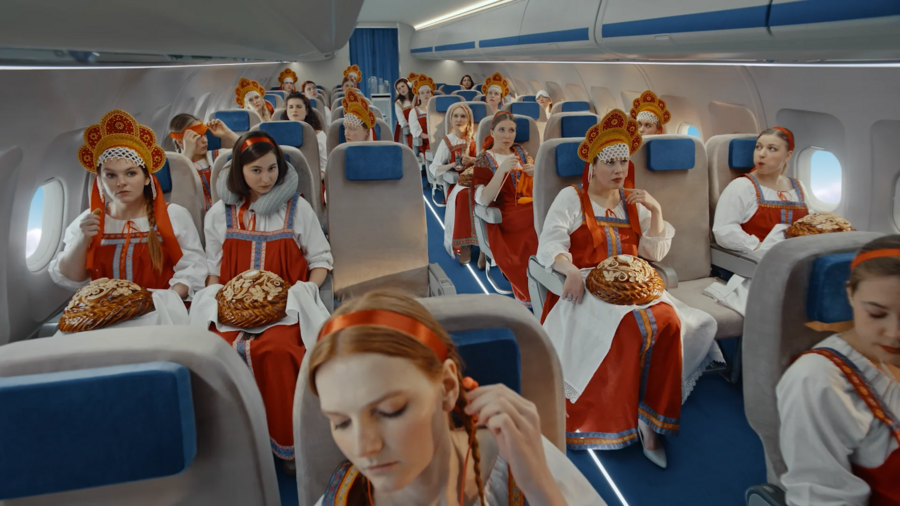

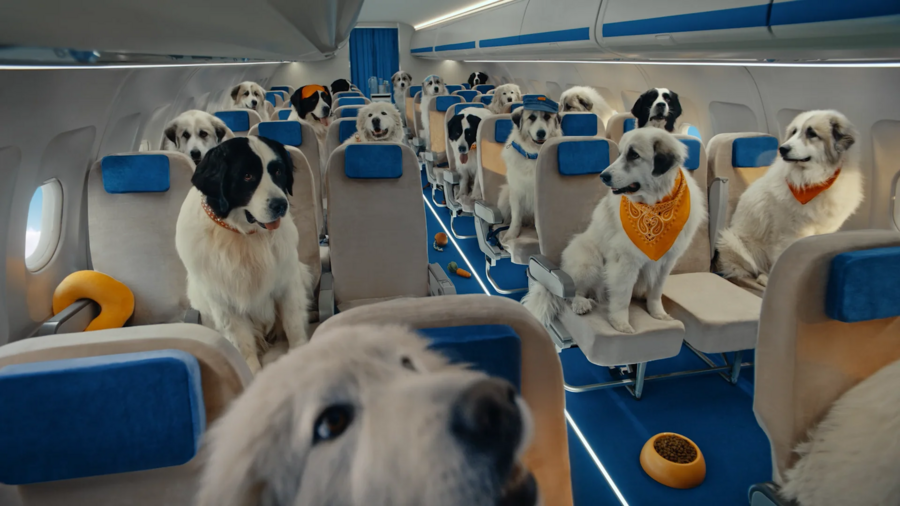
Aviasales 2025. Advertising Banners.
A brand can adopt human archetypes through its own behavior in advertising. The Hero makes the brand supportive and motivational, while the Rebel transforms it into a provocateur that challenges conventional norms.