//Categorization//
[1]Concept [2]Oliver Sacks and Franko Manniani’s Essays [3]Alexander Luria: «The Mnemonist’s Mind» [4]Memory Drawing — My Personal Practice 1| Childhood Apartment 2| Apartment of Conscious Temporary Living 3| One-Night Apartment [5]Conclusion
[1]concept
Spatial memory is the internal narrative of a place, which does not always align with its physical reality. Over time, a physical space may disappear, change, or become inaccessible, yet it continues to exist in memory in a different form—no longer as an exact replica of an apartment, room, or house, but as a subjective image pieced together from fragments, sensations, and discrete visual cues. Sometimes, a location is remembered vividly not because of the length of time spent there, but because of emotional intensity, a landmark event, a state of vulnerability, or a powerful impression. In such moments, the space is imprinted on memory alongside the experience, becoming part of one’s inner emotional landscape.
To visually examine this process, my research turns to memory drawing—a method for externalizing an internal image and tracing its structure. This technique allows one to see what remains in memory, what has vanished, and what has been repositioned across space and time. In this context, the drawing functions not as an attempt to reconstruct an exact floor plan, but as a tool for manifesting memory—its gaps, logical additions, emotional highlights, and unexpected details.
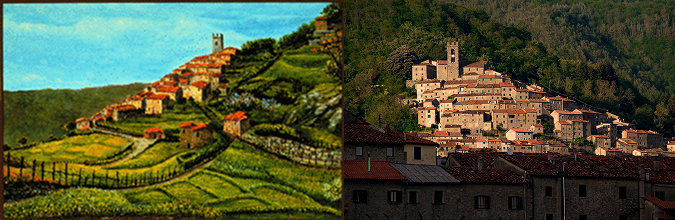
In the history of art and visual culture, spatial memory can be examined through the case of the artist Franco Manziani, as described by Oliver Sacks in his essay «Paintings of His Dreams.» In it, the neurologist-writer recounts a rare example of how the memory of a place begins to function almost like internal sight: a long-abandoned village returns to the artist in detailed images and gradually becomes the primary subject matter of his paintings. His works can be viewed as an attempt to retain a space that is no longer physically present but is preserved within memory with extraordinary force. Here, painting becomes a means of restoring visibility to a place and giving a material form to an internal image.
For a theoretical foundation, I examine the work of the Soviet psychologist and neurologist Alexander Luria, «The Mnemonist’s Mind.» In it, memory is treated as a system of images, associations, and internal connections. Luria describes memory as a complex imagistic structure where one impression hooks onto another: a sound can evoke a color, a word a visual scene, and a detail an entire space. In my research, the idea that memory is constructed through visual and sensory anchors—color, shape, arrangement, detail, emotional state—is particularly crucial. Space in memory is not stored as an exact copy. It is reconstructed; sometimes a single detail is retained with almost photographic clarity, while another is erased entirely.
Visual exploration of spatial memory is built upon four main pillars: Color—what often remains in memory as the emotional tone of a space. Emotion—the feeling of a place, which can be stronger than the precise layout. Detail—a specific object remembered most clearly. The recall process—documentation of brain activity and internal sensations.
Key question:
How does visual memory encode space differently depending on the duration of stay, age of perception, and the emotional significance of a location?
Hypothesis: I hypothesize that when space is transferred from memory onto a drawing, the memory will display its selectivity: some details will disappear or shift, while color, emotion, and isolated visual fragments will form the basis for reconstructing the image of the place.
[2]Oliver Sacks and an Essay on Franco Manzini
Visual and spatial memory can be examined through the phenomenal case of the artist Franco Maniani, as described by Oliver Sacks in the essay «The Landscape of His Dreams» from the book Anthropologist on Mars. Maniani was born in the Tuscan village of Pontito, later left Italy, and lived in the United States for many years. Despite his physical distance from his hometown, Pontito became the main and almost sole subject matter of his paintings. Sacks describes Maniani as an artist of memory: his images arose not from direct observation, but from an internal vision of the place—a place that continued to exist in his consciousness with extraordinary detail.
The case of Manniani is important to this study because it demonstrates memory not as passive storage of the past, but as an active visual mechanism. His Pontito is not merely recalled—it returns as a space into which the artist can seemingly re-enter with his gaze. Saks described in an interview that Manniani’s memories «consumed him”—“his memories consumed him.» This is a crucial formulation: memory here functions almost as an obsessive presence, rather than a tranquil recollection of the past.
It is particularly striking that Mannyani’s paintings were compared to Pontito’s photographs taken from the same viewpoints. At the exhibition The Memory Artist in Exploratorium, his picturesque views of Pontito were juxtaposed with photographs of the village, and Sachs noted the «astonishing accuracy» of these images. For my research, this moment becomes methodologically significant: photography can serve not as a way to test whether memory works «correctly» or «incorrectly, ” but as material for comparing documentary space and inner image. In Mannyani’s work, this comparison demonstrates that memory can be simultaneously subjective and surprisingly precise.
However, in the case of Manyani, it is important to consider not only accuracy but also the emotional nature of the memory. Pontito was connected to childhood, loss, emigration, war, and a break from his former life. Biographical materials about Manyani state that during World War II, the village experienced Nazi occupation and destructive events; furthermore, Manyani lost his father in childhood. Therefore, his memory of the place should not be understood as a neutral «photographic» ability, but as an emotionally charged reconstruction. The space becomes vivid not only because of visual memory but also because of the experiences that were imprinted upon it.
Sax dedicates a separate section to the medical explanation of the Manzoni phenomenon. After moving to the U.S., the artist suffered from a severe illness characterized by high fever, seizures, and exceptionally vivid dreams of Pontito. In one interview, Sax speaks of a «kind of memory epilepsy”—“an epilepsy of memory”—linking Manzoni’s case to possible temporal lobe epilepsy. In another source, Sax describes how, upon waking, the images of Pontito remained with Manzoni with complete depth and reality, „like holograms.“
For the research, it is important not to delve too deeply into the diagnosis, but to capture the principle itself: for Manyani, memory functions like a visual experience. It doesn’t simply tell him what a place looked like; rather, it seems to re-inhabit it. This leads to the connection with spatial memory: the artist does not recall Pontito as a separate facade or a single view; he reconstructs the village as a volumetric environment—with streets, houses, stone, perspective, turns, and viewpoints.
Mianni’s paintings can be viewed as an attempt to translate an internal three-dimensional space onto a two-dimensional plane. In memory, a village can exist as a volumetric model: the artist seems able to move mentally within it, change perspectives, and observe details. But painting demands choices—which fragment to bring out, which angle to fix, and which details to make visible. This is precisely why his work is important for my project. It demonstrates that an image recalled from memory is not simple reproduction, but rather reconstruction: memory selects, emphasizes, refines, and materializes space.
Visually, this chapter can be enhanced with two types of materials: photographs by Pontito and reproductions of Mianni’s paintings. It is particularly important to showcase pairs of «painting—photograph, ” if images with a similar point of view can be found. This juxtaposition will allow viewers to see how memory transforms a real place into a stable artistic image. Within the context of my research, Mianni serves as a starting point: through him, one can discuss space that is physically absent yet continues to live inside a person as a detailed, emotional, and almost obsessive visual model.
[3]Alexander Luria — «The Mnemonist’s Mind»
A second theoretical pillar of this research is Alexander Luria’s book, «The Mnemonist Mind.» Luria describes the phenomenal memory of Solomon Shereshevsky—a person who memorized vast amounts of information through vivid images, associations, and synesthetic connections. This text is important to my research not as a direct example of remembering an apartment or a city, but as a model of how memory can be constructed through visual and sensory anchors. Britannica describes Luria’s subject as having synesthesia—a state where a stimulus from one sense evokes experiences in another sensory domain.
For Luria, memory is not a dry repository of facts. It operates through images, scenes, colors, sensations, and relationships between objects. In Shereshevsky’s case, a word, sound, or number could evoke a visual image, color, texture, or an entire internal scenario. In this sense, his memory was not abstract but almost «spatial»: information was placed within imagined scenes and held through internal visual constructs. This is relevant to my research because a space can also be recalled not entirely, but through a set of anchors—the color of a wall, the light from a window, the position of the bed, the floor’s texture, or an emotional state.
Through Luria, memory can be described as a binding process. A recollection is sustained not only by what a person saw, but also by how it was experienced. For example, a color might be remembered alongside anxiety, light alongside a sense of safety, or a specific object alongside a moment of transition or an event. Therefore, in a memory drawing, the elements that are not the «most important» from an architectural perspective might surface—but rather the ones most emotionally charged. A detail becomes an anchor: through it, the entire space is reconstructed.
If Sachs provides an artistic example of memory that retrieves a lost place, then Luria helps describe the mechanism of that memory. The internal image is composed of associations. It can be very precise in one fragment and almost blank in another. One part of the space is recalled clearly because it is connected to a strong feeling or visual focus. Another part disappears because it lacked emotional or visual anchors. This is why memory often functions unevenly: a person might remember the color of the curtains but not the door’s placement; they might remember the corner of a room but not reconstruct the entire floor plan.
This idea can be linked to modern concepts of spatial memory. Cognitive psychology features the concept of a cognitive map—an internal representation of space that helps a person navigate, recall routes, and connect objects to one another. Contemporary research links this ability to the function of the hippocampus and adjacent brain regions: place cells help encode location, while grid cells participate in creating an internal coordinate system.
For visual research, this can be translated into simpler terms: a person stores a place not just as an image, but as an internal schematic. Remembering an apartment might include the route from the entrance to a room, the sense of distance, the location of windows, doors, and furniture, and the direction of light. However, this internal schematic is not necessarily accurate. It can become distorted, simplified, or lose connections between parts of the space. Therefore, when attempting to draw an apartment from memory, a strange effect can occur: the space seems to exist volumetrically in the mind, but on paper, it begins to fall apart. Some details become clearer, others vanish, and missing parts must be reconstructed through logic.
Spatial memory is studied through various objects and situations. In psychology and neuroscience, these can include mazes, routes, virtual environments, floor plans, urban landmarks, familiar rooms, and navigation or object-placement recall tasks. In artistic research, such objects can be memory drawings, maps, diagrams, photographs, personal archives, apartment plans, or interior fragments. For my project, what is particularly important are not laboratory tests, but the visual traces of memory: drawings, photographs, and documentation of the recall process.
In the practical section, I will draw upon three types of spaces: the childhood apartment, the apartment of conscious temporary living, and the one-night apartment. Through these, one can observe how memory shifts depending on the duration of stay, the age of perception, and the emotional significance of the place. The childhood apartment may be recalled through atmosphere, individual objects, and bodily sensations. The temporary living apartment is recalled through habitual routes and daily details. The one-night apartment is recalled through a vivid fragment—light, color, anxiety, a random detail, or the sensation of another person’s space.
Thus, Luria helps us view memory as a system of images and associations, while modern models of spatial memory function as a system of internal orientation and mapping. Together, they provide a language for analyzing memory drawings. I can look not only at whether the drawing matches a photograph, but at which elements memory selected, which it amplified, which it lost, and which it reconstructed in the very process of depiction. In this sense, the drawing becomes not an illustration of the memory, but a method for exploring its structure.
[4]memory drawings — my personal practice
In this section, I draw upon my own visual memory, treating drawing as a method for reconstructing memories of space. I am interested in how the internal image of a place is transferred onto paper: what remains most distinctly, which details disappear, what elements emerge during the act of drawing, and how the memory itself changes when I attempt to depict it.
For this analysis, I have selected three spaces connected to different periods of my life: the childhood space, the youth space, and the space of a brief stay. These locations differ in the duration of my stay, the degree of emotional closeness, and the nature of the memories. Having been away from my hometowns for two years, some of these places have begun to resurface particularly often. In my memory, they manifest through color, light, individual objects, the sensation of a room, and the emotional state associated with that space.
1| childhood apartment
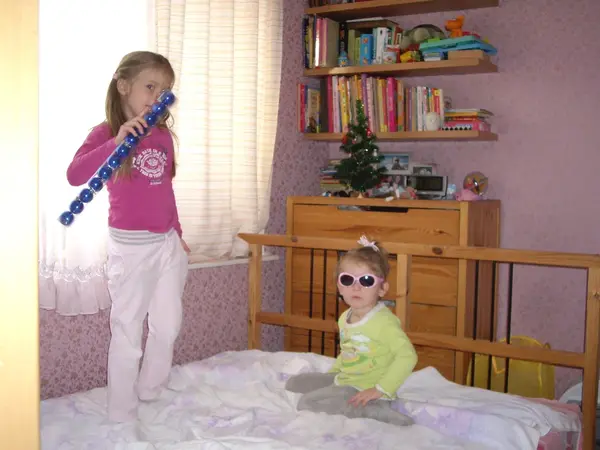
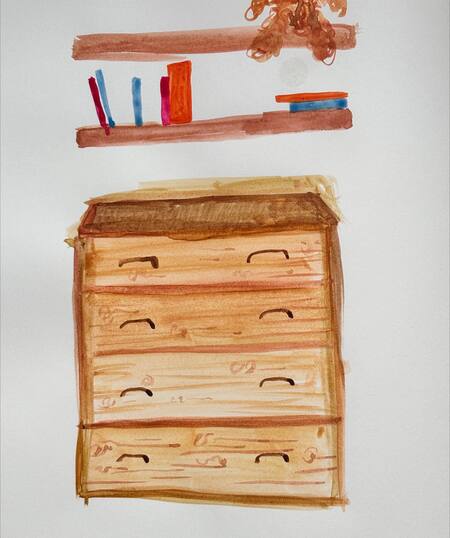
One distinct childhood memory involves a traumatic incident: at age three, I almost knocked over a chest of drawers onto myself. This event remains particularly vivid in my memory, so I recall the chest’s placement with considerable certainty.
This drawing became one of my first attempts to capture a spatial memory. In this instance, the place is recalled through an event: it is not the entire room, but a specific object and its positioning that become the central point of memory.