Concept
This study examines the functions of silence in performance practices from the second half of the 20th century into the early 21st century. In recent decades, silence has ceased to be a marginal phenomenon in art and has transformed into an independent artistic strategy. However, existing research often focuses solely on music or treats silence exclusively as a metaphor for absence. In this work, silence is of interest not as an image, but as a tool employed by different artists to achieve various objectives.
The objective of this research is to identify the functions of silence in performance, installation art, and architectural practices.
To achieve this goal, the following objectives are set: first, to articulate the directions of «foundational» works that established the possibility of discussing silence as an artistic material; second, to analyze the evolution of approaches to silence; and third, to compare classical strategies with contemporary practices.
«Silence often signifies a form of protest that a person cannot express directly; instead, they merely imply it, while voicing the exact opposite opinion.»
Regarding the research hypotheses, the first one posits that the function of silence has historically transformed. It is hypothesized that the author’s dialogue with the observer carries a different intonation due to societal changes over time. Furthermore, there is a premise that the viewer’s responsibility in performative practice evolves over time. The second hypothesis suggests that silence becomes a tool for expressing entirely different themes. This is due to the inherent neutrality of this technique, which implies freedom in its use and interpretation. There is also the idea that silence carries something intrinsic, and this emotion may be similar among people who share a common cultural code.
The research questions include an inquiry into whether silence, as the absence of sound itself, is neutral or if it already conveys a combination of emotions. Another question of interest is whether this emotion is collective or individual to each person.
The study utilizes works from diverse genres—ranging from classical musical avant-garde to installations and contemporary architecture. The breadth of the sample is justified by the nature of the phenomenon itself: silence does not belong exclusively to music or theater; rather, it operates at the intersection of mediums, and its function can only be understood through a comparative analysis of heterogeneous practices.
One investigation compares the early and late works of a key author, examining Cage’s tradition alongside the newest Russian and Western practices from recent years. This reveals not a rupture, but a lineage: contemporary artists inherit the traditions of the avant-garde, but they transform its ideas into a language addressing social and ecological themes.
The 20th Century: Foundation
«4’33»» (1952, John Cage)
Silence as a Paradox
Cage exposes the impossibility of silence. He demonstrates that silence is always a projection.
Silence is a vessel that fills with surrounding sounds.
Score of John Cage’s 4'33»
Silence can be conceived as a container, where the formal duration of the work and the performer’s gestures are the only elements that establish structure. Incidental events occurring in the space become the content.
Abramovich approaches silence not through paradox, but through limit.
The Voice Freed (1975, Marina Abramović, Ulay)
«The artist’s task is to create an image, an energetic connection, that leaves you no choice—that makes it impossible not to be 'here and now, ' in this space, with the person who is addressing you. And then nothing else remains in your consciousness—only 'here and now.'» (Marina Abramović)
The silence in Abramovich—it is not a philosophical category. It is connected to a physiological limit, to the restriction that the artist’s body imposes.
How can a musical piece relate to silence?
Morton Feldman’s work, «Rothko Chapel,» is unique in its use of silence as a composition. It is, in essence, like John Cage’s «4′33″.» However, there is a connection to Cage: Feldman was a close friend of Cage, which explains the similar perspective.
«Rothko Chapel» (1971, Morton Feldman)
In Feldman’s work, silence enters into a dialogue with sound. The pauses are not empty; they acquire a discernible pattern: the longer the silence lasts, the more richly it feels.
Pauses are interspersed with notes—they are equal partners.
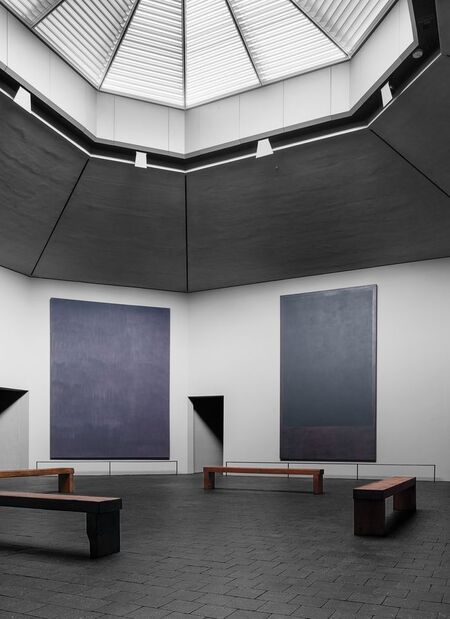
Feldman’s piece was created to be heard in conjunction with Rothko’s paintings. This allows one to follow the idea both auditorily and visually.
Similar to the splashes of paint on the empty canvas in Rothko’s paintings, silence is the foundation of the work: notes are interspersed with silence, rather than the other way around. (Peter Quantrill, 2002)
Returning to the comparison of silence with Cage’s vessel, the contents of this vessel are both the sounds within the piece itself and incidental sounds in a chapel, such as creaking floorboards or the listener’s breath.
Rothko Chapel
Another example of using silence is the work, «Sound of Melting Ice.»