Visual Research Concept
Chess is one of the few games where a complex system of relationships lies hidden behind seemingly simple rules. Six types of pieces, divided into two opposing sides, create a hierarchy in which each piece has a specific value, capability, and purpose. Although all pieces occupy the same playing field, their position within the system is unequal.The history of chess is closely tied to the history of social order. Originating in India as the game Chaturanga, which reflects the structure of an army, chess gradually spread across different countries and cultures, changing its appearance and rules. In Europe, the game adopted features of feudal society—the king, queen, clergy, cavalry, and infantry appeared on the board. Consequently, chess pieces began to be perceived as symbols of social roles and statuses.
Chaturanga Game
It is especially interesting to examine the internal hierarchy of chess. The King occupies the highest position, yet he is restricted in movement, vulnerable, and dependent on the protection of the other pieces. The Queen has slightly more freedom of action and can influence virtually any part of the chessboard. On the other hand, the numerous pawns have limited capabilities and often become exchangeable resources during the game to achieve a specific goal. Thus, a piece’s value is not always determined by its individual characteristics. That is, even the most powerful piece cannot exist outside the overall system.At the same time, chess allows for a change in the usual order. A pawn, initially holding the lowest position in the hierarchy, can transform into a Queen or another piece upon reaching the opposite edge of the board.
Given these guidelines, a question arises: to what extent is a participant’s status determined by their initial role, and can they change their own status independently?
As part of my research, I examine the chessboard as a metaphor for a societal model that reflects the principles of social inequality, power distribution, subordination, and the struggle for status. Through the game’s history—the evolution of the pieces, their functions, and the rules of interaction—I investigate how the game’s rules create social hierarchies. Special attention is paid to the contradiction between individual potential and the game’s overall structure: can a piece transcend its assigned role, to what extent is its value determined by its position within the system, and who truly dictates the unfolding of events—the player or the rules to which everyone is subject?
Chapter 1. Play as a Reflection of Social Structure
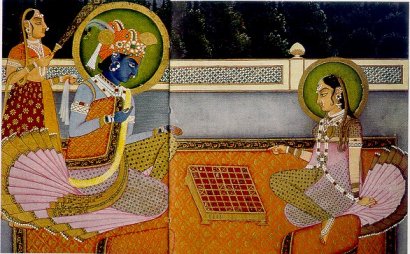
Chess evolved from earlier board games, one of which is the Indian Chaturanga, known since the 6th century. Its name is linked to the composition of ancient Indian armies: infantry, cavalry, war elephants, and chariots. The exact same structure is traceable in the composition of chess pieces—they differ in function and capability, and their movements adhere to the general rules of the game [1].
«Chaturanga Party,» circa 1805–1815. India
After chess spread to Persia, the Arab world, and Europe, the names and appearances of the pieces changed. However, the underlying system maintained the principle of role distribution: each piece possessed specific capabilities and occupied its designated position on the board. Consequently, chess represented a competition between two players within an ordered system of interactions.
During the Middle Ages, chess helped people understand the structure of society. One such example is the treatise by the Italian monk Jacobus de Chessolis, created in the 13th century. The author described the chessboard as a model of an ideal society, where each piece and pawn corresponded to a specific social role.
Jakob’s De Chessolis Manuscript, «A Moralized Game of Chess,» University of Chicago Library
The King and other major pieces symbolized power and the aristocracy, while the pawns represented ordinary people: peasants and artisans. Furthermore, each participant’s position was defined by their duties and place within the larger system. Chessole emphasized that no representative of the social order can exist in isolation. [2] This example demonstrates how the chess metaphor was utilized to explain social hierarchy, principles of subordination, the distribution of responsibilities, and the interaction among different strata of society.
Yakobus de Chessolis' Manuscript, «A Moralized Game of Chess, ” University of Chicago Library
It turns out that chess is like a model of society. Through it, one can understand how the hierarchy is structured, who holds power, why everyone has different opportunities, and how everything depends on one another.
Chapter 2. The Architecture of Chess Hierarchy
The chessboard is a system where all pieces adhere to unified rules, yet each initially possesses different capabilities. Each piece has a specific mode of movement that defines the boundaries of its action. The Queen can move vertically, horizontally, and diagonally; the Rook moves vertically and horizontally, and the Bishop moves diagonally. The Knight has a unique method of movement, the King is restricted to one square, and the Pawn can only move forward [3].
Thus, a piece’s position is determined by its inherent function. Even if two pieces occupy equally advantageous positions, their capabilities will differ depending on the type of piece.
Chess set from Nishapur, 12th century, Iran
Chess pawn from Nishapur, 9th–12th century, Iran
Chess pawn from Nishapur, 9th–12th century, Iran
Differences are also evident in the historical design of chess sets. For instance, in a 12th-century set from Nishapur, the king is depicted as a throne, the queen as a smaller throne, the knight as a stylized horse head, and the pawns as small geometric forms. Despite the abstract nature of the imagery, the pieces retain distinct visual characteristics that emphasize their unequal roles within the game system.
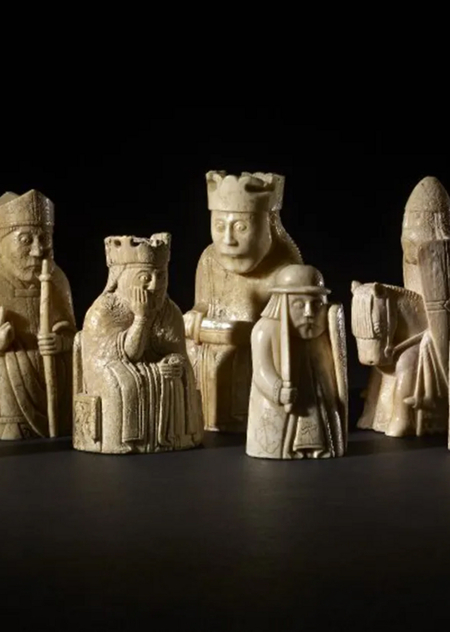
Medieval chess pieces from the Lewis hoard, Late 12th — Early 13th Century, Norway
Medieval chess pieces from the Lewis hoard—Rook or Castle—late 12th–early 13th century, Norway
But such a system does not define the significance of a particular piece. Its value depends on where it is placed and the situation that has developed on the board. For example, a pawn can be decisive for the outcome of a game, despite its low value. The queen can move almost anywhere, but its loss does not always mean defeat. The king has limited mobility, but its safety determines the possibility of continuing the game. This shows that value and influence do not always coincide. Even if a piece has many options, it does not always decide the outcome of the game. And a piece that seems to have an insignificant role might prove crucial for achieving victory.
Bishop chess piece, 1150–1200, Norway
«The simplest way to distinguish the figures of the adversaries is by color. Although paint traces might have been visible when the figures were discovered, they are no longer apparent today. Scientific analysis of some figures revealed traces of mercury. This suggests that some of them were once painted red using cinnabar (mercuric sulfide).» [4]
Knight chess piece, c. 1250, England, Walrus ivory
Knight chess piece, circa 1250, England, Narwhal tusk
Thus, we can examine the chess hierarchy through the distinction between formal status and actual influence. A piece’s position sets its initial capabilities, but it does not entirely determine its value in a specific situation.
Chapter 3. Power and Dependence