
In contemporary advertising communication, viewer attention has become one of the most critical resources. Every day, people are exposed to a vast quantity of visual messages, most of which go unnoticed. In an effort to stand out from the competition, brands employ various techniques to capture attention: unconventional imagery, humor, emotional narratives, and provocation. Shock advertising has become one of the most radical tools, intentionally violating the viewer’s preconceived expectations and eliciting a strong emotional response.
Of particular interest in this context are the advertising campaigns of the Italian brand United Colors of Benetton, created during their collaboration with photographer Olivier Toscani. Instead of the traditional display of clothing, the brand used imagery that addressed pressing social issues: racial prejudice, religion, illness, death, and societal taboos. This strategy transformed commercial advertising into a space for public discourse and challenged conventional perceptions of what an advertising message should be.
The selection of this topic stems from an interest in the psychological mechanisms through which visual images capture attention and shape emotional responses to what is seen. The Benetton advertisements serve as illustrative material for studying these processes, as their impact is built not so much on showcasing product benefits as on confronting the viewer with an unexpected, contradictory, or emotionally charged image.
Primary Research Question: How does the violation of social and visual expectations in United Colors of Benetton advertising capture the viewer’s attention and influence the perception of the advertising message and the brand itself? Research Hypothesis posits that shocking imagery can amplify advertising attention by disrupting expectations and causing emotional arousal; however, the intensity of the emotional response does not guarantee a positive attitude toward the brand. Furthermore, in certain instances, provocation can lead to rejection and hinder the reception of the commercial message.Research Goal: To identify the core psychological mechanisms of provocative Benetton advertising and to evaluate the advantages and limitations of this type of communication strategy.
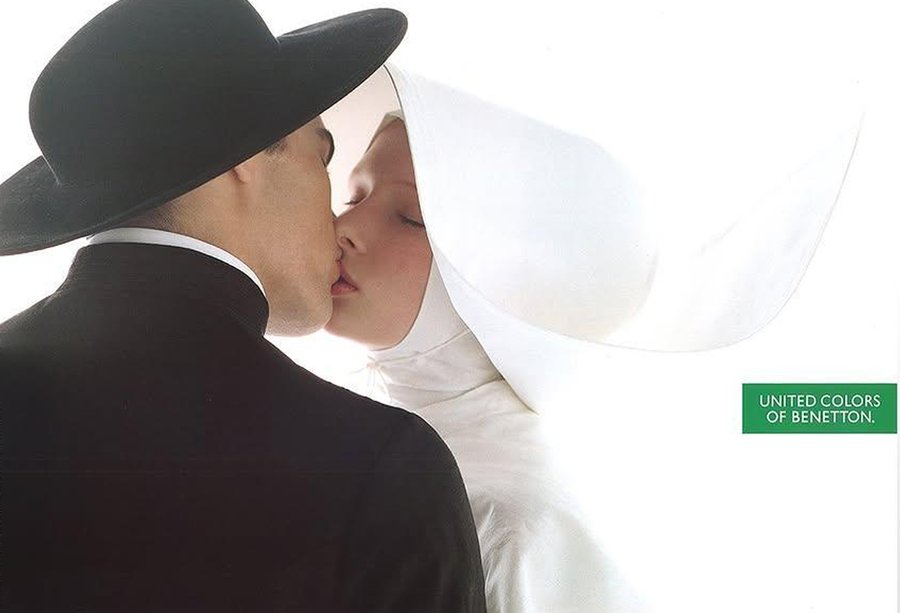
Four advertising images were selected as visual material: a priest and nun kissing (1991), a photograph of a newborn baby (1991), an image of AIDS activist David Kirby dying (used in advertising — 1992), and a composition of three anatomical hearts (1996). These works demonstrate various ways of influencing the viewer: challenging social norms, engaging physiologically sensitive imagery, evoking emotional empathy, and utilizing visual paradox.
The principle guiding the material selection is not the degree of sensationalism in the images, but the diversity of the potential psychological mechanisms through which they exert influence. By comparing the chosen examples, we can determine which visual and semantic strategies are employed to capture attention and how the nature of the emotional stimulus might affect the interpretation of an advertising message.
Advertisement for United Colors of Benetton, photographer Oliviero Toscani
The research will examine perceptual psychology concepts such as selective attention, expectation violation, emotional arousal, cognitive conflict, and associative links. Special attention will be paid to the relationship between capturing attention, message recall, and brand attitude formation. These processes will be treated as interconnected yet not identical.The methodological foundation of the work will consist of visual and comparative analysis of advertising imagery, an investigation into the historical and social context of their appearance, and a review of scientific literature on perception psychology and advertising impact. For each example, the key visual decisions, the hypothesized mechanisms of psychological influence, and the potential limitations of the chosen approach will be highlighted.It is crucial, however, to distinguish the author’s interpretation of an image from substantiated data regarding audience reaction. Visual analysis alone does not allow for a reliable determination of an advertisement’s commercial effectiveness. Therefore, conclusions regarding actual impact will be based on available documentary evidence and studies, or treated as reasoned hypotheses if such data is absent.
The structure of the research follows a principle of moving from the general to the specific. The first part examines the characteristics of Benetton’s advertising strategy and the historical context of the brand’s collaboration with Oliviero Toscani. Subsequently, the psychological mechanisms underlying the shock factor are revealed. The main body consists of a sequential analysis of four advertising images, followed by a comparison of the techniques employed. The conclusion will present findings regarding the initial hypothesis and explore possible ways to mitigate the negative consequences of provocative communication without sacrificing its expressiveness.
Thus, this research aims to understand how design and conceptual choices can guide an audience’s attention and emotional response. Using Benetton as an example, we intend to show that the ability of an advertisement to provoke a strong reaction does not automatically equate to its unequivocal effectiveness. A critical criterion is not just the visibility of the image, but also how well the emotions and associations evoked in the viewer align with the brand’s communication objective.
Three Hearts, 1996, Oliviero Toscani
Traditional clothing advertising typically showcases the product itself, its features, or the lifestyle the consumer should associate with. In the United Colors of Benetton campaigns, created with the involvement of Oliviero Toscani, this logic was radically reimagined. Instead of clothing, the audience was presented with images related to racial differences, religion, illness, death, and social conflicts. The product ceased to be the main focus. A societal issue took its place, and the connection to the commercial brand was established through the United Colors of Benetton logo.
This approach allows us to pose an important psychological question: what happens when an advertisement’s image evokes emotions unrelated to the advertised product?
Advertising as a Violation of Expectations
Let’s examine a famous 1991 advertisement depicting a kissing priest and a nun.
Within it, a conflict arises between the religious symbolism, which implies certain behavioral norms, and the intimate gesture, which violates those expectations.
This very contradiction becomes the central element of the advertising message.
The viewer is confronted not with a familiar consumption scenario, but with an image that demands interpretation. Questions arise: Why are these characters depicted together? What does their kiss mean? What is the relationship between the scene and the clothing brand?
From the perspective of perception psychology, the following sequence can be hypothesized:
Generated by AI for educational purposes
Important Distinction: an unconventional image can capture attention, but on its own, it does not guarantee the correct understanding of the message or a positive perception of the advertiser.
The history of the collaboration between Benetton and Oliviero Toscani demonstrates that the transition to shock advertising occurred gradually.1984. Differences as Value. Toscani photographs children and young people of diverse ethnic backgrounds wearing Benetton clothing. Diversity becomes part of the brand’s advertising image.1989. Transition to Social Conflicts. More provocative images appear in the advertising, addressing racial relations and societal stereotypes.1991. Taboo Breaking. Campaigns featuring a kissing priest and nun, as well as a newborn baby, spark public debate.1992. Documentary Reality Instead of Staging. Benetton uses photographs by journalists focused on pressing social issues. Among these is a photo by Teresa Farr, taken by David Kirby.
This sequence highlights a significant shift: the brand is gradually moving its focus from the attractive image of the product to an emotionally rich message about the world.
Why This is Important for Advertising Psychology
Benetton’s advertising campaigns allow for the examination of three distinct outcomes of influence:
Attention: Does the viewer notice the image among other messages?
Recall: Is a connection retained between the image and the brand?
Attitude: What emotions and judgments does the viewer transfer to the advertiser?
Historical evidence suggests that certain Benetton campaigns have indeed sparked protests, criticism, and public debate. However, this does not yet prove their positive impact on consumer behavior.
The distinction between advertising visibility and its efficacy will form the basis of further research.
Benetton utilized advertising space not only to showcase products but also to present the audience with socially significant and emotionally charged images. Based on the reviewed materials, it can be assumed that provocation helped the brand stand out from conventional clothing advertisements. However, the ambivalent public reaction indicates that capturing attention is not equivalent to achieving positive perception. This leads us to the following question: why can an unexpected and emotionally charged image capture a person’s attention?
Shock Psychology: Why Provocation Grabs Attention
Violation of ExpectationsReligious imagery is associated with specific behavioral norms. The kiss between the priest and the nun contradicts these norms.
The potential effect is surprise and a shift in focus toward the unusual scene.
Contrast of ExpectationsOne image conforms to the conventional language of fashion advertising. The other disrupts it by presenting physiological reality.
Unexpectedness can capture attention, but the subsequent reaction depends on the viewer’s personal experience and attitude toward the image.
Emotional Arousal
David Kirby’s photography addresses themes of suffering, death, and human vulnerability.
Such imagery can evoke sympathy, anxiety, or discomfort. However, the power of the experience alone does not prove advertising effectiveness.
Visual Paradox
Three almost identical hearts are labeled White, Black, and Yellow.
The contradiction between racial categories and anatomical similarity invites the viewer to independently formulate the concept of human equality.