Navigation
— Concept
— Who owns the female body?
— Clothing as the uniform of a new society
— The state permits femininity
— The national dress: a politics of fabric and tradition
— Conclusion
— Bibliography
Concept
Can a dress be a political statement? At first glance, clothing is a very personal matter. Some choose a dress for a beautiful silhouette, others for comfort. But in the 1920s and 1930s, women’s wardrobes were influenced by politics more than one might initially assume.After World War I, Europe underwent massive transformations. Old social orders were disintegrating, women were increasingly entering the workforce, and perceptions of beauty and femininity were shifting. Short skirts, flowing dresses, bare arms, and the rejection of the corset became not merely fashion trends, but part of a new way of life. However, not all nations were ready to embrace such freedom.In the Soviet Union, Italy, and Germany, clothing gradually became a tool for shaping a new society. The states envisioned the ideal woman differently, but all understood the significance of her appearance. Through silhouette, fabric, hemline, headwear, and even hairstyle, certain values could be communicated.It is particularly interesting that the political influence on fashion was not always expressed through direct prohibitions. Sometimes it was conveyed by creating new dress archetypes, supporting national production, or disseminating specific imagery in magazines and posters. As a result, a dress could articulate politics just as effectively as an official slogan.
The main object of study is Soviet women’s fashion of the 1920s and 1930s. However, to gain a deeper understanding of the changes that occurred, it is necessary to compare it with the fashion of fascist Italy and Nazi Germany. This comparison reveals that the state’s drive to influence women’s appearance was not an exclusively Soviet phenomenon.
In the USSR, following the 1917 Revolution, the former system of social stratification underwent a major reassessment. Luxurious fabrics, intricate ornamentation, and overtly opulent dresses gradually came to be associated with the pre-revolutionary and bourgeois lifestyle. Practicality, simplicity, and functionality moved to the forefront. A woman was expected to be not only a mother and wife but also a worker, an active participant in public life, and a part of the new collective.
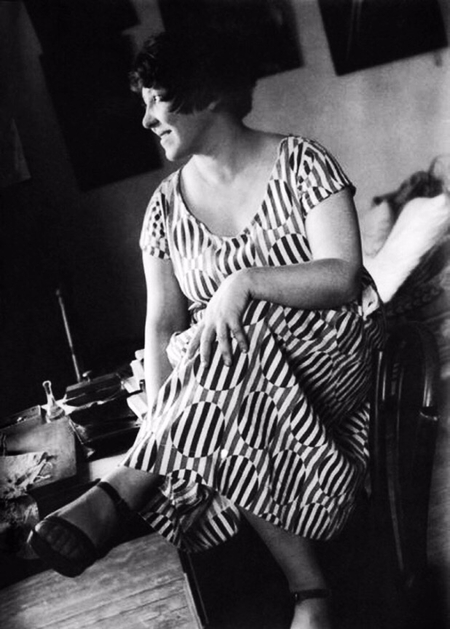
At the same time, constructivist artists Varvara Stepanova and Lyubov Popova attempted to fundamentally change the principle of clothing design. Their projects featured geometric shapes, unconventional fabric patterns, and functional tailoring. Clothing ceased to be merely an adornment of the body. It needed to enable a person to move, work, and live within the new rhythm. But to what extent did these projects truly become part of the daily lives of Soviet women? And why did the ideal constructivist suit differ so drastically from what could be seen on an ordinary city street?
The research will be built around three core questions: What kind of woman did the state wish to portray? By what means did it attempt to shape her external appearance? And how closely did this image align with real life?
Special attention will be paid not only to political posters and fashion illustrations but also to the garments themselves. It is important to consider how the proportions of the female figure evolved, why a loose silhouette was welcomed in some instances while a defined waist was preferred in others, how folk motifs were employed, and why broad shoulders could become a symbol of strength and discipline.
Ultimately, women’s clothing of the 1920s–1930s will be presented not merely as a reflection of fashion trends, but as a kind of map of political expectations. Behind the simple work dress, the geometric ornamentation, the national costume, or the fitted jacket lie different conceptions of what a woman should be and what place she should occupy in society.
Whose body is it?
1
1