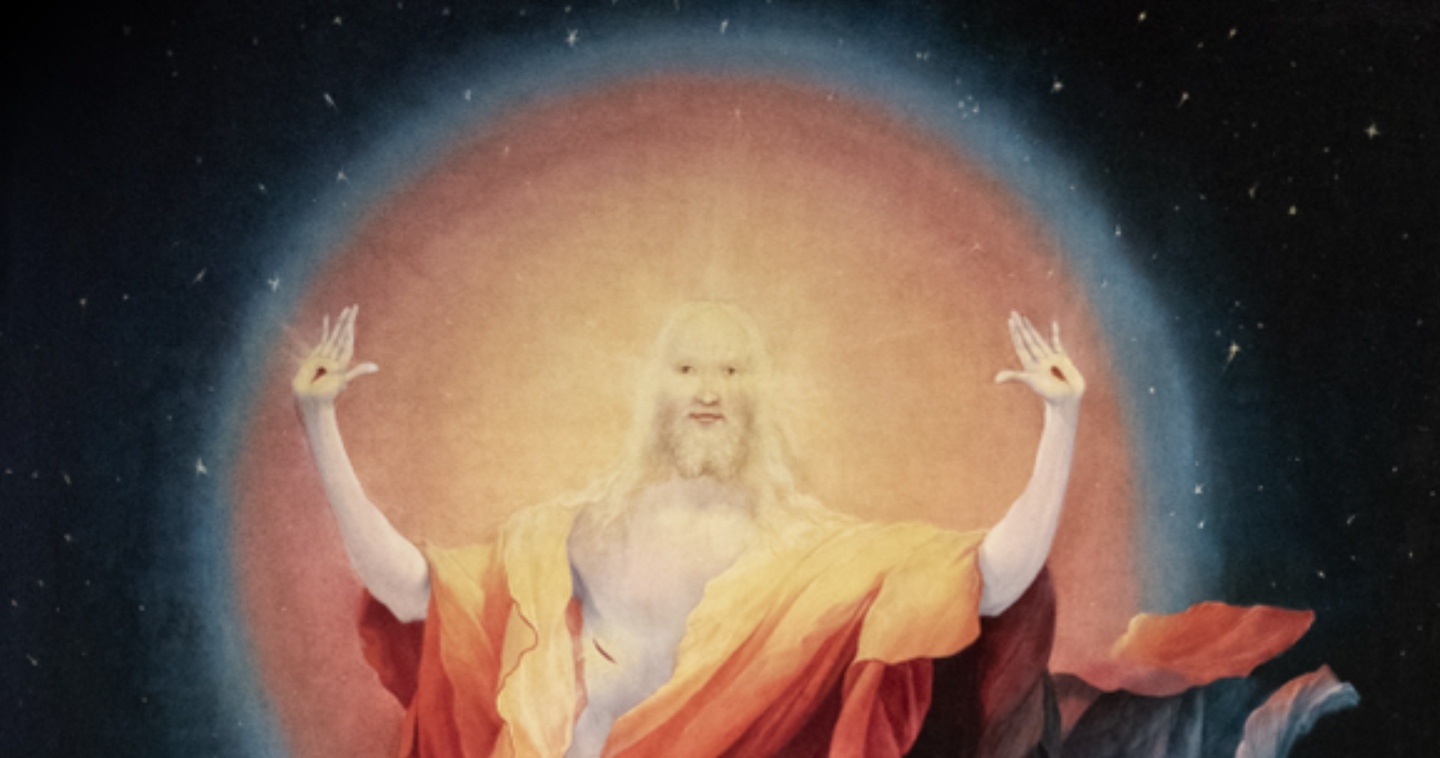
Средневековые мотивы в творчестве Маттиаса Грюневальда
Sections
I. Concept
II. Main Body
Chapter 1. Unity of Meaning
Chapter 2. Space and Composition
Chapter 3. Color Palette
III. Conclusion
Concept
In the late fifteenth century, European art underwent significant transformations. The Renaissance replaced the medieval traditions and canons. Artists mastered new ways to depict light, sought to portray the human figure with anatomical accuracy, and conveyed the depth of real space. Mythological and secular themes began appearing in art. In the Middle Ages, representation primarily served religious purposes: it conveyed Christian views of the world, emphasized the spiritual significance of events, and artists utilized a system of symbols understandable to the faithful viewer.The shift toward new artistic principles did not mean the complete disappearance of medieval traditions. This is particularly evident in the work of the German artist Matthias Grünewald (Matthäus Gotthard Nigert), a master of mystical effects, dynamic poses, and dramatic scenes, who worked in the early sixteenth century.
Key research question: what features and techniques of medieval art persist in the work of Matthias Grünewald, and how does the artist reinterpret them in the early sixteenth century?
While reading Ernst Gombrich’s The Story of Art, I developed an interest in the works of Grünewald and a desire to delve deeper into the subtle messages and symbols he embeds within his narratives. I was intrigued by how medieval art influenced his creativity, as I discovered parallels between the two that I plan to explore further. I wanted to investigate precisely which characteristics of medieval painting are preserved in his works and how they were transformed within the master’s artistic language.
Research Hypothesis: Matthias Grunewald’s work demonstrates a continuity of artistic principles from medieval art.
When selecting works for research, the primary criteria were their artistic expressiveness and their potential for comparison and contrast with Grunewald’s works. To study the topic, we selected art historical books, scholarly articles, and museum publications dedicated to medieval painting, Renaissance art, and Grunewald’s oeuvre. The main research method involved visual comparison of the works and an analysis of specific artistic solutions.
The religious genre of art remains relevant in our time—this research may be useful to many contemporary artists and iconographers.
Photo 1. Matthias Grünewald, Isenheim Altarpiece, «Crucifixion, ” 1506–1515.
Chapter 1. The Unity of Meaning
Medieval religious painting was not created solely to depict a biblical event. It was meant to help the viewer understand Christian doctrine, to pray, to contemplate faith, and to grasp the spiritual meaning of the image.
Grünwald retains this moral message.
His paintings also aim to evoke a religious experience in the viewer, to help them comprehend religious narratives, but the impact is achieved more allegorically: through especially expressive portrayals of suffering, symbols, and fantastic imagery.
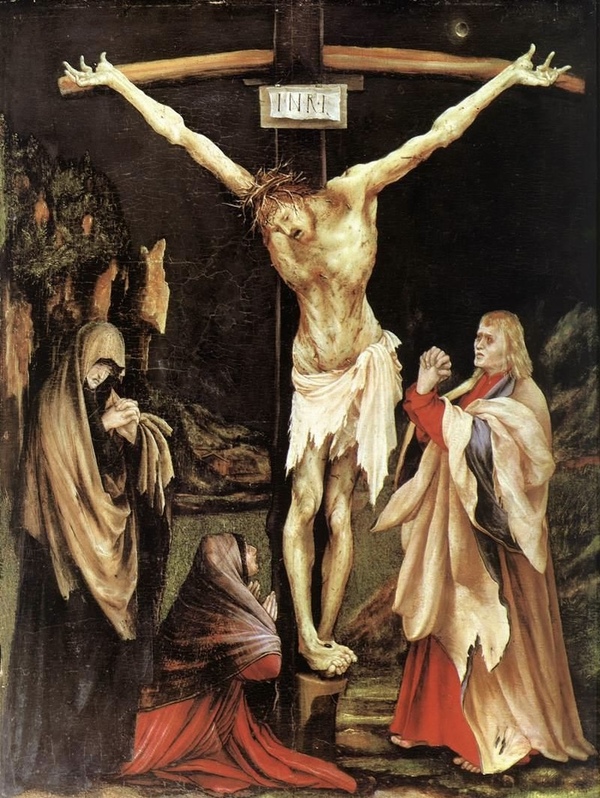
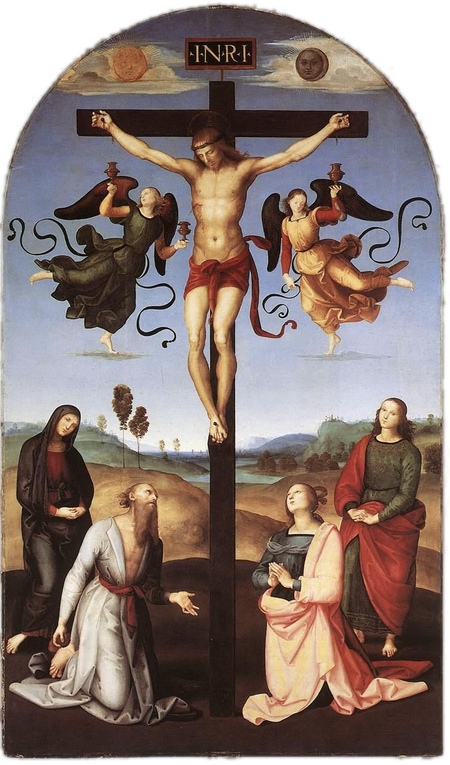
Photo 1. Matthias Grünewald. «The Small Crucifixion» c. 1511–1520. National Gallery of Art, Washington. Photo 2. Raphael. «The Crucifixion» (Mond Crucifixion) c. 1502–1503. National Gallery, London
To begin, let’s compare the works of Grünewald and Raphael, as the artists lived and created almost concurrently. We can see how vastly different their works are. Grünewald does not romanticize the image of Christ; instead, he vividly depicts perhaps unsightly suffering. In his work, Christ is a martyr—exhausted, with a mutilated body. Raphael, on the other hand, creates beautiful, spiritual images. The artists have different goals. Grünewald attempts to clearly illustrate the narrative and convey emotion. In this pursuit, he aligns with masters of the late Middle Ages: Giotto, Masaccio, and Cimabue. Raphael’s work, conversely, pleases the viewer’s eye and idealizes the images of saints.
Symbolism in Grunevald’s Work
In medieval art, objects, animals, gestures, and so on could possess an additional, hidden meaning. The viewer was expected to decipher and comprehend this symbolic significance.
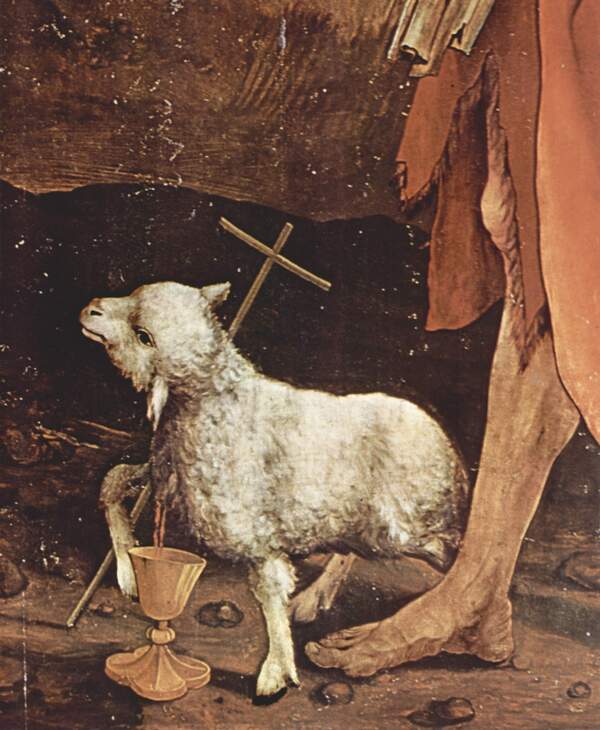
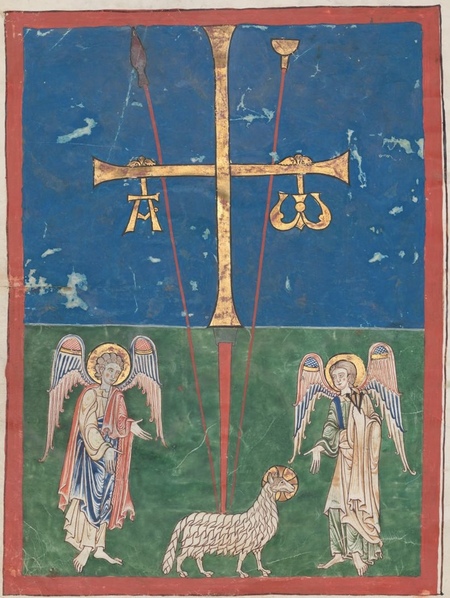
Photo 1. Matthias Grünewald, Isenheim Altarpiece, «Crucifixion, ” fragment with the Lamb of God, 1506–1515, Isenheim Altarpiece. Photo 2. Page from the Beatus Manuscript, „Lamb at the Foot of the Cross, ” c. 1180, Spain.
The Lamb—Christ’s Symbol. The medieval tradition of depicting Christ as the sacrificial Lamb persists in Grünewald’s paintings.
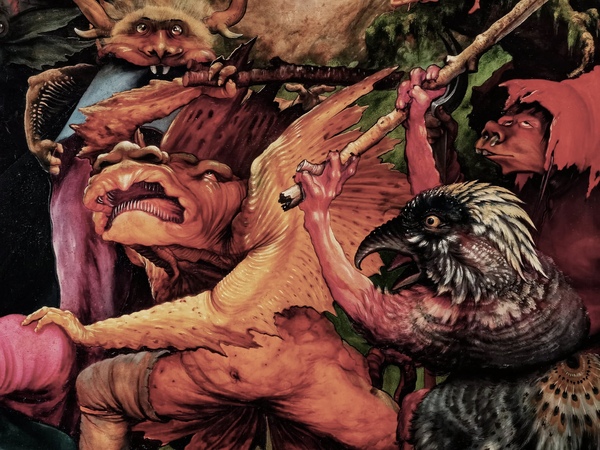
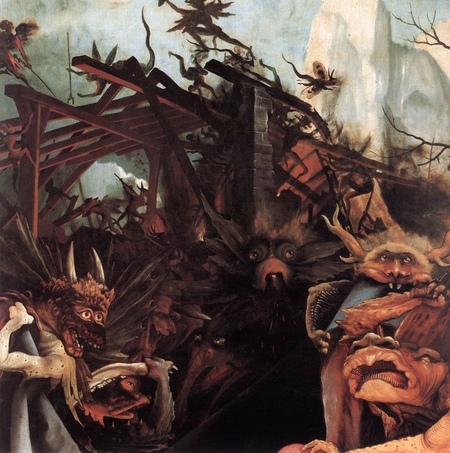
Photos 1, 2. Matthias Grünewald, Isenheim Altarpiece, «The Temptation of Saint Anthony, ” details (images of beast-demons)
Photo 1. Beatus from the Silos «Hell, ” 1091–1109. Spain.
In the miniature «Hell» from «Beatus from the Silos,» a world of sin and punishment is depicted. In addition to humans, we see fantastic creatures with unusual body structures: human torsos, clawed limbs, horns, and tails. Their appearance indicates their belonging to a supernatural realm, emphasizing their ugliness. In «The Temptation of Saint Anthony,» Grünewald also uses images of hybrid monsters, whose bodies combine human and animal characteristics. In the works analyzed, fantastic creatures become a visual embodiment of spiritual threat, simultaneously evoking feelings of fear and repulsion.
Chapter 2. Space and Composition
Figure Proportions: Size = Significance
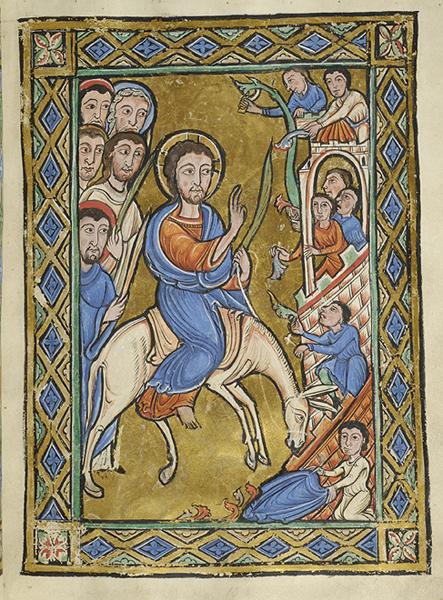
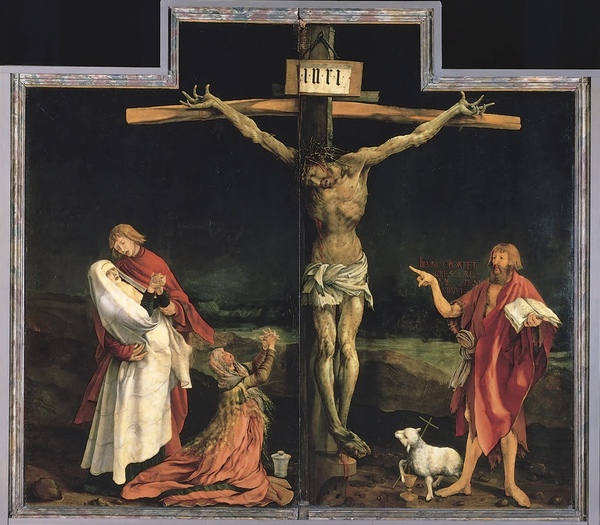
Photo 1. Bamberg Psalter, «The Entry of Christ into Jerusalem, ” circa 1220–1230. Germany. Photo 2. Matthias Grünewald, Isenheim Altarpiece, „The Crucifixion, ” 1506–1515.
In the Bamberg Psalter miniature, Christ is depicted significantly larger than the other figures in the scene. The people who greet Christ are scaled down in comparison. This is not a perspective error: the scale is meant to illustrate the importance of the characters. In Grünewald’s «Crucifixion, ” deliberate distortions of natural proportions are also present, with the difference in the size of Mary Magdalene’s and Christ’s arms being particularly noticeable. The artist also uses this technique to emphasize the significance of a specific figure—Christ.
Photo 1. Ingeminger Altar, Matthias Grünewald, «Crucifixion» 1506–1515.
Architecture as a method of spatial organization