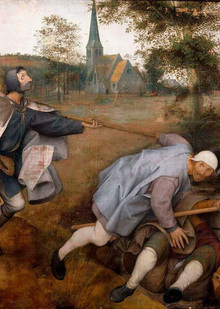
Pieter Bruegel the Elder, «The Census in Bethlehem,» 1566.
Introduction
The art of the Northern Renaissance, particularly the works of masters such as Hieronymus Bosch and Pieter Bruegel, is rightfully regarded as one of the darkest and most enigmatic sections in the history of painting. Their canvases are often imbued with complex, multi-layered symbolism, reflecting ideas about morality, religion, human nature, and fate—frequently hidden beneath vivid imagery and bizarre scenes. What complicates the deciphering of their intentions is that many of their symbols and motifs are rooted in the folk tales, folkloric traditions, and spiritual beliefs of the medieval Dutch. These cultural codes, passed down through generations, have since been lost or heavily distorted, making a direct understanding of the artists' intentions nearly impossible. Some symbols and allegories may possess contexts and meanings that will remain permanently inaccessible to contemporary researchers. Furthermore, the artistic style and the intricate allegorical language of Bosch and Bruegel frequently employ abstract and mystical motifs, which only deepens the mystery of their work. Their paintings evoke a sense that every detail contains hidden knowledge intended only for the chosen few—for those intimately familiar with the context of that era. Perhaps humanity will never fully uncover all the secrets of the great masters of the Northern Renaissance. Their works are like a looking glass that invites the viewer to contemplate and to search for their own answers. This lends their art a special magic and timeless significance, turning them into an endless wellspring of inspiration, mystery, and an artistic dialogue between generations.
Navigation
- Introduction
- Context: The Northern Renaissance
- Hieronymus Bosch 3.1. The Seven Deadly Sins and the Four Last Things 3.2. The Swineherd
- Pieter Bruegel the Elder 4.1. The Great Fish Eats the Small Fish 4.2. Dutch Proverbs
- Conclusion
- Sources
Northern Renaissance
The Northern Renaissance—the period of fine art from the 14th to the 16th centuries. Initially, the term encompassed territories north of the Alps, but it later spread to other European countries. Belonging to this term does not imply a geographic location; rather, it unites countries based on shared characteristics within a historical and cultural context. The art of the Northern Renaissance is characterized by stylistic heterogeneity, but the narrative remains consistent. Painting of that era was closely connected to religion, humanism, and popular culture. Naturalism and expressiveness became the foundation for representing the human figure; even biblical figures began to acquire features resembling real people.


François Clouet, «Equestrian Portrait of Francis I, ” 1540 / François Clouet, „Toilette of a Lady, ” 1571
Hieronymus Bosch
Hieronymus Bosch
Hieronymus Bosch—Eroon Antonisson van Aken, more widely known as Hieronymus Bosch—was a Dutch Renaissance painter whose work is interwoven with fantastical, folk, philosophical, and satirical motifs. He was born around 1453 in Hertogenbosch (Brabant province). His family, who hailed from the German city of Aachen (the origin of the surname), had long-standing traditions in the artistic craft. His grandfather, Jan van Aken, was an outstanding artist, and nearly every member of the family was involved in the arts. A pivotal event in the painter’s life occurred in 1486: he joined the Brotherhood of the Virgin Mary—a religious organization dedicated to the veneration of the Virgin Mary. During this period, he was tasked with decorating religious festivals and rituals, as well as painting the altar for the chapel of that brotherhood in St. John’s Cathedral. From this time onward, religious themes became the foundation of his work, running a continuous thread through his entire artistic career.
The Seven Deadly Sins and the Four Last Things
Hieronymus Bosch, «The Seven Deadly Sins and Four Last Things» (1475–1480).
The Seven Deadly Sins and the Four Last Things—a work from Hieronymus Bosch’s early creative period. The piece is based on a classic religious narrative: the most dreadful sins and their consequences. The story unfolds through imagery drawn from the life of Dutch society. The narrative is quite straightforward, lacking the dense symbolism for which the author is typically known. For this reason, some art historians suggest that the paintings were not solely the work of Bosch.
The Eye of God—the focal point of the painting, composed of an image of a iris and pupil from which Jesus Christ appears, emerging from his tomb. This image reminds the viewer of the omnipresent nature of God; no sin can be hidden from his gaze, as the inscription below states, «Be careful, be careful, the Lord sees.»
The scene of gluttony presents a family at a feast—a greedy and uncontrolled consumption of food, insatiability. The situation is dirty and repugnant; these people see nothing in life except filling their stomachs.
Laziness is illustrated by a woman sleeping by the fireplace; she is so dependent on her comfort that she refuses to do absolutely anything, not even pray.
Greed is represented by a corrupt judge. He ought to be honest and impartial, but the lust for wealth has clouded his mind; he is ready to pass an unjust verdict.
The fight demonstrates anger. The scene illustrates how inhumane people can be in their aggression—grotesque, and in a way, comical.
Lust is depicted as an outdoor celebration. Men and women flirt in an intimate setting. Lust is a sin that clouds the mind.
Pride is presented as a self-admiring woman, whose mirror is held by a demon.
«Two dogs and only one bone—no agreement”—an aphorism describing envy, which is demonstrated in the foreground fragment.
Death, judgment, heaven, and hell—these are the final four things. When a person dies, their ultimate fate is decided in judgment; for those who have committed the aforementioned sins, we await inevitable punishment in hell.
For the hay
Hieronymus Bosch, «The Garden of Earthly Delights,» 1516
«The Garden of Earthly Delights» is one of Hieronymus Bosch’s most renowned triptychs. It is also rooted in a religious narrative, but the author’s character and style are more pronounced than in his earlier works. The triptych overflows with symbols, complex metaphors, and details of non-obvious meaning.


The first section of the triptych depicts the creation of the world. This part illustrates the creation of humanity, the fall from grace, and the expulsion from paradise—the religious origin of everything.