Concept
The selection of the topic stems from an interest in ASMR as a phenomenon that reproduces artistic strategies of sonic and multisensory art while remaining outside institutional frameworks. Its mass proliferation coincides with a period of cognitive overload: the information flow and constant immersion in the digital environment have created a sustained demand for experiences that engage the body directly. The subject of the visual investigation becomes the practices of sound art and the mechanism of their adaptation within ASMR.
Multisensoriality is a strategy involving simultaneous engagement with multiple sensory channels: auditory, tactile, and proprioceptive. ASMR (Autonomous Sensory Meridian Response) is a sustained bodily reaction to auditory and visual stimuli perceived as a physical sensation without direct contact.
What practices of sonic art shaped the artistic language of ASMR and enabled its transition into mass culture?
The selection of visual material is based on the principle of direct comparison: the research includes documentation of sound art installations and performances where multisensory qualities function as a deliberate artistic strategy, as well as ASMR videos that reproduce the same techniques within the context of mass media consumption. The selection criterion is the identification of structural correspondences in the handling of sound, space, and the audience’s bodily response. Textual sources are selected by referencing academic studies in the fields of sound art history, multisensory perception theory, and platform culture media studies. Their analysis aims to compare theoretical approaches to sound art with the mechanisms of its adaptation in mass environments, allowing for the interpretation of the visual material within a broad historical and cultural context.
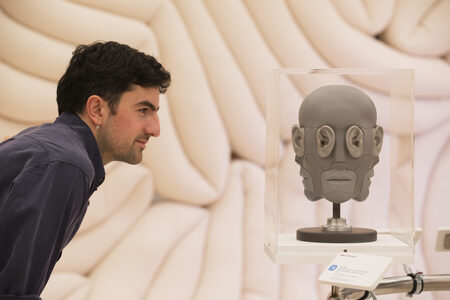
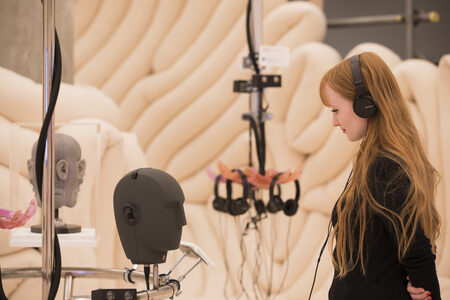
Ed Reeve. Design Museum: Weird Sensation Feels Good: The World of ASMR in London. 2022–2023
The research structure is built upon a historical-analytical principle, allowing us to trace the trajectory of multisensory strategies from avant-garde sound art to the ASMR phenomenon. This approach ensures a seamless progression—from theoretical and historical context through the analysis of specific artistic practices to a comparative examination and understanding of the mechanism of mass adoption. The organization merges visual material, art-historical context, and theoretical frameworks into a unified analytical system. This allows for a clear exploration of how multisensory artistic strategies migrated from the domain of sound art into everyday media consumption.
1. Concept 2. Multisensory Engagement in Sound Art: Strategies and Techniques 3. Sound Artists—The Predecessors of ASMR 4. From Installation to Video Clip: The Adaptation of Multisensory Practices in Mass Media Space 5. Conclusion
The widespread appeal of ASMR is due to its reproduction of multisensory artistic strategies developed in sound art and sound art, adapting them to the format of everyday media consumption.
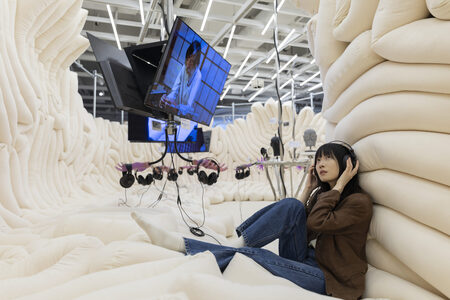
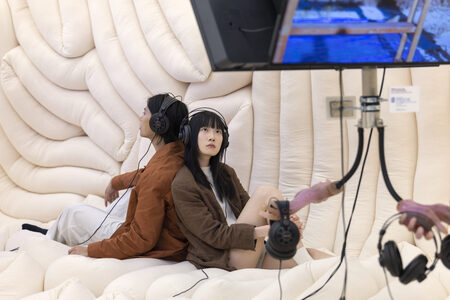
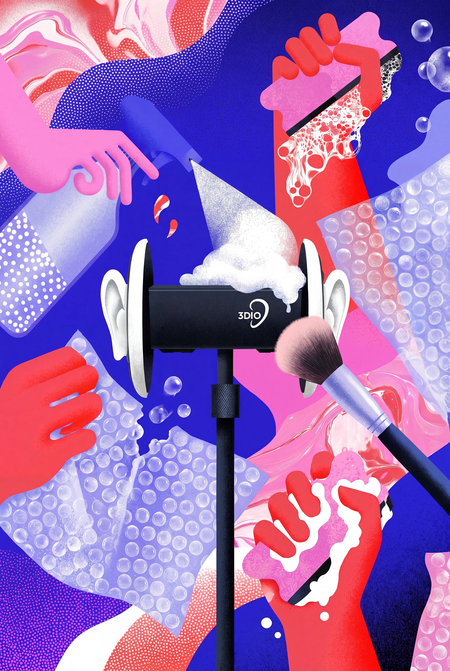
Ho66.studio. Design Museum: Weird Sensation Feels Good: The World of ASMR in Hong Kong. 2025
Multisensoriality in Sound Art: Strategies and Techniques
The theme of multisensoriality inevitably extends beyond mere auditory influence. Even in early experiments in sound art, artists sought ways to engage not just the ear, but also the body, space, and the viewer’s nervous system. This is not simply about adding new channels of perception; sound becomes tangible, almost material. The artist’s mastery is demonstrated in the ability to construct a scenario where listening simultaneously means feeling and physically perceiving the space. This chapter examines the strategies and techniques that sound artists have employed to move sound from an abstract sphere into the realm of embodied experience.
John Cage. 4′33″. 1952.
John Cage. «4′33″». 1952 / Performed by William Marx. 2010
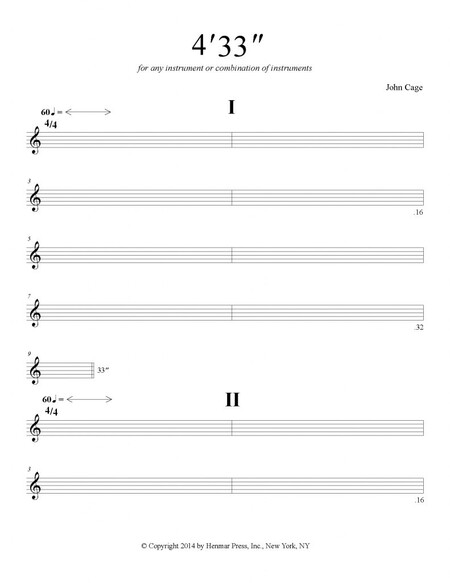
The video version of John Cage’s «4’33», ” featuring William Marx, reveals one of the central strategies of sound art—transforming everyday noise and the very act of listening into an artistic event. Within the context of the chapter on multisensory experiences, the work demonstrates how sound art shifts focus from a musical composition to the bodily perception of space: the hum of an empty hall, the rustle of clothing, and the pianist’s almost imperceptible movements begin to feel almost physical. This directly relates to the research theme, «Haptic Quality of Sound: ASMR Between Art and Everyday Life, ” because sound here functions not as information, but as a sensory environment that immerses the viewer in a state of intense concentration.
The video is visually built upon the juxtaposition of the scene’s monumental emptiness and the camera’s intimate proximity to the performer. The black-and-white cinematography, the static figure of Marx at the Steinway grand piano, and the slow pacing of the editing create an effect of suspended time, characteristic of ASMR video. The primary technique involves capturing micro-gestures: a raised hand, a pause before a movement, the barely audible squeak of the stage. This heightened sensitivity to detail later becomes one of the core tenets of ASMR aesthetics, where the viewer’s bodily response arises from nearly imperceptible sounds and the feeling of a personal presence near the source of the sound.
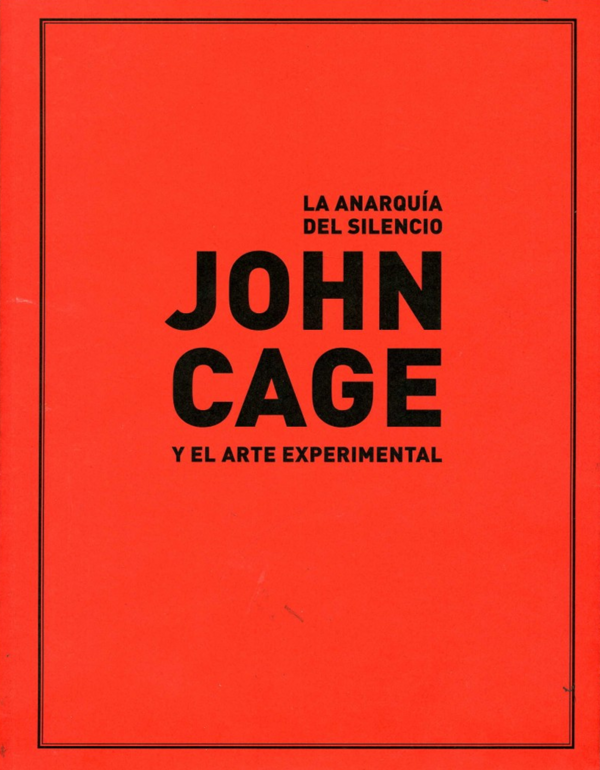
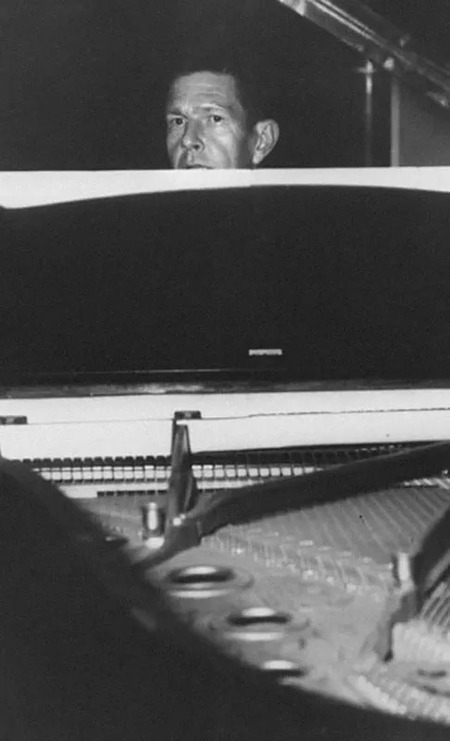
Catalog cover for the exhibition John Cage y el arte experimental. 2009 / John Cage in Japan. 1962
David Tudor. Rainforest. 1968
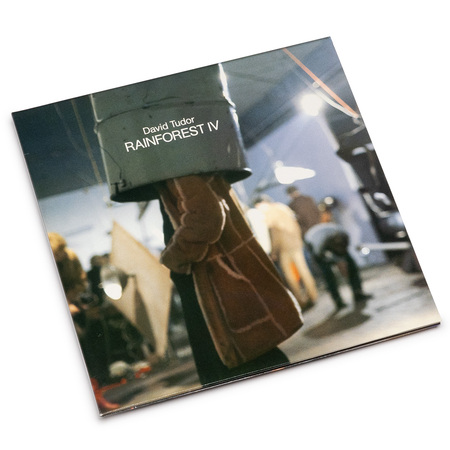
David Tudor. Rainforest IV. 1973
Within the installation space, metal barrels, buoys, and pipes are suspended at various heights throughout the hall—each object simultaneously acts as a resonator and a transmitter. Electronic signals pass not through speakers, but directly through the physical bodies of the objects, causing them to vibrate and deform the sound depending on the material, shape, and thickness. Visitors were permitted to place their teeth and skull bones against the vibrating objects, perceiving the sound through bone conduction—the act of listening became a literally embodied experience where the boundary between sound and touch vanished.
David Tudor. Rainforest. 1968 / Performance excerpt. 2011
Upon listening, the first sensation is complete disorientation: it is unclear where the sound is coming from or what is producing it. Electronic signals, after passing through metal and plastic, lose their synthetic nature and transform into organic textures—clicks, scrapes, chirping, a dull hum. There is no melody, no narrative, only a continuous stream of micro-sounds layering upon one another. Whispers and vibrations smoothly migrate from one ear to the other; breathing slows, and attention narrows to individual acoustic events—the body resonates before consciousness can fully engage. This principle of sound spatial migration and hyperfocus on acoustic textures directly anticipates the ear-to-ear technique in ASMR, where micro-vibrations travel from one channel to another, creating the illusion of the sound source being physically close to the listener’s body.
Rainforest has undergone a long transformation—from staged music to autonomous installation. In 1968, Tudor created a sound score for Merce Cunningham’s ballet, using eight «instrumental speaker» objects that imitated birds and animals. In 1973, the piece underwent a radical shift at the New Music in New Hampshire festival: participants experimented with large suspended objects, and the audience was free to move among them and interact with the sculptures. The group Composers Inside Electronics continued to develop Rainforest up until the 1990s, employing between 12 and 40 objects in spaces ranging from university galleries to Pierre Cardin’s studio in Paris. In 2009, CIE participants created a self-starting version, Rainforest V, where the computer randomly sequences hundreds of unique sounds for each object—an evolution, not a reconstruction, as the creators themselves described it.
David Tudor. Rainforest V (exhibition variation). 1973–2015 / Museum of Modern Art (MoMA). David Tudor and Composers Inside Electronics Inc. 2019–2020
Max Neuhaus. Times Square. 1977
Molly Flores. Max Neuhaus: Times Square. 2020
The installation is physically invisible: the sound is broadcast through a subway ventilation shaft located on the safety island between 45th and 46th Streets and Broadway. There are no signs, no indicators—the work exists as an anonymous gift to the urban space, which most passersby mistake for routine ventilation noise. Newhouse spent several years negotiating with the New York Transit Authority to integrate the sound into the city’s infrastructure—the installation ran continuously from 1977 to 1992, was shut down, and was restored in 2002 by the Dia Art Foundation.
Sound—a low-frequency electronic drone, a deep, metallic hum punctuated by resonant tones that evoke the vibration of a giant tuning fork. It has no beginning, no end, and no musical development—only a continuous, slowly pulsating presence. Upon entering the sound field, the body responds before the consciousness: a subtle vibration rises through the lattice, up through the soles of the shoes, slowing the pulse and easing muscular tension. As movement occurs across the lattice, the sound fluidly transitions from one ear to the next, creating the illusion of a three-dimensional acoustic cloud hovering beneath the feet. This principle—an invisible, corporeally felt sonic cocoon that filters out visual chaos and guides the experience into pure sensory perception—directly anticipates ASMR practices for anxiety relief, where a low-frequency background drone functions as a tool for physical nervous system regulation.