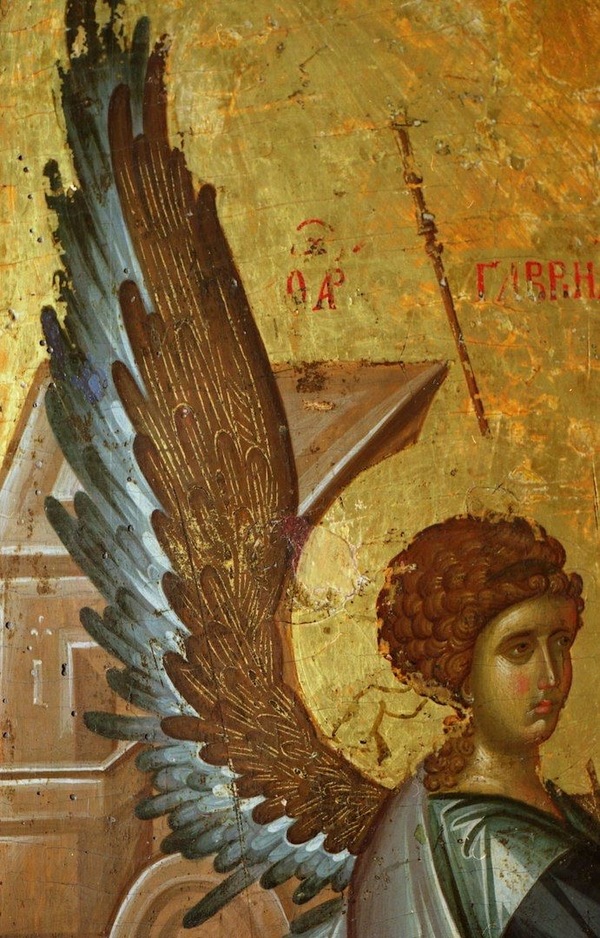
In Christian art, wings are more than just an attribute of flight. They are a visual sign that helps define the nature of a being, its place in the spiritual hierarchy, and its relationship to the sacred. This study compares the wings of angels, seraphim, cherubim, the symbols of the evangelists, and demonic creatures. The focus is on form, number, structure, color, and compositional placement.
Hypothesis
The visual differences in the wings function as a kind of code. Even without a label, they can guide the viewer toward a specific image and emotional perception.
Two wings of an angel
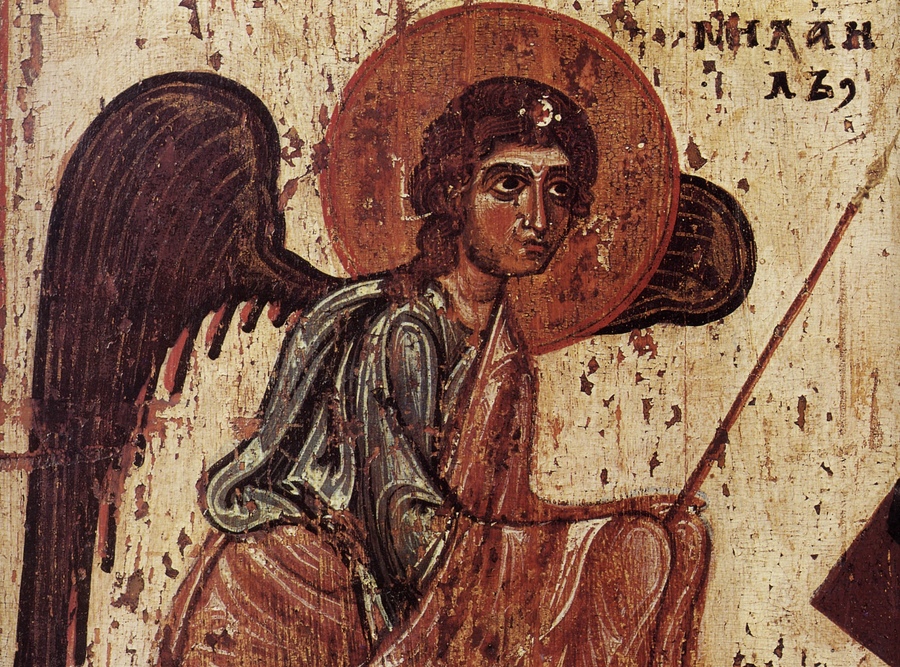
Icon of Veneration of the Cross
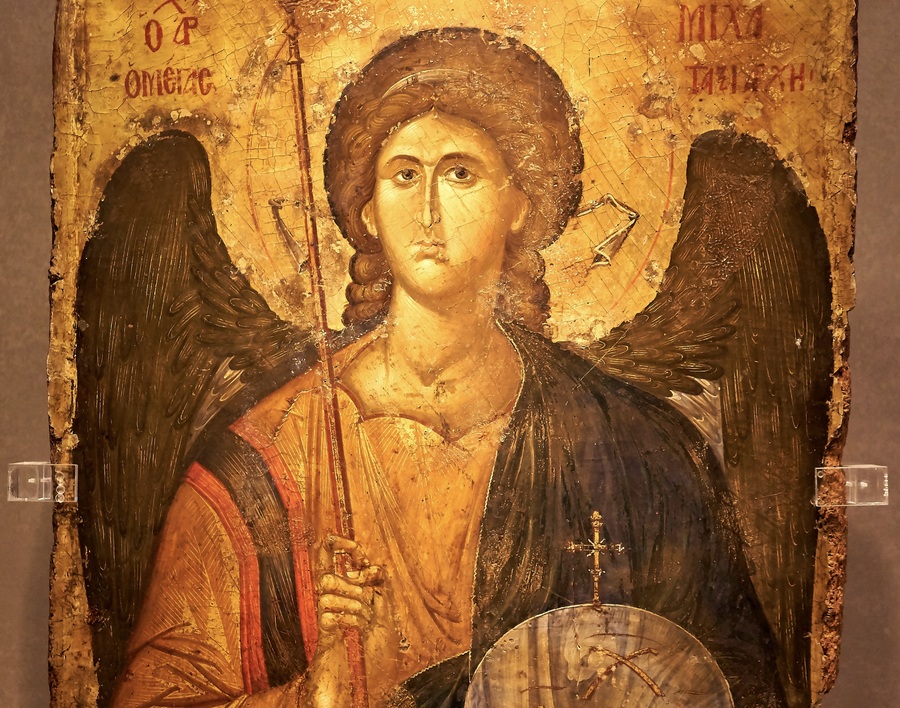
«Archangel Michael» icon
«The Annunciation» icon
Icon of Archangel Michael
Two feathered wings—the most recognizable type. The human figure remains discernible, while the wings signify its celestial nature. In Orthodox iconography, an angel’s wings serve as the primary symbol of their incorporeal nature, spiritual swiftness, lightness, and readiness to instantly execute the Creator’s will. Since angels are immaterial spirits, the wings function as a metaphorical language, allowing the conveyance of their status as «heavenly messengers» (Greek: angelos—messenger). The wings often possess a natural curve that mirrors the contour of the back, creating a sense of movement. White is the customary color for angels' wings, as it conveys purity and light.
Archangels are the highest rank in the angelic hierarchy, not a separate type of winged being.
Archangels' wings can be depicted as more decorative, larger, and broader than those of angels.
«Cathedral of Archangels» icon
Fragment of the icon «Archangel Michael»
The History of the Symbol’s Origin
Priscilla’s Catacombs Ancient Christian Burials in Rome
In early Christian art (for instance, in the Roman catacombs of the 2nd–3rd centuries), angels were depicted without wings—externally, they bore little resemblance to ordinary youths dressed in white garments. Iconographers intentionally omitted wings because, in the ancient world, they were strongly associated with pagan deities: Nike (the goddess of victory), Eros, or Hermes. Only by the 4th–5th centuries, when Christianity was firmly established, did wings become an indispensable and universally accepted element of angelic iconography.
Six Wings of a Seraph
The image of a seraph emerged from the biblical depiction of a celestial being residing near God. Its artistic portrayal gradually evolved over many centuries—from fiery, winged creatures to the recognizable six-winged form found in Byzantine iconography.
Fragment of the «Last Judgment» icon
Seraphim around Christ Pantocrator
Six-winged seraphim in the sails of the Hagia Sophia dome
Seraphim at the Prepared Throne
Seraphim with RePids
Three pairs of wings follow the text of Isaiah: the upper wings frame or cover the face, the lower wings conceal the legs, and the middle wings are spread for flight. Often, there is no body at all—only a face within a ring of wings. The positioning of the wings expresses awe before divine sanctity. The red color of the wings signifies divine love, burning, and the fiery nature of seraphim. The blue color speaks to spiritual depth. The wings can also be golden or dark brown.
Cherubim: Wing as Boundary
With the spread of Christianity, the image of the cherub was gradually reinterpreted. If in the Old Testament it was primarily associated with guarding the sanctuary and the presence of God, in Christianity it became part of the depiction of the heavenly hierarchy. In early Christian art, angelic beings did not always have clearly delineated iconographic types. Wings gradually became an important characteristic identifying a celestial being. Around the 5th–6th centuries, a more defined visual language for depicting the heavenly orders began to form.
Cherubim in the apse of the Cathedral of Chephalo
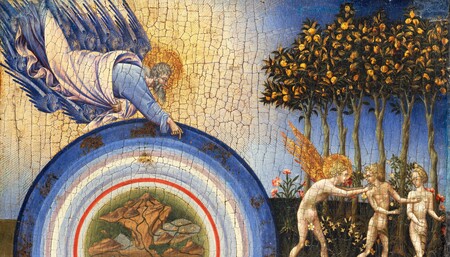
«The Expulsion of Adam and Eve from Paradise»
Cherubim are associated with the divine throne, protection, and sacred space. In biblical descriptions, their appearance is complex: multiple faces, wings, and an unusual combination of human and animal characteristics.
Various depictions exist in art: polycephalic beings, winged heads or faces encircled by wings. This variability demonstrates how artistic tradition transforms text.
The wings can cover the body, creating a sensation of an enclosure or shell. They function as a visual boundary between the sacred and external spaces.
The cherubic wing not only signifies a celestial nature but also forms a protective, enclosed composition.
According to the description in the Book of Ezekiel, the cherubim have four wings. Blue wings symbolize spiritual knowledge.
Cherubim and Seraphim