CATEGORY INDEX
[1] Biblical narrative and interpretation
[2] Symbolism and the image of the Star of Bethlehem
[3] Characters and the perception of the heavenly sign
[4] Light and artistic techniques for its representation
CONCEPT
The Star of Bethlehem is one of the key visual motifs in Christian culture, intrinsically linked to the Gospel narrative of the Nativity of Christ. According to the Gospel of Matthew, the appearance of this extraordinary star served as a sign of the Savior’s birth, guiding the Magi to the infant Christ. In the biblical account, the star functions as a symbol of divine revelation, spiritual enlightenment, and the connection between the celestial and terrestrial realms. Over centuries, this image has been a vital component of religious iconography, receiving diverse artistic interpretations.
This visual study examines how the image of the Star of Bethlehem is depicted in Western European painting from the 14th to the 18th centuries, how its symbolic meaning shifts, and the role it plays in constructing artistic space. The primary focus is on works depicting the Nativity of Christ, the adoration of the Magi, and related biblical episodes. Through a comparative analysis of paintings from different historical periods, I aim to trace the transition from a conventional symbolic representation of a heavenly sign to a more complex engagement with light, space, and chiaroscuro.
Key Research Question — how the depiction of the Star of Bethlehem evolved in Western European painting from the 14th to the 18th centuries, and how its symbolic meaning transformed into an artistic device for organizing light and space? The research hypothesis is that in Western European painting from the 14th to the 18th centuries, the image of the Star of Bethlehem gradually moves beyond the framework of a conventional religious symbol and acquires an independent artistic function. The image of the star becomes part of the light composition—specifically, it influences the illumination of characters and space, shapes the emotional perception of the scene, and directs the viewer’s attention—while retaining its original biblical and symbolic meaning.
Chronological boundaries allow us to trace the evolution of artistic language. During this period, concepts of space, light, and image realism changed, which is also reflected in the interpretation of religious subjects. Comparing works from different eras reveals how the same biblical image acquires new visual characteristics while retaining its original spiritual significance. The Star of Bethlehem is examined as a religious symbol, a narrative anchor, and an artistic tool capable of organizing composition, directing the viewer’s attention, and creating a unique atmosphere in the artwork.This theme was chosen due to an interest in the relationship between religious symbolism and the artistic language of painting. The Star of Bethlehem is of particular interest because it combines a specific biblical narrative with a complex visual phenomenon—light. By studying this single image, one can trace how artistic conceptions of the divine, light, and methods of depicting it have changed over several centuries.For this research, works of Western European painting from the 14th to the 18th centuries were selected—works depicting the Nativity of Christ, the adoration of the Magi, or the Star of Bethlehem itself. The main selection criteria were the presence of a visually distinct image of the celestial sign, the possibility of analyzing its interaction with the characters and space, and the artistic qualities of light representation.
BIBLICAL NARRATIVE AND INTERPRETATION
Artists across centuries have addressed the Gospel narrative of the Nativity of Christ and the adoration of the Magi. The analysis is based on comparing the visual interpretations of the biblical story—which episodes artists choose, how they depict Christ’s birth, the appearance of heavenly signs, and the arrival of the Magi. We will examine the degree to which the biblical plot is reproduced literally and what additional details are introduced into it, reflecting the culture and worldview of the era.
«Adoration of the Magi» by Giotto di Bondone, 1304–1306
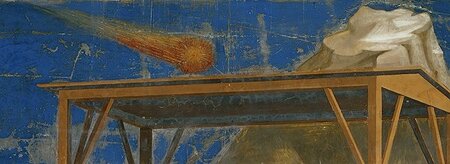
«Adoration of the Magi, ” a fresco by Giotto di Bondone, was created between 1304 and 1306. The artist references the biblical episode of the Magi’s adoration, presenting it as a specific historical event. At the center is the Virgin Mary holding the infant Christ. One of the Magi kneels and kisses the edge of Jesus' swaddling clothes. The other two Magi stand nearby, holding precious gifts: gold, frankincense, and myrrh. Beside Mary are Joseph and an angel in white robes with gold trim. Giotto moved away from strict Byzantine canons, adding volume and depth to his work. He created an illusion of space through a carefully conceived composition and architectural elements, which was a true innovation. This allowed the characters from the Gospel events to be more relatable to his contemporaries. The star here serves as a visual explanation for the Magi’s arrival. It connects the celestial event with the earthly action; therefore, while the characters are focused on adoring Christ, the star is placed above the scene as a sign of a higher order. The space remains quite conventional, with the landscape and architectural elements serving as a backdrop for the religious event. In this way, Giotto presents the star as a specific celestial sign that explains the Magi’s journey and unites the heavenly and earthly levels of the narrative.
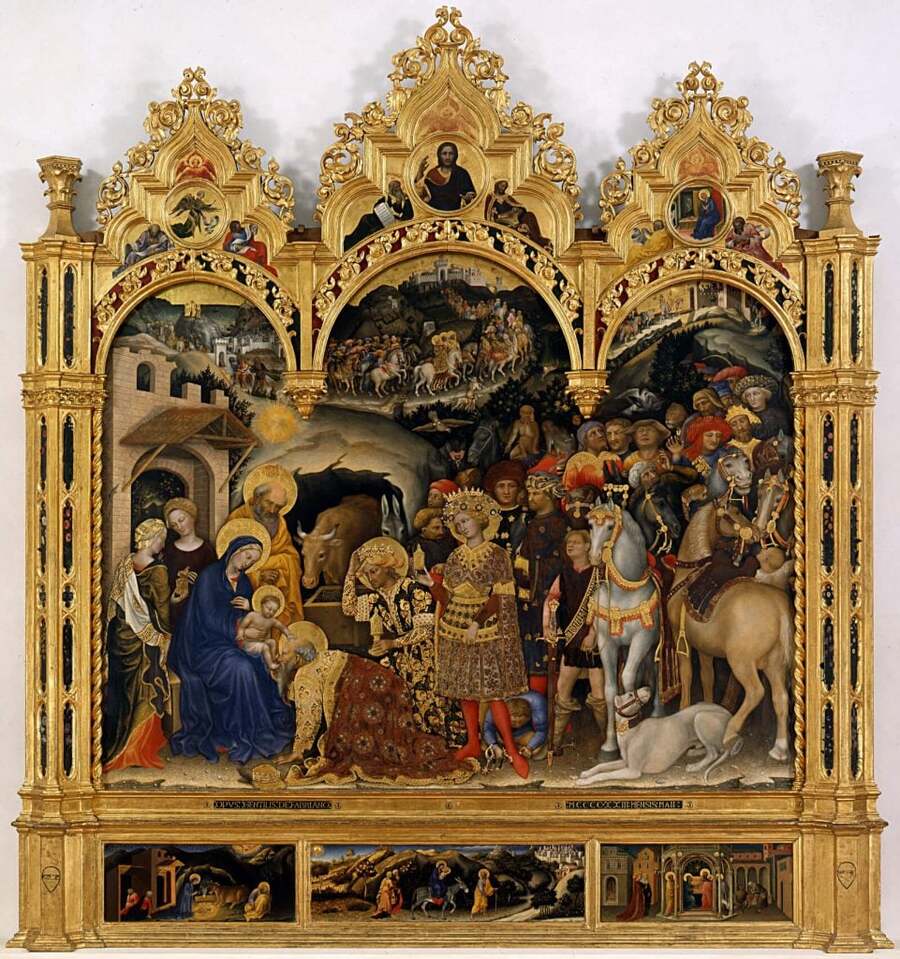
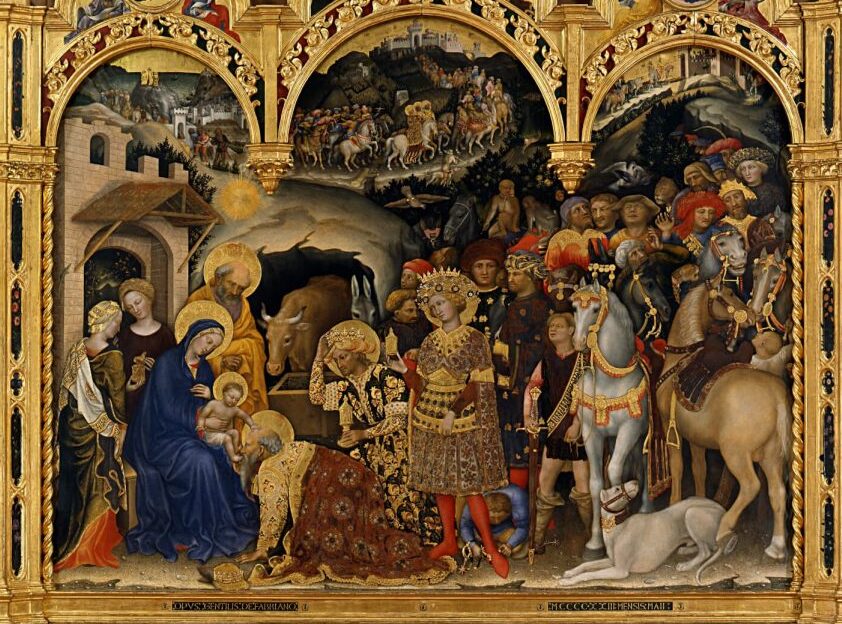
«Adoration of the Magi» by Gentile da Fabriano, 1423
«Adoration of the Magi» («Procession and Adoration of the Magi») is an altarpiece by Gentile da Fabriano, created in 1423. It is one of the master’s most significant works, representing the zenith of International Gothic style. The central panel depicts the adoration of the newborn Christ by the Magi—the wizards leading the procession offer gifts to the Holy Family. To the left of the manger are the Virgin Mary, Joseph, and the infant Jesus. A key feature of the composition is the use of framing arches to tell the sequential story of the Magi’s journey. In the upper left corner is the scene at the beginning of the journey—the Magi spot the star; in the middle ground is the stop at Herod’s palace in Jerusalem; and in the right section is the entry into Bethlehem. The procession moves clockwise. The Star of Bethlehem serves as the starting point for the Magi’s journey, and its significance is revealed through the sequence of events depicted. In the main scene, the characters' attention is already focused on the infant Christ, so the star does not compete with him for the central focus. Here, the star is part of the sequential narrative of the Magi’s journey; it links several temporal episodes into a single story, illustrating how the celestial sign becomes the catalyst for the earthly voyage.
«Adoration of the Magi» by Sandro Botticelli, 1475
One of Sandro Botticelli’s most famous paintings, created around 1475. It is housed in the Uffizi Gallery in Florence. The painting depicts the biblical scene of the Adoration of the Magi, with the Virgin Mary holding the infant Jesus at the center, and Saint Joseph standing nearby, leaning on a staff. The composition is structured so that all the figures seem to move toward the center, toward the infant, lending the scene dynamism and drama. Surrounding the central group is a large crowd of people in diverse attire. Botticelli transplants the Gospel narrative into the recognizable setting of 15th-century Florence. The star is positioned above the central group and visually signifies the heavenly origin of the event. However, the viewer’s primary focus is drawn to the human figures—their poses, faces, and gestures. The Magi have already reached the destination of their journey, so the star functions as a symbolic confirmation of what has occurred. The architectural ruins and landscape create this transition between the earthly world and the sacred event. Botticelli merges the religious narrative with the contemporary cultural environment. While the star retains the meaning of a divine sign, it becomes part of a complex composition where human forms play a crucial role.
«The Adoration of the Magi» by Domenico Ghirlandaio, 1485–1488
A painting by the Italian Renaissance master Domenico Ghirlandaio, executed around 1485–1488 and housed in the Ospedale degli Innocenti gallery in Florence. In the center, Mary holds the infant while three kings kneel before them. The architecture carries symbolic weight—it is perceived as an image of the fading pagan world giving way to Christianity. In this work, the central visual element is not the star, but the scene of adoration itself. The gaze and gestures of the figures are directed toward the infant, and the ruins create an architectural frame that highlights the central group. Ghirlandaio demonstrates how a religious event can unfold to reveal a broader concept of epochal change. The absence of a prominent depiction of the star allows the viewer to see how the meaning of a celestial sign can yield to the symbolism of Christ himself and the space surrounding him.
«Adoration of the Magi» by Leonardo da Vinci, 1481
«Adoration of the Magi» is an unfinished painting by Leonardo da Vinci, an outstanding Italian artist of the High Renaissance. It is held in the Uffizi Gallery in Florence. At the center, the Virgin Mary is depicted with the newborn Jesus, surrounded by pilgrims who have come to worship the Son of God. Arranged in a semi-circle behind the Mother of God are numerous figures—the painting is literally saturated with characters. The empty space in the foreground is «intended» for the viewer, and this very device makes the painting personal, allowing the viewer to become a participant in the event. The artist portrays the adoration of the Magi as a complex, multi-figure event. In the center of the composition is Mary with the infant, around whom a semi-circle of people forming expresses wonder, reverence, and excitement. In the background, architectural structures, staircases, and groups of riders are visible. Unlike works where the star occupies a prominent place in the sky, here the main focus is on the people’s reaction to the appearance of Christ. The celestial event is revealed through the movement and gestures of the characters, while the architecture creates a complex spatial structure. The contrast between the calm central group and the agitated background heightens the drama of the scene. The artist shifts the emphasis from the external depiction of the heavenly sign to the internal human reaction. The meaning of the event is revealed through movement, gestures, and the complex organization of space.
The works show a noticeable shift in how Christmas and the adoration of the Magi are narrated. In the early pieces, the star retains a crucial narrative function—it explains the arrival of the Magi and connects the celestial omen with a terrestrial event. In Botticelli’s work, it is integrated into a more complex composition that unites the religious narrative with the artist’s contemporary life. In the later pieces, the focus shifts primarily to the human figures, their gestures, emotional responses, and spatial organization. The Bethlehem Star ceases to be an obligatory center of visual storytelling, and its significance persists even when the artist does not depict it.
THE SYMBOLISM AND IMAGE OF THE STAR OF BETHLEHEM
We will examine the Star of Bethlehem as a standalone visual symbol. It is important to trace how artists depict the heavenly sign—whether as a conventional marker, a radiant star, or an unusual astronomical phenomenon. By comparing works from different eras, we can observe how the visual language of the star and its role in composition evolves.
«Adoration of the Magi» by Rogier van der Weyden, 1450–1464
«Adoration of the Magi”—an altarpiece triptych by Rogier van der Weyden, created between 1450 and 1464. The central panel depicts the scene of the „Adoration of the Magi“ (Matthew 2:9–11), featuring the Virgin Mary with the infant at the composition’s center, flanked by the three Magi and their retinues to the right. The Magi are arranged diagonally toward the center. The elder kneels, holding the infant’s feet, while the child raises a hand to his lips. In this work, the star is depicted directly above the scene of adoration. The composition is quite conventional—the figures of the Magi, Mary, and the infant are placed in the foreground, while architectural and decorative elements establish a confined setting. The star occupies the upper part of the image, serving as a celestial guide. Here, it functions as an element interacting with the characters, rather than merely a symbol.
«The Nativity» by Albrecht Altdorfer, 1513
Albrecht Altdorfer’s painting, «The Nativity, ” was created around 1513. It stands as a vibrant example of the Danube School of painting, which is characterized by a keen focus on landscape and mystical atmosphere. At the center of the composition is an unusual structure built of brick and wood, within which the Holy Family is dimly situated, while three angels hover above them. The painting’s primary feature is its mystical light—the dark tones combined with the bright accents of light emanating from the angels and the infant create a palpable sense of mystery. In Altdorfer’s work, the celestial space acquires a distinct expressiveness. In his rendering, the star is part of the nocturnal landscape, perceived not as a conventional symbol but as an integral element of the surrounding environment. It is placed above the earthly scene, guiding the viewer’s gaze toward the site of Christ’s birth. Space in Altdorfer’s art achieves autonomy—architecture, nature, and the sky interact with one another. The star becomes integrated into this environment, helping to unify the elements; while its symbolic function endures, the connection to the landscape and space is significantly amplified.
«Adoration of the Magi» Albrecht Altdorfer, 1530–1535
Albrecht Altdorfer’s painting, «Adoration of the Magi,» created around 1530–1535, is housed in the Städel Museum in Frankfurt am Main. Its defining feature is how the figures and the surrounding environment merge into a cohesive whole, establishing a magnificent, celebratory scene. Mary’s mantle and headwear are rendered with voluminous folds, while the three Magi are depicted in luxurious attire. The architectural ruins in the background are meticulously detailed and adorned with winding foliage. The sky in the painting appears magical—Altdorfer portrays the star as a brilliant celestial event that guided the Magi. This imagery underscores the divine nature of Christ’s birth and the role of the Magi as sages following a divine sign.
«The Adoration of the Magi» Hieronymus Bosch, 1510
«The Adoration of the Magi”—a triptych by Hieronymus Bosch, created around 1510. This is the artist’s most enigmatic and multifaceted work and is housed in the Prado Museum in Madrid. On the central panel, the Madonna is majestically seated before a dilapidated hut. She presents the infant to the Magi, who are dressed in luxurious robes. Behind the scene, ragged peasants observe, peering from behind the barn wall on the right, and climbing onto the roof and into the trees for a better view. One of the most compelling figures is the man standing in the barn doorway behind the Magi. He is semi-nude, wearing a massive crown, and demons are embroidered on the banner and on the object he holds in his left hand. Here, one can grasp the symbolism of the triptych itself—the struggle between light and darkness. The scene presents a contrast between the divine event and the imperfections of the world, as well as elements hinting at the world’s sinful nature. There is a theory that the artist employed alchemical visual codes; for instance, associating the infant with the philosopher’s stone and the star with the five-pointed star, a symbol of the five elements. In this context, the star’s function differs from that of a natural light source—it is perceived as a radiant sign rather than a source of illumination.
The Star of Bethlehem gradually takes on various visual forms. In early painting, it functions as a conventional symbol designating a divine event, while in Altdorfer’s works, its spatial role is amplified—the star becomes part of the night sky and interacts with the architecture and landscape. Artists experiment with perspective and materials in these works, employing unusual compositional solutions. Despite this, the star’s symbolic meaning remains intact; it continues to signify the connection between the earthly event and the divine realm.