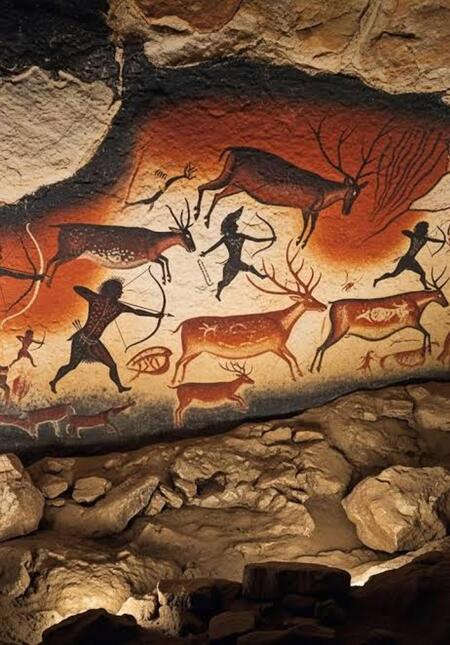
Visual organization of space in cave paintings: an analysis of compositional solutions using the Lascaux cave as an example.
I. Research Concept
Author: Matochkina Alisa, B26UKI04 Educational Program: «Management in Audiovisual Industries» Instructor: Usov Denis Alexandrovich Discipline: History and Theory of Culture and Communication
Table of Contents
• Research Topic • Rationale for Topic Selection • Areas of Study • Key Research Question • Research Hypothesis • Research Objective • Research Tasks • Principles for Selecting Materials for Visual Study • Principles of Categorization • Principles for Selecting and Analyzing Textual Sources • Research Methodology • Materials for Visual Study -Context: Lascaux Cave in the Upper Paleolithic Art System -Cave Space as the Foundation of Composition -Lascaux: The Bull Hall—Monumentality and Axial Symmetry -Lascaux: The Axial Corridor—Rhythm, Movement, and Sign-Tectonorphic Forms -Lascaux: The Apse—Palimpsest and Vertical Hierarchy -Connection between Spatial Organization and Ritual Practice • Bibliography • Image Sources
Research Topic
Visual Organization of Space in Cave Paintings: An Analysis of Compositional Solutions Using the Lascaux Cave as an Example.
Rationale for Topic Selection
From childhood, I have been fascinated by cave painting and the methods ancient people used to realize their creative expression. At first glance, the drawings might appear to be merely a chaotic collection of animal figures. However, upon closer inspection, it becomes clear that ancient artists didn’t simply draw on a flat wall; they incorporated the natural irregularities of the rock—its cracks and protrusions—into their work. I wanted to move beyond simply describing the scenes («here is a bison, here is a horse») and instead investigate how these figures relate to one another and to the cave itself. Analyzing the composition, the superimposition of images, and their connection to ritual practice opens up a rich field for visual analysis. I decided to examine the extent to which the wall’s relief influenced the shape and placement of the figures, and how various spatial problems were addressed within the Lascaux cave.
Areas of Study
• Paleolithic Art of the Franco-Cantabrian Region • Spatial Organization and Composition in Cave Painting • Utilizing Natural Relief as a Basis for Imagery • Visual Analysis of Palimpsests (Layering of Images) • Sacred Topography of the Cave
Key Research Question
How did a Paleolithic person organize the space of the Lascaux Cave using painting, and what role did the natural features of the rock surfaces play in the composition?
Research Hypothesis
I hypothesize that the visual organization of space in the Lascaux cave was not arbitrary. The ancient artists deliberately constructed compositions, utilizing natural fissures and wall undulations to create volume, and the arrangement of figures and signs was tied to the ritualistic nature and the hierarchy of space within the cave.
Research Objective
Analyze the compositional decisions in the different halls of the Laskó cave and determine what visual techniques were used to organize the space and interact with the relief.
Research Objectives
• Select images of the paintings and engravings from the Lascaux cave for comparison. • Examine how the natural irregularities of the walls and ceilings are utilized in the composition. • Analyze the techniques used for layering images and conveying depth. • Compare the methods of spatial organization across the different halls of Lascaux (Bull Hall, Axial Corridor, Apse). • Identify the relationship between the placement of images and presumed ritual practices. • Investigate how lighting (or the lack thereof) influenced the perception of the composition.
Material Selection Principle
For this study, I selected key compositional ensembles from the Lascaux cave dating to the Upper Paleolithic period (approximately 36,000–12,000 years ago). I aimed to choose entire spatial zones rather than isolated figures so that their visual organization could be assessed.
The selection included: • The Bull Hall (Salle des Taureaux / Rotonde des Taureaux)—a frieze depicting bulls, horses, and deer. Dimensions: 17 meters long, 5.5–7.5 meters wide. • The Axial Gallery (The Axial Gallery)—compositions featuring horses, bulls, and signs (tectiforms). • The Apse (Abside)—an area of extremely dense concentration of engraved images and quadrilateral symbols.
The main selection criteria were: • The works belong to the Upper Paleolithic period (around 36,000–12,000 years ago); • There are high-quality reproductions and diagrams available to examine the composition’s details; • There are visible examples demonstrating the use of wall relief; • Figures are present in complex perspectives, overlays, or adjacent to signs.
Principle of Rubrication
I decided to approach the material not through individual scenes, but through the spatial strategies employed across the cave’s various chambers. This approach allows one to see how different artists addressed the same challenges—such as conveying volume or movement.
The material is divided into several thematic parts: • The cave space as a compositional foundation. This examines how the cave’s topography (entrances, halls, crevices) influenced the placement of the drawings. • The Bull Hall. This analyzes the axial symmetry, the monumental scale of the figures, and the creation of «portals» within the image space. • The Axial Corridor. This looks at the rhythmic organization of figures, the representation of movement, and the inclusion of geometric signs (tectiforms). • The Apse. This separately examines the zone of ultra-dense engraving concentration, where the layering of images creates a palimpsest effect. • Connection to ritual practice. This explores how the inaccessibility of certain chambers and the density of the imagery might have influenced the viewer’s behavior.
This structure allows a transition from specific visual observations to a broader understanding of how ancient people structured sacred space.
Principles for Selecting and Analyzing Textual Sources
For this research, I primarily utilize academic articles, materials from the official portal of the French Ministry of Culture, encyclopedic data, and works by researchers of Paleolithic art (for example, articles by J.-M. Jeunet and A. Leroi-Gourhan).
Textual sources are used to:
- Refine the dating and cultural attribution of the paintings;
- Understand the topography of the cave (where the hall is situated in relation to the entrance);
- Learn about the presumed ritual practices associated with these halls;
- Compare my own visual observations with archaeological interpretations.
Crucially, I strive to separate the visual analysis itself from scientific hypotheses. If a researcher writes that the superposition of drawings is connected to the «magic of fertility, ” I treat that as an interpretation, not as a verifiable fact visible on the wall.
Research Methodology
The research methodology is based on a comparative visual analysis of paintings and engravings. The analysis of each object proceeds sequentially: first, I examine the photograph or diagram itself, and only then do I consult the description.
The work is structured in several stages:
- Initially, I review the overall panorama of the hall or ceiling to understand how the figures are distributed in space.
- I note how the drawing interacts with the irregularities of the wall (cracks, bulges).
- I identify any figure overlaps and how this affects the perception of depth.
- Subsequently, I study academic sources to learn about the dating, lighting conditions in the cave, and the preservation status of the drawings.
- I verify whether the compositional «oddities» I have noted are connected to the shape of the rock or damage.
- I compare the spatial strategies of the different Lascaux halls against each other.
This method allows me to first independently «read» the visual text of the cave, and only afterward to test my hypotheses with scientific evidence.
II. Research Materials
Context: Lascaux cave, upper Paleolithic art system
The Lascaux Cave is located in the Vezère Valley, near the modern town of Montignac (Dordogne department, France). It was discovered in 1940. At first glance, the cave paintings might suggest that early humans were simply filling empty spaces on the walls. However, visual analysis reveals that the cave was not merely a «canvas» for them. The walls, vaults, fissures, and protrusions each possessed their own inherent form, and the artist engaged in a dialogue with these forms. Lascaux provides particularly rich material for such an analysis, as its space is clearly divided into several zones, each demonstrating its own logic of image organization.