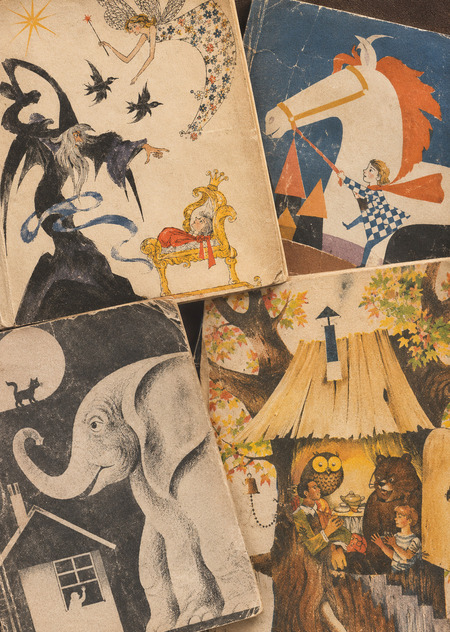
Concept
In this visual study, I will examine and analyze the literary and visual absurdity in the design of Henri Sapgir’s works. I will pay particular attention to how the characteristics of his poetic language—the unfamiliar imagery, wordplay, and disruption of narrative logic—are reflected specifically in the book. The research aims to study not only the independent artistic value of the illustrations but also their connection to the literature itself. For me, Henri Sapgir’s texts presented a wonderful opportunity to analyze his characters and situations, which can acquire unexpected properties, and his play with language becomes an important part of the artistic world. Furthermore, the artist—who must manage to find the necessary visuals that suit a specific text’s content, its unusual logic, or the mood and specific character of the characters—is also a crucial element.
The foundation of my work lies in illustrated editions of works by Heinrich Sapgir published in the 20th century. The main books I have selected are: «Wonder Woods» by Viktor Pivovarov (1967), «New Words» by Eric Bulatov (1966), «Four Envelopes» by Ilya Kabakov (1976), and «The Cannibal and the Princess, or Everything Reversed» by V. Sergeev (1991). I chose these because they directly embody the works. I selected precisely these works because they are where the artist engages with original imagery, conceptual structures, and absurd situations. Furthermore, this involves not only a narrative correspondence between the image and the text but also an augmentation and reinterpretation of it.
In the first part of my research, I will examine the characteristics of literary absurdity in Sapgir’s works: wordplay, unexpected semantic combinations, disruption of conventional cause-and-effect relationships, and the creation of unusual imagery. The second part will focus on the transition from a literary image to a visual one. I analyze which textual elements artists select for depiction and how they interpret them, followed by the main artistic techniques used to create visual absurdity: grotesqueness, exaggeration, deformation, unconventional composition, and the interplay between image and typography. The third part is dedicated to analyzing four specific works. Finally, in the concluding section, I compared literary excerpts and illustrations to determine the extent to which the visual sequence continues, amplifies, or alters the original meaning of the text. For source selection, I utilized scientific and research publications, catalogs, library materials, and reliable information regarding publications.
The analysis of Sapgir’s illustrations goes beyond the literal depiction of the events described in the text; they become an independent extension of the literature, employing visual techniques to convey the author’s inherent illogic, unexpectedness, and multi-layered symbolism. Consequently, the illustrations do not merely help the reader visualize what is happening—they also broaden the interpretation of the literary work.
Features of Literary Absurdity in the Works of Heinrich Sapgir
Genrikh Sapgir
The Literary World of Heinrich Sapgir: Absurdity, Wordplay, and the Subversion of Conventional Logic.
As a poet and writer who created works for both children and adults, he experimented extensively with forms and language itself. Born in 1928 in Biysk to a Jewish family—his parents were a shoemaker and a laundress—he died in Moscow in a trolleybus due to a heart attack in 1999.
In his children’s works, these traits manifest through humor, fantasy, and unusual situations where the familiar, mundane gray world begins to obey different rules. Heinrich immerses us in another reality, one where we view ordinary things from a different angle, and where expected events can become distorted.
Book cover «New Words,» 1966. Artist Erik Bulatov
Illustration by Erik Bulatov in the book «New Words»
Illustration by Erik Bulatov in the book «New Words»
Cover of the book «Wondrous Forests» from 1967. Artist Victor Pivovarov
Illustration by Viktor Pivovarov in the book «Wonderful Forests»
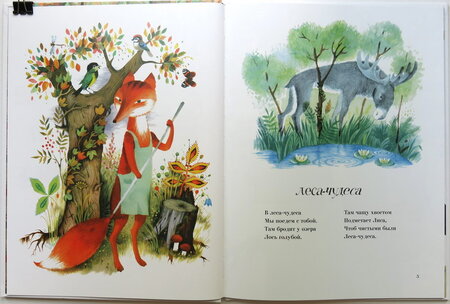
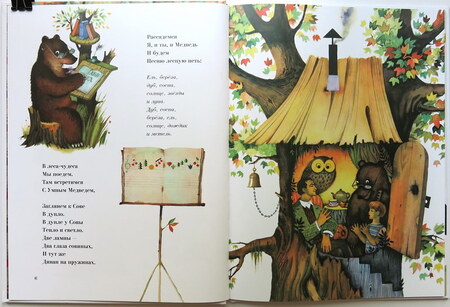
Illustrations by Victor Pivovarov in the book «Wonder Forests»
Cover of the book «The Cannibal and the Princess, or Everything the Opposite, ” 1991. Artist V. Sergeev
Illustration by V. Sergeev in the book «The Cannibal and the Princess, or Everything Reversed»
Cover of the book «Four Envelopes, ” 1976. Artist Ilya Kabakov
From Literary Text to Visual Image
Illustration by Victor Pivovarov in the book «Wonderful Forests»
Students 1963 Photo: Vladimir Akimov / RIA Novosti
Literary Absurdity and Its Artistic Manifestation
Conclusion: The Diversity of Visual Absurdity. The Unity of Text and Illustration.
URL: https://moslenta.ru/city/mestnye/drak-ne-bylo-nikogda-chistye-prudy-1960-kh-v-vospominaniyakh-moskovskogo-starozhila.htm (Accessed: November 19, 2026).
URL: https://anticvarium.ru/lot/show/41191 (Accessed: November 19, 2026).
URL: https://rgdb.ru/home/news/4456-pogoda-byla-prekrasnaya-vecher-k-90-letiyu-pisatelya-genrikha-sapgira (Accessed: November 19, 2026).
URL: https://artchive.ru/artists/94607~Oleg_Vasil'ev_i_Erik_Bulatov/works/673849~Novye_slova (Accessed: November 19, 2026).
URL: https://www.litfund.ru/auction/742/342/ (Accessed: November 19, 2026).
URL: https://rech-deti.ru/catalog/7/69/ (Accessed: November 19, 2026).
URL: https://www.chitai-gorod.ru/product/lesa-chudesa-hudozhnik-viktor-pivovarov-3046838 (Accessed: November 19, 2026).
URL: https://anticvarium.ru/ (Accessed: November 19, 2026).
URL: https://www.litres.ru/book/genrih-sapgir/chetyre-konverta-74495611/ (Accessed: November 19, 2026).
URL: https://taberko.livejournal.com/233227.html (Accessed: November 19, 2026).