INTRODUCTION
The animated short «Betty Boop and Grampy» (1935), produced by Fleischer Studios, offers a compelling example of the evolution of American animation during the 1930s. During this period, animation actively experimented with visual expressiveness, character plasticity within the frame, spatial composition, and the synchronization of visuals with music. The goal of this study is to analyze the film’s visual language, identify artistic techniques and clichés characteristic of the era, and determine the specific features and innovative solutions that distinguish Fleischer Studios' work from the productions of other animation studios at the time.
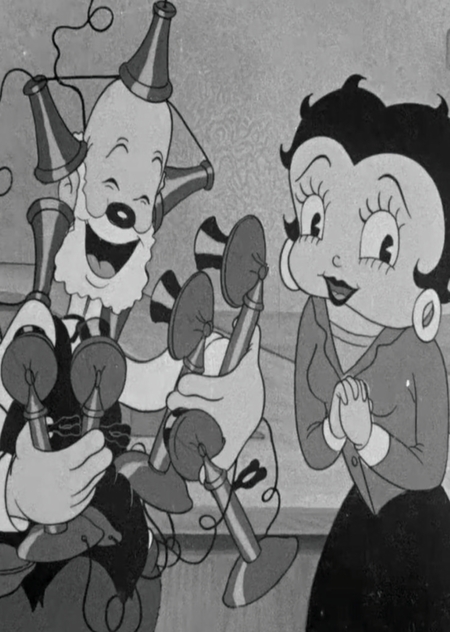
Excerpt from the cartoon «Betty Boop and Grampy» (1935)
«Betty Boop and Grampy» is an American short animated film created by Fleischer Studios in 1935. It premiered on August 16, 1935. Dave Fleischer directed the film, and Max Fleischer produced it. The cartoon is rendered in black-and-white hand-drawn animation and runs for about seven minutes.
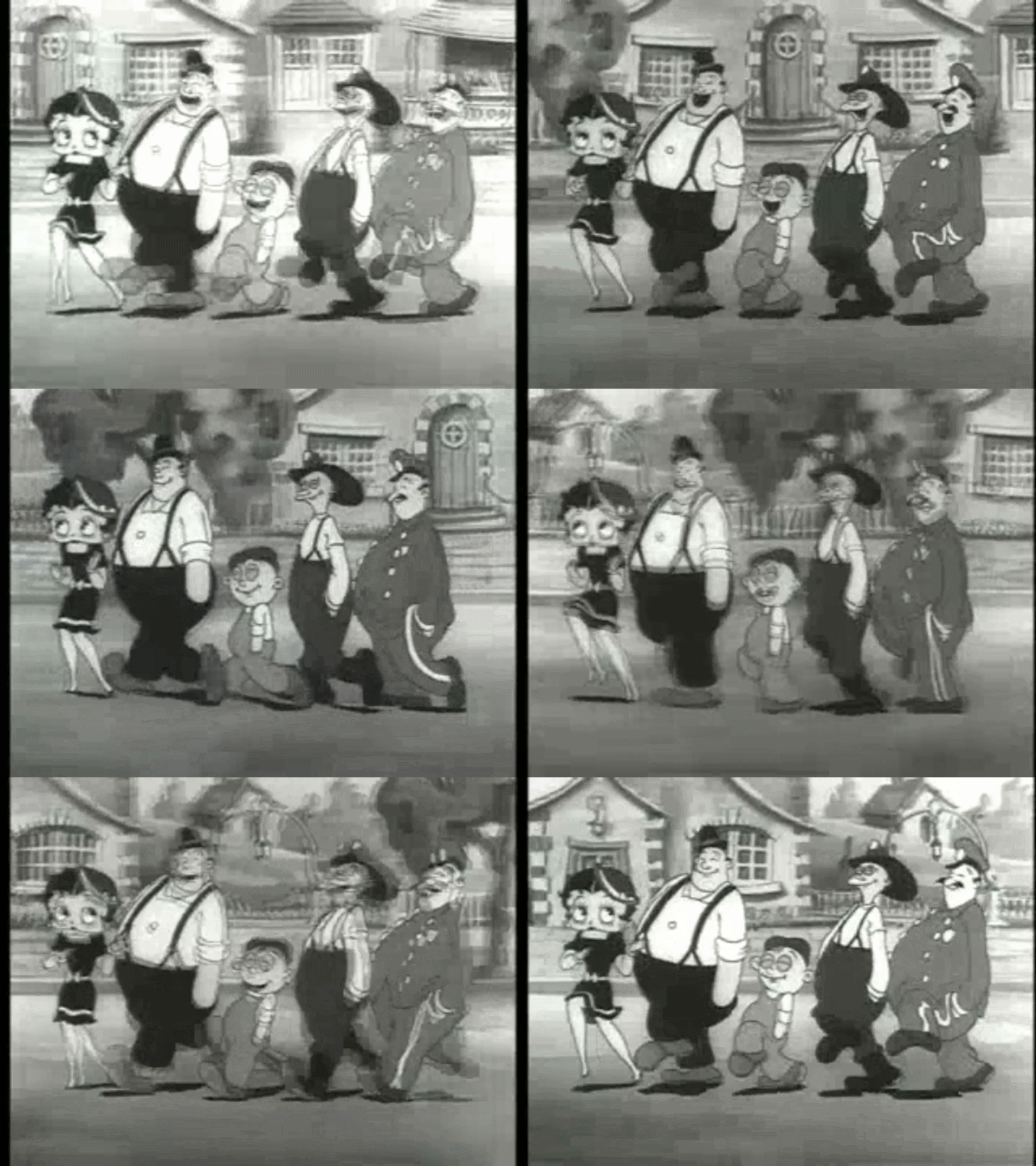
Excerpt from the cartoon «Betty Boop and Grampy» (1935)
The story centers on Betty Boop, who receives an invitation to a party from her elderly relative—an eccentric inventor. On the way to his house, Betty invites a variety of people to join the celebration: dockworkers, a firefighter, and a police officer, who, captivated by the invitation, abandon their daily routines. Upon arriving at Grammy’s house, the guests discover his unusual inventions and mechanical contraptions that transform ordinary household objects into whimsical devices. The party culminates in a musical and dance performance.
Excerpt from the cartoon «Betty Boop and Grampy» (1935)
Excerpt from the cartoon «Betty Boop and Grampy» (1935)
Excerpt from the cartoon «Betty Boop and Grampy» (1935)
The cartoon holds particular historical significance because it is in this film that the character Grampy first appears, and he later became a permanent feature in the Betty Boop cartoon series.
Excerpt from the cartoon «Betty Boop and Grampy» (1935)
Clip from the cartoon «Betty Boop and Grampy» (1935)
TABLE OF CONTENTS
• Visual language
• Common techniques of that era
• Comparison with contemporary animation
• Conclusion
VISUAL LANGUAGE
Elastic Plasticity and the Rubber Hose Principle.
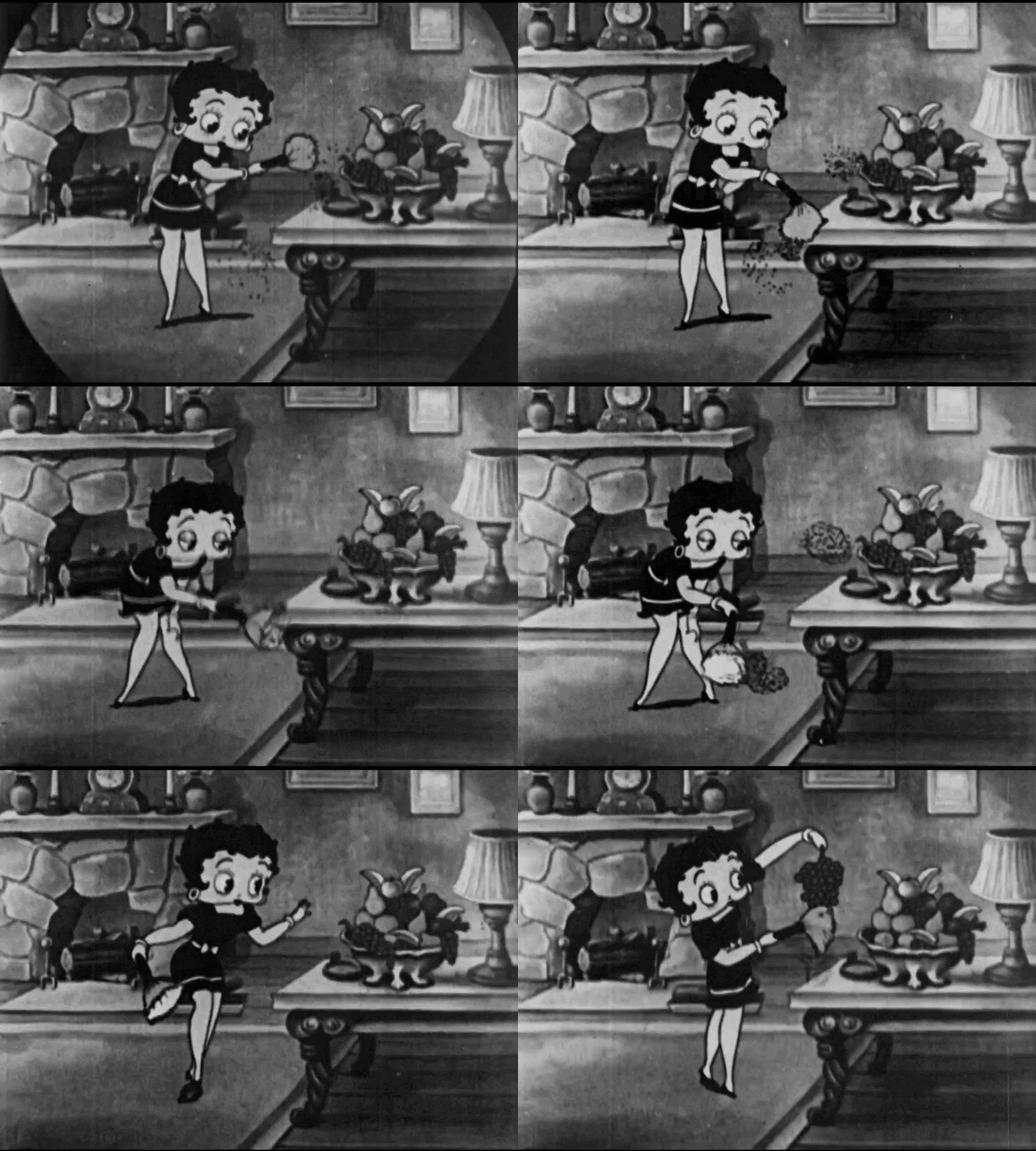
One of the most characteristic techniques of Fleischer Studios is the so-called rubber hose animation. This is a legacy of 1920s animation, where characters did not have strictly fixed anatomy.
Excerpt from the cartoon «Betty Boop and Grampy» (1935)
Excerpt from the cartoon «Betty Boop and Grampy» (1935)
Motion as continuous action.Fleischer had a particular fondness for perpetual movement. Rather than staging a scene around a static backdrop and a moving character, the studio often made almost everything move.
Excerpt from the cartoon «Betty Boop and Grampy» (1935)
Excerpt from the cartoon «Betty Boop and Grampy» (1935)
Working with perspective and spatial depth.In 1935, Fleischer Studios was already utilizing its own system for creating three-dimensional space—the Setback Camera, also known as the stereoscopic system.
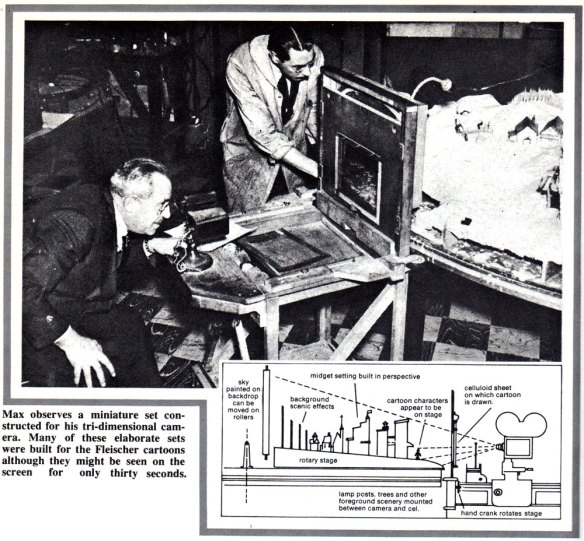
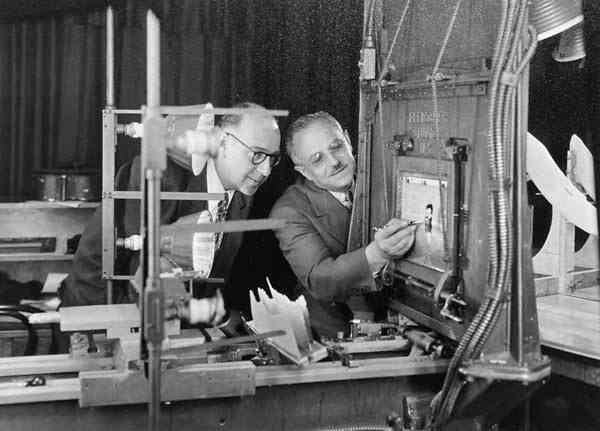
Unlike a typical painted backdrop, this piece utilized a physical three-dimensional set placed on a revolving platform. A layer of painted animation was positioned in front of it, and the camera shot both elements together.The result created the illusion that the character was genuinely moving into the depth of the three-dimensional space.
Excerpt from the cartoon «Betty Boop and Grampy» (1935)
COMMON TECHNIQUES OF THAT ERA
One of the main traditions of early animation is that the plot doesn’t necessarily have to be complex. In this cartoon, Betty is simply going to a party, but along the way, she meets people who abandon their responsibilities for an invitation.
Slapstick — physical comedy.Physical humor was one of the primary tools of animation during that era.
Excerpt from the cartoon «Betty Boop and Grampy» (1935)
In «Betty Boop and Grampy,» the exaggeration of consequences is particularly effective. For example, the porters don’t just stop working—the piano literally crashes and shatters against the sidewalk. The situation is deliberately pushed to absurdity.