Concept
Every person has a unique concept of home—for some, it’s a modern apartment; for others, it’s gilded chandeliers and high ceilings; for still others, it’s where their family is.
This work is about homes—more precisely, about three homes that women spent decades transforming into works of art without ever leaving them or ceasing to live in them. For Nelly Mae Rowe, the home was a «playroom»; for Mary Nol, it was first a summer cottage by the lake; and for Tessa Presby, it was a space where she needed to display her collection of pencils.
Images
Within outsider art, there is a distinct current: «art environments.» These are gardens, plots, and homes that the owners entirely transform into an authorial space. Typically, people think of them in terms of images like a sermon garden or a castle. In this way, the familiar space gradually stops serving only utilitarian functions and becomes a complete artistic statement.In this research, I want to focus on the distinctive characteristics when a woman constructs such an environment. The home is traditionally associated with daily life—cooking, storing belongings, relaxing, caring for loved ones, and hosting guests. However, in the works of the selected artists, conventional domestic elements take on new artistic meanings.
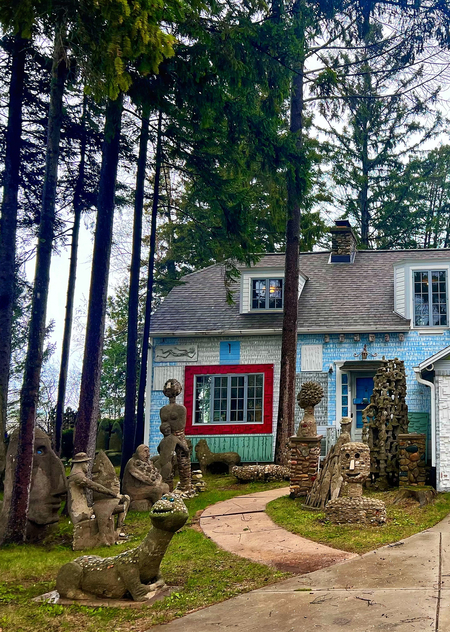
For this study, three artists were selected: Tess Prisbry (Bottle Village), Nelly Mae Rowe (Playhouse), and Mary Knoll (house and sculptures on Lake Michigan).
Images
However, I do not assume that all three authors shared the same concept of home or domestic life. Their homes were built on their own plots of land—not within a single year—yet they differed based on their hosts' diverse backgrounds. The study focuses on the details that change when the object remains the same, but the circumstances and history diverge.
The research involves dividing into two main parts.
(01) The first section is dedicated to the interior space of the home: rooms, household objects, collections, and materials in use. Here, I will examine how domestic items take on a new function.(02) The second part will focus on the house from the outside: the threshold, the yard, guests, and neighbors. In this way, the home will be examined both as the author’s personal space and as a location accessible to people from the outside.
Illustration
In both parts, three works will be discussed through the lens of three questions: what is the initial function of the space or object, how does the artist transform it, and what new role does it assume within the artistic context?
For textual sources, research utilizes studies of the environments themselves (SPACES materials, works by Joe Farb Hernandes, William Arnott’s essays on Rowe), websites of museums and foundations that present these places (High Museum, Kohler Foundation, Atlanta History Center), and public commentary regarding the fate of these buildings.
Design
Thus, the goal of this work is to address the question: how does domestic life shape the visual language of the environment a woman constructs within her own home?
The core hypothesis is that familiar domestic functions and objects do not disappear during the process of artistic spatial transformation; rather, they become the foundation of its new visual language. It is the interaction between the utilitarian and the artistic that allows the residential building to gradually attain the scale of an independent work of art while retaining a connection to the creator’s personal history.
In conclusion, I will summarize the research and show what form the home environment takes, even when it becomes monumental.
Home within
Design
In the conventional sense, a home interior is composed of objects that people use in daily life—for example, for me, this includes my chair, shelves of figurines, and stationery. Each item carries a specific function, for which it is placed in a convenient location.
However, for creative individuals—like Tessa Prisby, Nellie May Rowe, and Mary Nol—this order becomes entirely different; sometimes only a resident of that space can truly understand it.
Design
So, the history of Bottle Village begins with a rather unusual, yet everyday problem—Tressa wanted to house her pencil collection, which some sources say ranged from 2,000 to 17,000 pencils.In 1956, Tressa Prisbry decided to build a separate space for them. However, the cost of standard building materials proved too high, so she began using discarded bottles found at the dump.
and
i
Over time, 13 smaller buildings and other structures were added. As a result, objects like pencils and dolls in the Prisrb house, instead of being integrated into the interior design, become foundational elements for specific buildings. One might even say that the building is constructed around these objects, rather than the objects merely filling the rooms.
So, in Bottle Village, besides the pencil house, she also built a dollhouse (housing about 600 dolls, which, according to stories, she dressed every day), a rampus room for her grandchildren, Cleopatra’s bedroom, and a meditation room where she sang and played the piano.
She created mosaic floors inside using small plastic items and broken tiles. This story illustrates the Rampus Room: there was brown tile featuring a portrait of Queen Victoria on the floor, and many visitors asked her to dig it up and sell it, but Priscilla refused.
i
It can be seen that for Tressa Prisrb, the subjects and the home become one entity; she strives to keep them and «incorporate them into the home.»
You can also notice those same pencils in the photographs adhered to round wooden ornaments. However, Tess’s buildings are not constructed only around objects. Her creations can also be perceived as an act of care for loved ones. According to Smith, when two of her children died of cancer, she built them small rooms where they were surrounded by colored light streaming through bottle-like walls at sunset.