Topics
— Concept — 1. Vogue as part of mass media culture: the formation of visual images and perceptions of femininity — 2. Female representation in traditional glossy media culture (2000–2009) — 3. Digitization of media culture and the changing image of women (2010–2019) — 4. Contemporary digital media culture and new forms of the female image (2020–2025) — — Conclusion
Concept
Fashion has always been closely linked to the evolution of media. It reflects and reflects changes occurring in society, and sometimes it dictates them. Throughout the 20th and 21st centuries, fashion magazines played a crucial role in shaping people’s perceptions of beauty. Through these magazines, society was conveyed what kind of life to aspire to and how to conduct oneself in accordance with social roles. Vogue became the most influential publication in this field: its covers have, over time, evolved into autonomous media messages conveying views on femininity, success, and public recognition.The female image holds a special place in Vogue’s visual culture. The cover stars become a reflection of the current aesthetic ideals and cultural perceptions of their time. Through composition, photography, typography, styling, and the selection of the model, the magazine communicates specific meanings and values. The cover functions as a specific mediatext. Its visual elements are integrated to create a cohesive message.The choice of this topic is driven by the massive changes in media culture over the last three decades. In the early 2000s, print magazines remained one of the main sources of fashion information, and the formation of beauty standards largely depended on the editorial policies of major publishers. However, with the development of the internet, social media, and digital platforms, the ways in which media content is created, distributed, and consumed have changed. If fashion magazines previously transmitted aesthetic norms predominantly, today greater influence is exerted by influencers, social media users, and independent media platforms. These changes have also impacted Vogue’s operations. The magazine has gradually adapted: adopting digital formats, experimenting with visual language, and expanding the range of its cover models.
Key research question: How has the transformation of media culture between 2000 and 2025 influenced the ways the female image is visually represented on Vogue covers, and what shifts in perceptions of femininity do these processes reflect?
The primary material selected is the covers of the American edition of Vogue (Vogue US) spanning the period from 2000 to 2025. This time frame allows for tracking the transition from the dominance of traditional print media culture to the proliferation of social networks and contemporary digital communication. The choice of a single national publication is driven by the need to maintain a unified editorial context and ensure a more consistent comparison of the visual materials.The research logic is built upon visual analysis—aimed at studying composition, color palettes, photographic style, and typography; content analysis—which allows for the classification of the cover models and the identification of quantitative changes in their characteristics; comparative analysis—necessary for juxtaposing different stages of media culture development; and media cultural analysis—which examines the relationship between shifts in the media environment and the ways femininity is represented. The transformation of the female image on Vogue covers is examined as a reflection of larger processes in media culture development. Special attention is given to the interrelation between the changes in methods of media content production and distribution, the evolution of digital platforms, and the transformation of the visual representation of women. This approach allows for a clearer tracing of how the role of a fashion magazine changes in the contemporary media landscape and what new forms of representation emerge as a result of these changes.
The cross-sections from 2006, 2016, and 2026 were selected due to qualitative shifts in the media landscape. 2006 marks the peak of Web 2.0, a period when the visual language of professional publications remained relatively stable and hierarchical. 2016 represents an algorithmic turning point: social media and algorithmic feeds become the primary channel for visual content distribution, and the logic of visibility begins to influence editorial decisions. 2026 is a snapshot capturing the current state, tied to the proliferation of generative AI and «hypervisualization, ” which radically changes the ontological status of the image and perceptions of its authorship and veracity. These three temporal points allow us to observe the shift in the regimes of power visibility.
The visual study consists of four chapters. The first chapter examines Vogue as part of mass media culture, analyzes the role of fashion magazines in shaping public perceptions, and reveals the significance of the cover as a mediatext. The second chapter investigates the characteristics of female representation during the period of dominance by traditional mass media (2000–2009). The third chapter is dedicated to the transformation of media culture under the influence of social networks, the development of personal media, and the changing visual image of women (2010–2019). The fourth chapter examines the features of contemporary digital media culture, new communication formats, and the transformation of female representation during the period 2020–2025. The conclusion summarizes the findings, compares the identified trends, and formulates the main conclusions regarding the interconnectedness of media culture evolution and the changing visual image of women on Vogue covers.
VOGUE AS PART OF MASS MEDIA CULTURE: THE FORMATION OF VISUAL IMAGES AND PERCEPTIONS OF FEMININITY
Fashion is an important element of mass media culture. It not only reflects current trends in clothing but also shapes perceptions of beauty and style. One of the primary tools of this influence has been fashion magazines, among which Vogue holds a special place. Founded in the United States in 1892, the magazine has evolved into an international publication capable of influencing fashion preferences and visual standards.The cover of Vogue is not merely a photograph of a model or celebrity; it is a complete visual statement. Through the heroine’s appearance, clothing, pose, facial expression, color, and composition, a specific image of womanhood is constructed. For instance, a stern gaze and reserved posture might convey confidence and independence, while soft lighting and a romantic image may align with traditional ideals of femininity. To understand these processes, Stuart Hall’s theory of representation is crucial. According to his approach, images do not simply reflect reality; they actively participate in creating meanings and understandings of the world. Therefore, the covers of Vogue can be viewed as a mechanism for shaping specific ideals of female appearance and behavior.
As digital technologies have evolved, the media environment in which magazines exist has also changed. While the press was once the primary channel for disseminating images, over time, websites, social media, and video platforms have been added. The audience has gained the ability to discuss content directly, share it, and influence its distribution. This relates to Henry Jenkins' concept of convergent culture, which describes the interaction between traditional and new media.
Changes in the media landscape have also influenced the portrayal of the female image. Themes of individuality, self-expression, and physical diversity have become more noticeable on covers. However, traditional notions of beauty have not disappeared entirely.
The period from 2000 to 2025 allows us to trace how the visual language of Vogue and the ways women are depicted have evolved alongside the development of media culture. Comparing covers from different years will help us determine which traits of the female image have remained constant, which have transformed, and how the shift from print publications to digital media has impacted these changes.
2. FEMALE REPRESENTATION IN TRADITIONAL GLAMOUR MEDIA CULTURE (2000–2009)
In the early 2000s, Vogue remained a primary source for shaping perceptions of fashion and female beauty. The print magazine established visual benchmarks. The female archetype was most often built around the vision of a slender, polished, attractive, and confident woman. The featured subjects included both professional models and renowned actresses and other public figures.We will next examine specific covers and the particularities of their visual language characteristic of that era.
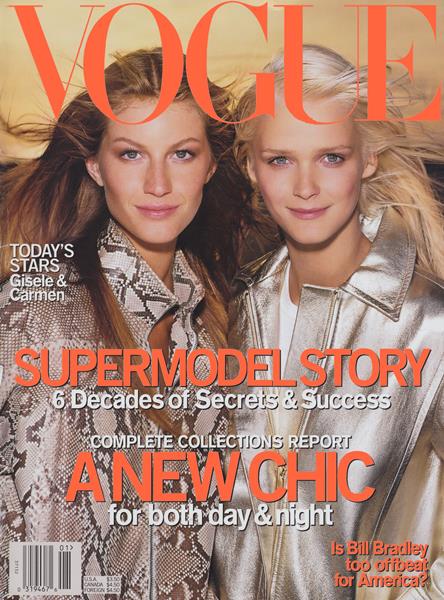
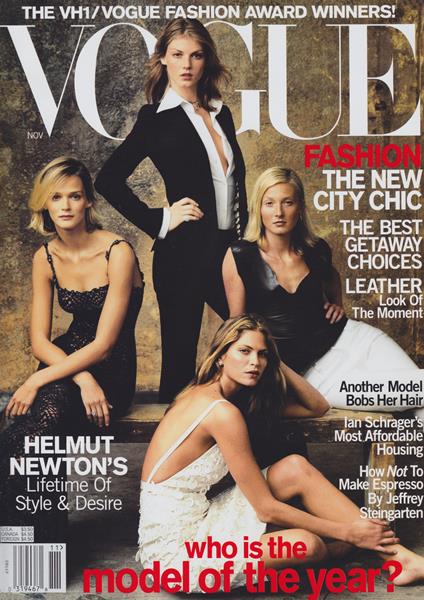
January 2000 Vogue US Cover / November 2000 Vogue US Cover
On the January cover of Vogue US for 2000, Giselle Bündchen and Carmen Kass are featured, photographed by Steven Meisel. The models are positioned side-by-side, looking directly at the camera. Their metallic attire, flowing hair, and close proximity create a sense of movement and confidence. The orange VOGUE lettering harmonizes with the overall color palette and immediately draws the eye. The cover underscores the status of supermodels—both women are presented as central figures of the fashion world, rather than simply clothing display models.The November 2000 cover, shot by Annie Leibovitz, features four models: Carmen Kass, Angela Lindvall, Maggie Rizer, and Frankie Ryder. Unlike the previous example, this composition is group-based. One of the women stands in the center, while the others are arranged around her in various poses. The dark clothing and natural background establish a more dramatic mood. The placement of the models forms a visual hierarchy, yet all the heroines remain part of one unified image of the fashion industry. The text on the cover links the models to fashion awards, highlighting their professional acclaim.
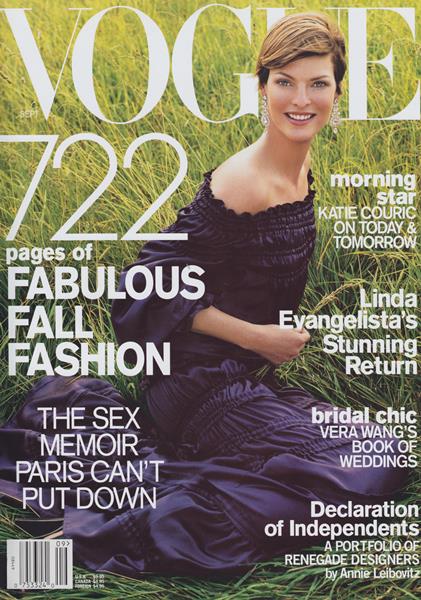
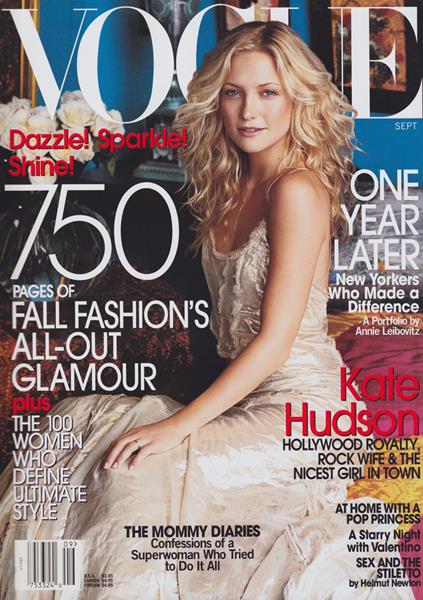
Vogue US September Cover, 2001 / Vogue US September Cover, 2002
The September 2001 cover, featuring a photograph of Linda Evangelista by Stephen Meisel, has a more natural atmosphere. The model is shown sitting among tall green grass in a dark, off-the-shoulder dress. The natural surroundings soften the typical polished look of a magazine shoot, and the contrast between her dark clothing and the light background highlights the subject. Her pose appears relaxed yet retains elegance. The headline, «Linda Evangelista’s Stunning Return, ” draws attention not only to the model’s beauty but also to her comeback in the industry. Here, the female image is linked to professional status, fame, and the opportunity to once again capture the audience’s attention.The September 2002 cover presents actress Kate Hudson, photographed by Herb Ritts. She sits in a light, long dress against a backdrop of white flowers and deep blue tones. The soft color palette and open pose create a romantic mood. Unlike the more severe portrayals of models, femininity here is conveyed through lightness, naturalness, and elegance. Furthermore, the large title, „750 Pages of Fall Fashion’s All-Out Glamour, ” emphasizes the scale of the issue’s fashion content. The cover demonstrates that Vogue utilizes not only professional models but also actresses whose popularity helps draw in readers.
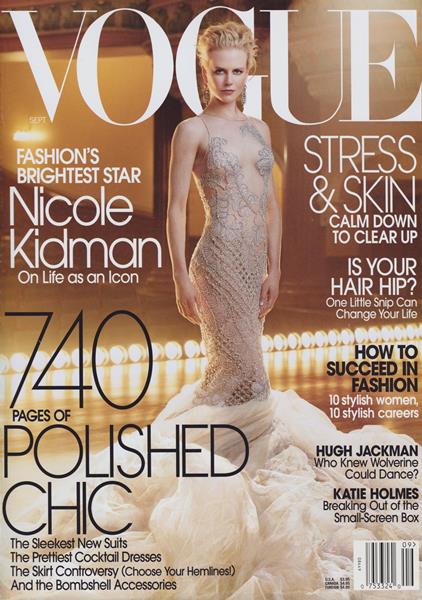
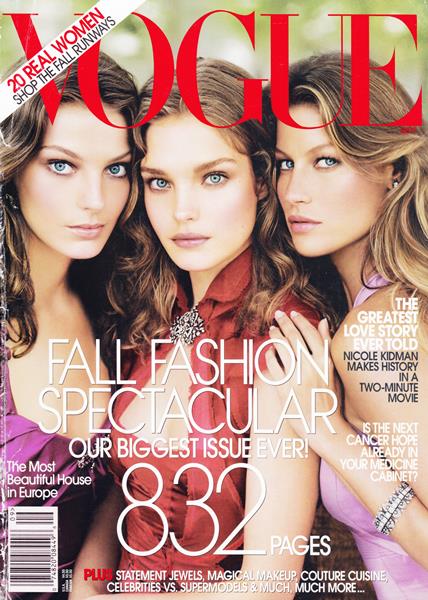
September Cover, Vogue US 2003 / September Cover, Vogue US 2004
The September 2003 cover, photographed by Annie Leibovitz featuring Nicole Kidman, evokes a completely different visual atmosphere. The actress is depicted full-length in a long, glittering gown with embroidery. Behind her, rows of bright lights are visible, reminiscent of a theater or a set. The warm golden and brown tones enhance the feeling of luxury and create an association with cinema. The heroine occupies the central focus, and her composed posture and direct gaze underscore her stature. In this instance, femininity is presented through spectacle, refinement, and public success.The September 2004 cover stands as a notable example of a collective portrayal of female beauty. It features models Gisele Bündchen, Natalia Vodianova, and Daria Verbova. The photographer was Steven Meisel. Instead of a single central figure, the attention is distributed among several women. Their faces are positioned close to one another, forming a unified composition. A similar stylistic sensibility unites the models, yet their individual appearances maintain each woman’s distinctiveness. In her editorial essay, Anna Wintour connected this cover to shifts in the fashion industry and a new attitude toward celebrity. This is an important example of how Vogue began presenting female beauty not only through a single celebrity but through an entire generation of models.
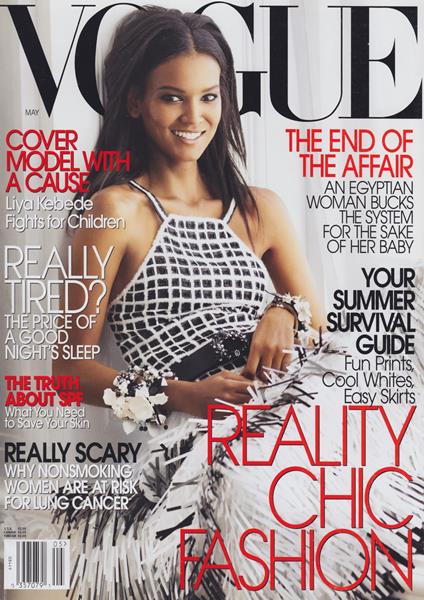
May 2005 Vogue US Cover / May 2007 Vogue US Cover
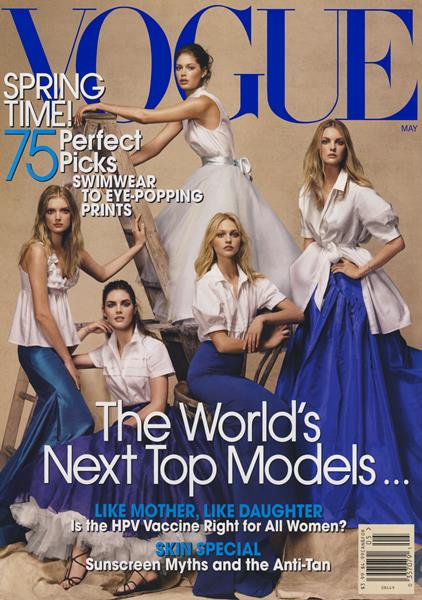
On the May 2005 cover is Liy Kebede, photographed by Karl Lagerfeld. The model is dressed in a contrasting black-and-white outfit featuring textured detailing and fringe. She sits in a relaxed pose, gazing at the camera with a slight smile. The light background highlights the details of her clothing and emphasizes the subject’s figure. Of particular note is the inscription, «Cover Model with a Cause, ” which links the model’s image not only to fashion but also to social advocacy. Visually, the cover retains the aesthetic of a glossy magazine, yet the text imparts a new dimension to the subject—social engagement.The May 2007 cover, shot by Steven Meisel, features five models: Lily Donaldson, Hilary Rod, Doutzen Kroes, Sasha Pivovarova, and Agnes Deining. All the women (with one exception) are dressed in white blouses and blue skirts, which lends a sense of unity to the composition. Furthermore, the models are positioned at varying heights: some are standing, others are seated or leaning on props. The beige background does not distract from the subjects, while the vibrant blue skirts create a strong color accent. The headline, „The World’s Next Top Models, ” directly communicates the cover’s core concept—the emergence of a new generation of models. These women are presented as professional participants in the industry, each possessing the potential to become a new star.
March Cover of Vogue US 2009 / May Cover of Vogue US 2009
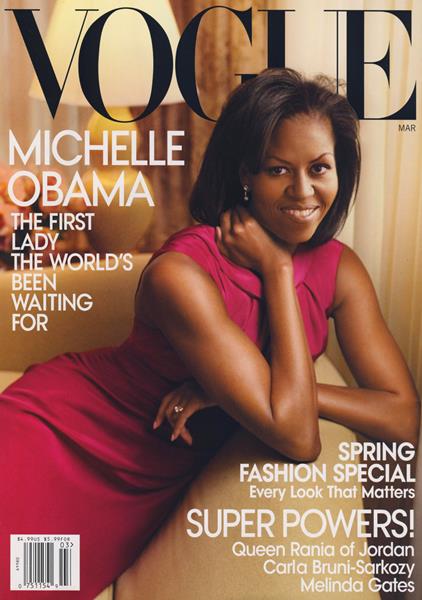
The March 2009 cover features Michelle Obama. Unlike most examples we have examined, the subject is neither a professional model nor an actress. She is shown in a bright pink dress, resting her arms on a surface and offering a slight smile. The warm background and soft lighting create a welcoming atmosphere, and her pose appears less staged and more open. The large text bearing her name emphasizes her independent significance. The appearance of the First Lady on the cover shows that Vogue is engaging with women whose fame stems not only from fashion but also from public and political life.
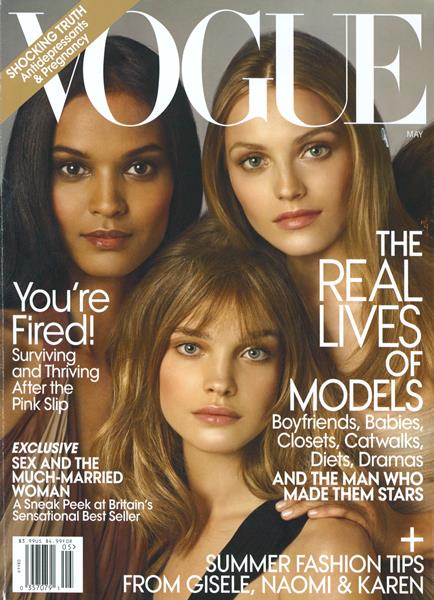
Another interesting example is the May 2009 cover, which features three models: Lia Kebede, Natalia Vodianova, and Anna Yagodzinska. Their faces are positioned close to one another, and the neutral background and soft tones do not distract from the subjects' appearance. The composition lacks a single dominant figure—attention is distributed among the three women. Furthermore, the differences in skin tone, hair color, and facial features give the group greater visual diversity. The caption «The Real Lives of Models» suggests viewing the models not just as beautiful faces on a cover, but as individuals with personal lives and unique experiences. This reveals the magazine’s interest in a more personal portrayal of its subjects.
The reviewed covers demonstrate that throughout the 2000s, alongside the familiar ideal of the glamorous and flawless woman, more natural, individual, and socially significant images gradually emerged.
Meanwhile, the core visual characteristics of glossy magazines persisted: meticulously crafted compositions, professional photography, and a focus on appearance and high fashion. The selection of featured women changes noticeably, however. If the early part of the decade primarily emphasized supermodels and celebrities, by the end of the period, covers increasingly featured group portraits, representatives from new generations of models, and women known outside the fashion industry. Yet, this does not signify a complete abandonment of traditional beauty standards. Rather, Vogue gradually expanded the conventional boundaries of the feminine archetype while retaining the signature aesthetic of a glossy publication.
3. DIGITALIZATION OF MEDIA CULTURE AND THE EVOLUTION OF FEMININE IMAGERY (2010–2019)
During the 2010–2019 period, the fashion industry underwent significant transformation. Social media, blogs, and digital platforms gradually became integrated into daily life, altering the traditional role of glossy magazines. Where Vogue was once a primary source for fashion aesthetics, readers could now track the styles of celebrities and models directly through online platforms. Women gained the ability to construct their own public image, share photographs, and influence fashion trends. Consequently, the magazine had to adapt to this new media environment and expand its definition of who could be featured on the cover.
March cover of Vogue US 2011 / November cover of Vogue US 2012
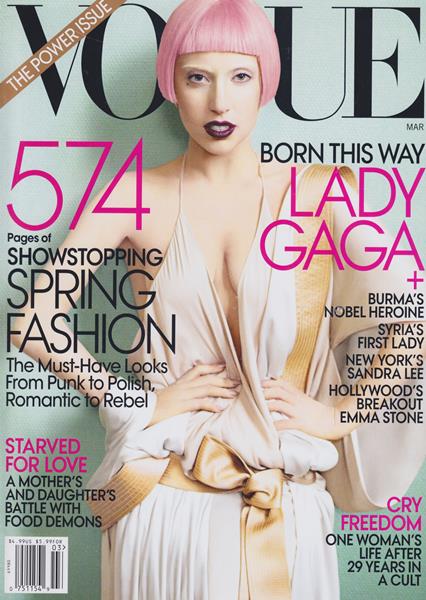
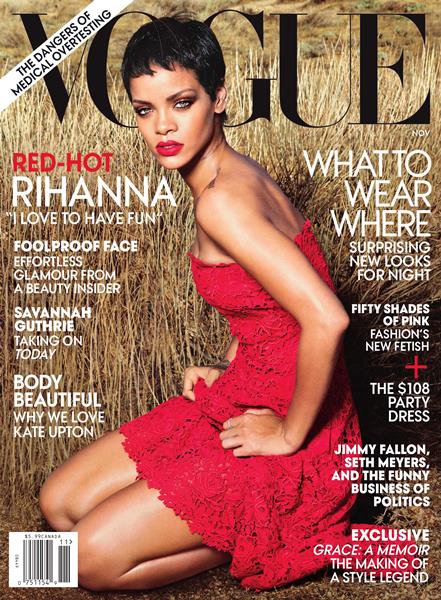
One notable example from the beginning of the decade was the March 2011 cover of Vogue US featuring Lady Gaga, photographed by Mario Testino. The singer is depicted in a light, flowing dress with a golden detail at the waist. Her short pink wig and dark lipstick immediately stand out against the light background. However, her pose is quite restrained, and her gaze is directed straight at the viewer. This creates an interesting juxtaposition: the subject’s appearance retains her recognizable extravagance, yet the photograph itself is executed with classic glossy aesthetics. The cover illustrates how Vogue began to actively incorporate artists into fashion culture whose popularity stems not only from their looks but also from their vibrant stage personas. What becomes significant is not adherence to conventional standards, but recognition and individuality. During this same period, the magazine began experimenting with digital formats: for the March 2011 issue with Lady Gaga, a dedicated iPad application was created, featuring supplementary photos, interviews, audio, and video. This signals that the printed cover was gradually becoming part of a broader digital narrative.The November 2012 cover features Rihanna, photographed by Annie Leibovitz. The singer is seated amidst tall, dry grass in a bright red lace dress. The saturated color of her attire sharply contrasts with the muted natural tones of the background. The subject looks directly into the camera, and her pose appears confident and slightly provocative. The red dress becomes the primary visual focal point, underscoring the boldness of the image. Unlike the more reserved portraits of the previous decade, femininity here is connected to vibrancy, sensuality, and autonomy. Rihanna is presented not as a passive object of admiration, but as a woman who actively directs her public image.