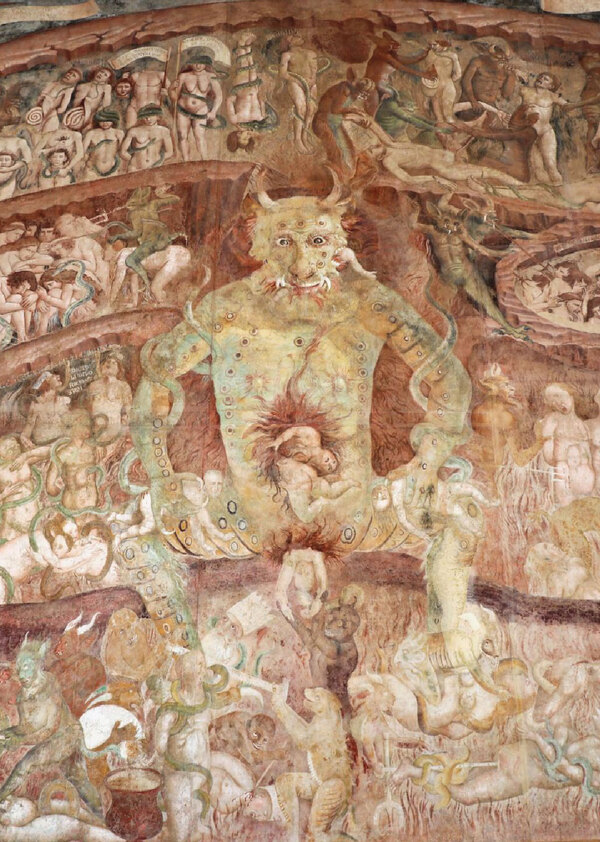
Research Objective
To study the characteristics of hell imagery in Western European art from the 12th to the 14th centuries—identifying the primary artistic techniques and visual motifs that medieval artists used to convey the concept of eternal punishment. Special attention is paid to the depiction of infernal spaces, the physical suffering of sinners, and demonic beings. Based on the analysis and comparison of paintings, frescoes, miniatures, and sculpture, this work will investigate how the visual representation of hell was formed and evolved in medieval art.
The depiction of hell in medieval Christian art holds a significant place, as it was through these images that artists conveyed conceptions of sin, punishment, and the afterlife. Studying these motifs allows us to trace how the unseen world was transformed into a specific and terrifying visual space. Of particular interest is how artists portrayed the torments of sinners, demons, and the space of hell itself, imbuing it with characteristic details and symbols.
In medieval art, hell is frequently depicted as a place of torment, filled with fire, monsters, and various instruments of punishment. Sinners are shown in agonizing postures, surrounded by demonic beings that act as enforcers of punishment. Furthermore, the depictions of these demons exhibit great variety—they are endowed with horns, claws, wings, bestial features, and unusual body forms that emphasize their opposition to all things divine.
This study will be built upon a comparative and typological analysis of Western European art from the 12th to the 14th centuries. Primary focus will be placed on three areas: the depiction of Hell as a space, the visualization of the physical torment of sinners, and the iconography of demonic beings. The analysis will examine composition, color palette, the nature of the figures depicted, their poses and interactions, as well as the degree of expressiveness and detail in the scenes.
By comparing frescoes, book miniatures, mosaics, and sculptural depictions, we can reveal common visual motifs and differences in the interpretation of Hell. Thus, this study aims to demonstrate the artistic means medieval masters employed to create the frightening and recognizable image of eternal punishment.
«Last Judgment, ” Santa Maria Assunta Basilica, Torcello, circa 1100.
The depiction of the Judgment in the mosaics of the Basilica of Santa Maria Assunta in Torcello portrays a bleak expanse of eternal torment, contrasted with Paradise. At the top, condemned sinners are being guided by angels toward punishment. Central to the scene is the figure of Hades, personifying the realm of the dead: upon his lap is depicted the wealthy man Dives from the biblical parable. Above this scene flows a river of fire, symbolizing God’s wrath and the inevitability of divine judgment.
«The Last Judgment, ” Santa Maria Assunta Cathedral, Torcello, c. 1100.
The lower section of Hell, divided into six distinct chambers of punishment, is particularly striking. This arrangement creates the impression of an organized space where every sinner is doomed to eternal retribution. Torment is represented through images of eternal fire, cold, and other corporeal suffering. Because of this, Hell is perceived not merely as a dwelling place for sinners, but as a vivid depiction of eternal punishment, designed to instill fear of sin in believers and to remind them of the inevitability of the Last Judgment.
Gislebertus. «The Last Judgment, ” Otton, c. 1130–1146.
«The Last Judgment» by Gislibert of Otton is a monumental stone relief (tympanum) above the western portal of St. Lazarus Cathedral in Otton, created around 1130–1145. The composition centers on a massive Christ the Judge, surrounded by a mandorla and angels. On either side of him, the souls are being divided: some head toward Heaven, where they are met by the Apostle Peter, while others are condemned to eternal torment in Hell. A significant scene is the weighing of souls by the Archangel Michael, who is being obstructed by a demon.
Gislebertus. «The Last Judgment, ” Otton, circa 1130–1146
The right side of the relief is filled with figures of sinners and demons. The condemned are depicted in unnatural, contorted poses: their bodies seem to be constricted by terror, and their faces express despair. A particularly terrifying scene shows a demon grasping the soul of a sinner with enormous claws and dragging it into hell. The contrast between the calm of the saved and the torments of the condemned intensifies the emotional impact of the work. Thus, Ghislbert transforms the Last Judgment into a vivid warning about the consequences of sin, intended to frighten the faithful and prompt repentance.
«Tundal’s Visions, ” medieval illustrations, circa 1149
In the miniature from the manuscript «The Visions of the Knight Tundale, ” one episode of the human soul’s journey through hell is depicted. In the left part of the composition, Tundale’s naked soul is shown, accompanied by an angel in a blue robe. Before them unfolds a terrible scene: a huge circular vessel filled with molten mass, within which are human figures. Some sinners are submerged in it almost entirely, while others fall from above, seemingly unable to escape the torment. The dark background and the reddish hues of the vessel amplify the sensation of heat, creating a stark contrast with the angel’s bright garment.
The depicted scene is dedicated to the punishment of murderers. According to the text of the medieval work, the souls of people who have taken other lives undergo repeated torments: they are burned on a scorching surface, after which the melted bodies drain through holes into a fiery vessel. The suffering then repeats itself, preventing the sinners from finding peace. The artist conveys this punishment through the image of a massive vessel filled with human bodies and figures falling into it from above. An angel accompanies Tundal, showing him the consequences of grave sins. Thus, the miniature presents hell as a space of infinite repetition of torment, where punishment is directly linked to the crimes committed during life.
«Mouth of Hell, ” Winchester Psalter, circa 1150
In the miniature «Mouth of Hell, ” Hell is depicted as the enormous, open jaws of a fantastic monster reminiscent of Leviathan. Inside its mouth are exposed human figures, tightly intertwined with one another. Their bodies are shown in helpless and unnatural poses, creating the impression that the sinners are being consumed by Hell itself and cannot escape.
Particular attention is drawn to the angel closing the mouth of hell with a door and a lock. This gesture symbolizes the finality of divine judgment: the souls of the condemned are forever imprisoned within. The image of the mouth transforms hell into a living monster that devours human souls, and the tight cluster of bodies intensifies the feeling of horror and hopelessness. Thus, the miniature vividly depicts hell as a space of eternal confinement and punishment for sinners.
«The Ad,» Garden of Earthly Delights, c. 1490–1510
In the miniature «Hell» from the encyclopedic manuscript «The Garden of Earthly Delights,» created by Abbess Gerharda Landsberg, hell is depicted as a multi-tiered space filled with fire, demons, and suffering sinners. The composition is divided into several horizontal levels, each illustrating distinct scenes of punishment. The background is a black expanse, from which vibrant red and orange flames especially stand out. Fiery areas also border the image, framing the scene. This structure allows for hell to be perceived as a rigidly organized space where every sinner is allotted a specific torment.
«The Ad, ” Garden of Delights, circa 1180
The diversity of punishments depicted is particularly striking. On the upper tiers, demons hang unclothed figures, torment them with sharp instruments, and subject them to fire. Below, one can see figures who are being beaten, forced to swallow various objects, as well as people placed in large cauldrons. Among these are groups marked with inscriptions as Jews, armed warriors, and monks. At the base of the composition sits Satan on a throne; the Antichrist is depicted on his lap. Satan himself is also bound by chains, which indicates the limitation of his power. Thus, the miniature is not merely an illustration of hellish torments, but rather a systematic depiction of punishments where the status of the sinners and the nature of their suffering hold special significance.
«Ad, ” Orvieto Cathedral, circa 1310–1330.
The sculptural relief «Hell» is part of the marble decorative cycle on the facade of the Basilica of Santa Maria Assunta in Orvieto, Italy. Dating to the first half of the 14th century, it is integrated into the composition of the fourth pillar on the facade, which is dedicated to the Last Judgment. The creation of these reliefs is associated with the Italian architect and sculptor Lorenzo Maitani, who oversaw the work on the facade, as well as with the artisans of his workshop. However, the precise authorship of individual sculptural scenes remains a subject of scholarly discussion. The reliefs are executed in marble and present a sequential narrative of humanity’s afterlife: the resurrection of the dead, the separation of the righteous and the sinners, and the depiction of paradise and hell.
«Ad, ” Orvieto Cathedral, circa 1310–1330.
At the top of the relief is a group of naked sinners being directed toward hell by an angel and demonic entities. The human figures are tightly grouped together; some are bound with ropes and are holding onto each other’s hands. Their faces express fear, despair, and resistance to what is happening. The variety of poses and expressions allows the artist to convey each person’s individual reaction to their impending fate. The composition creates the impression of a continuous movement of a crowd being forcibly led away from salvation toward eternal punishment.
«Ad, ” Orvieto Cathedral, c. 1310–1330
The lower portion of the relief depicts scenes of direct hellish torment. At the center is Satan, whose body is encircled by serpents and dragons. He sits atop a pile of sinners' bodies, trampling them with his feet. Surrounding him are demonic creatures torturing the damned: pulling at their hair, biting, beating, and ensnaring them with snakes. The human faces—twisted by pain and terror—are rendered with particular expressiveness. Thus, hell is presented as a space of cruel physical suffering, in which the demons act as direct executors of punishment, and the figure of Satan becomes the central image of the entire composition.