Concept
What details in the miniatures indicate whether the dragon is threatening, resisting, or already defeated?
I am comparing miniatures from two illustrated manuscripts of the Book of Revelation. The artists position the figures and place accents differently, even though they depict the same events. For instance, in scenes of the chase, the Woman and the dragon occupy different spaces, but in both miniatures, the Woman manages to escape.
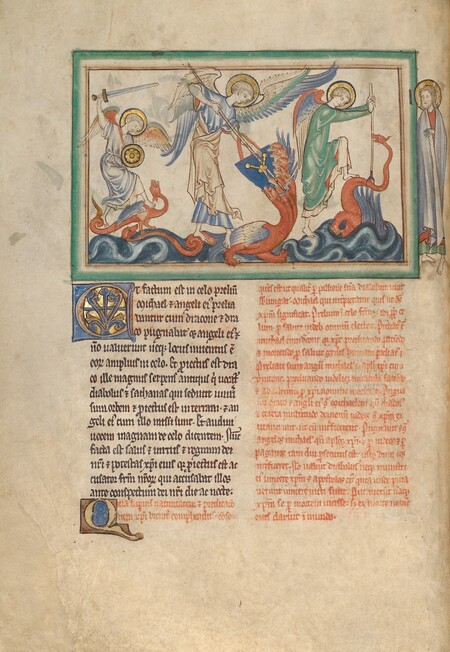
Its wings, tail, and multiple heads help identify it in each of these situations. To determine the outcome of the scene, one should examine the direction of the heads, what the body is supported on, and what the adjacent figures are doing. A shield between the jaws and the human, for example, shows where the adversaries have met. An overturned body at the edge of the miniature can indicate how the fight concluded.
At the bottom of the illustrations in both manuscripts, the water flows downward, and the Woman rises above the current.
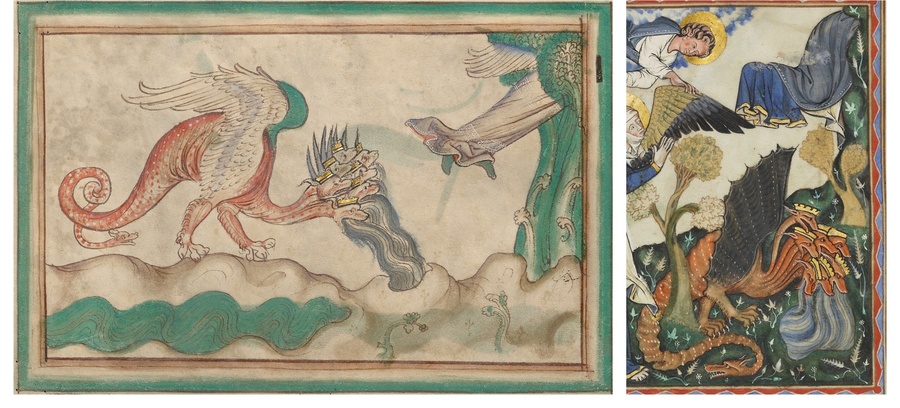
The Chase for the Wife. On the left — Getty Apocalypse. On the right — Dusa Apocalypse. Fragments.
First, I examine two pages where the dragon stands next to the beast to highlight its characteristics. I grouped the remaining miniatures according to how it interacts with other figures. In scenes with the Woman, the space between her and the dragon is significant. In battles with humans, the jaws are already pressed against the shields, while in the battle of the angels, the weapons are directed from top to bottom. In scenes following the battle, the dragon’s posture and its placement within the frame change.For comparison, I selected sixteen miniatures from two 13th-century English manuscripts. The Getty Apocalypse is dated to approximately 1255–1260 and is linked to London. The Bodleian Library catalog lists a wider range for the Duse Apocalypse, 1250–1275, and suggests Westminster as a possible creation site. The artists’ names are not indicated in the records [1, 2].I placed two versions of the same episode side by side. The overall views show where the frame runs and how the participants are positioned. Enlarged fragments help clarify a specific gesture or point of collision. For example, in the general view of the battle with the righteous, the raised swords are easily noticeable, while the fragment reveals the direction of the head of the tail behind the warrior. The scale of the fragments varies in some places, so I estimate the size of the dragon within each miniature.I sourced the dates, scene titles, and manuscript information from museum and library catalogs [1–3]. For the scenes with the Woman, the sequence of events in Chapter 12 of Revelation, analyzed by Sergi Domenec Garcia [5], is important. She explains why the Woman and the dragon appear twice in one frame in the Duse. When comparing the battle scenes, I relied on Edina Esenyi’s observation: in one miniature, a fight and a fall may coexist [4]. For the Getty, for instance, the dragon is still reaching for the angel in the center, whereas in the right frame, it is already lying overturned.
How to Find the Dragon
Impure spirits emerge from the mouths of the dragon, the beast, and the false prophet. The Getty Apocalypse, c. 1255–1260.
At the Getty, the red dragon stands between the false prophet and the spotted beast. The beast on the right also has several heads, which are raised higher. The dragon is distinguished by its long red neck, wings, and a tail that curls beneath the bottom frame.
The Dragon transfers power to the Beast. Apocalypse of Dusa, 1250–1275.
At the center, amidst the monsters, a crown is visible atop a long scepter. To the left, a dragon with a long neck and wings is turned toward it; to the right stands a furry beast. People on the edges are gazing toward this pair. The paws of both creatures meet on the scepter, and the transfer of power is evident in this gesture.
Heads and Tails
Heads and tails. On the left is Getty Apocalypse. On the right is Dusa Apocalypse. The magnification of the fragments varies.
Upon magnification, you can see how necks emerge from a single body, and the tail ends in another head. In these scenes, it lies near the bottom border. In battle with the righteous, Getty’s head also lifts behind the warrior and becomes a second source of threat.
How the Dragon Pursues the Woman
Before the opponent
A Woman Adorned in Sun. Gheti Apocalypse, circa 1255–1260.
Before the dragon appears, the Wife is positioned almost in the center. Rays radiate outward from her, and a band of clouds separates her from John on the left. On the next plate, the light circle remains, but the Wife is already leaning forward and raising her arms.
Dragon next to Infant
The Ascension of the Child. Left — Getty Apocalypse, c. 1255–1260. Right — Dusa Apocalypse, 1250–1275.
In the panel depicting the Adoration of the Child, it is evident that the artists have swapped the positions of the dragon and arranged the figures differently. In both instances, the resolution can be discerned by the hands lifting the child above the open jaws.
Dragon before the Wife; The Ascent of the Infant. Apocalypse Ghent, c. 1255–1260.
On the upper plane, the dragon extends along the left border, while its tail passes beneath the Wife almost across the entire miniature. She leans and raises her arms upward and to the right toward the angel who is receiving the Baby. The gaze travels diagonally past the child, even though the dragon occupies much of the space on the left and bottom.
The Dragon before the Wife and the Ascension of the Child. Apocalypse of Dusa, 1250–1275.
The dragon stands on the right side of Dusa. Its tail is curled near the bottom border, and its neck bends toward the Infant. The woman is seated, and the child is being lifted almost straight up through the cloud circle.
Gaining Wings
Gaining Wings. Fragments of Gethsemane Apocalypse and Dusa Apocalypse.
At Getty, the wings are clearly visible against a light background. In Dusa’s work, there are more figures and details around them, yet it is still clear where Zhenya will go next.
The Dragon pursues the Woman who receives eagle wings. The Getty Apocalypse, c. 1255–1260.
At Getty, the dragon’s front legs are raised, its head reaching toward the right. A bright gap remains in the center. Through this gap, it is clear that they are still far from Jena. Another movement is already above her—an angel descends with wings, and she raises her hands to meet him.
The Persecution of Jana and the Flight into the Desert. The Apocalypse of Dus, 1250–1275.
Dusa Jena appears twice. In the center, she is receiving wings, and in the upper right corner, she is already flying. The dragon also repeats. On the left, its heads are raised, while on the right, they are tilted toward the flow of water. Thus, several moments from Revelation chapter [5] are contained within one frame.