Navigation
1) Concept 2) Introduction to the Visual World of Alexandra Snezhko-Blotskaya 3) Visual Sources and Stylization 4) Architecturality of Mythological Space 5) Archetypes and Visual Metaphor in Characters 6) Cinematic Rhythm and the Dynamics of Myth 7) Conclusion
Concept
Alexandra Snezhko-Blotskaya is a director and animator whose work holds particular significance for me. I have loved her creations since childhood and return to them regularly. This is why the theme of my visual research—which explores the unique cinematic and plastic language of her ancient cycle—became an opportunity for me to study the director’s work more deeply, understand the characteristics of the artistic world she created, and comprehend why these pieces remain relevant decades later.
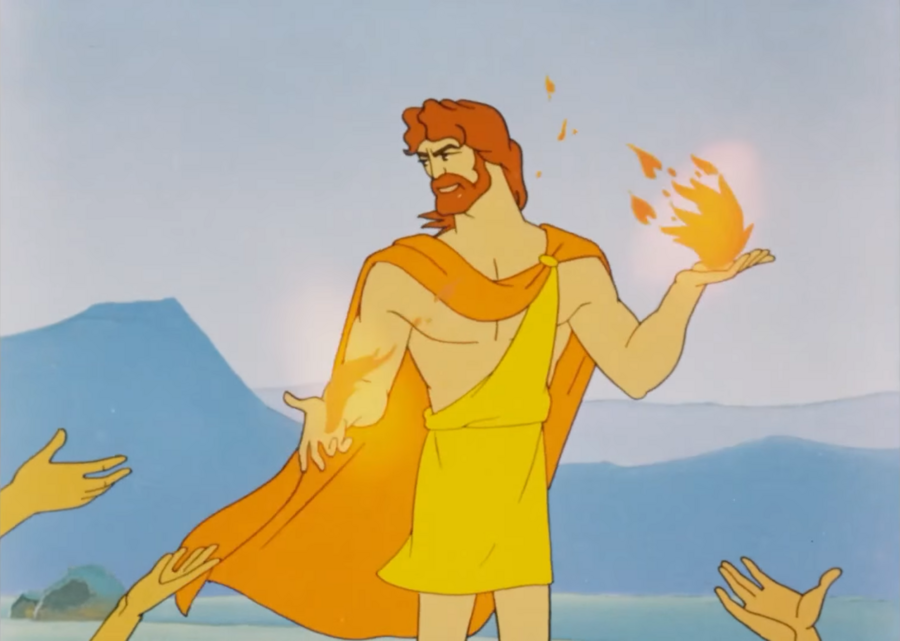
«Prometheus» 1974
The study focuses on five animated films from Soyuzmultfilm Studio: «Return from Olympus» (1969), «The Labyrinth: The Feats of Theseus» (1971), «The Argonauts» (1971), «Perseus» (1973), and «Prometheus» (1974). Created at the turn of the 1960s and 1970s, they represent a significant phase in the history of Russian animation and form a unique way of interpreting ancient Greek mythology on screen.
«Return from Olympus» 1969
The relevance of this study lies in the need to re-evaluate the Soviet artistic approach to ancient heritage. In Snezhko-Blotskaya’s interpretation, mythological plots cease to be merely retellings of ancient legends and transform into universal humanistic narratives about freedom, courage, moral choice, human dignity, and responsibility. Through the confrontation between gods, heroes, and monsters, questions are revealed that remain significant regardless of the historical era.
«Argonauts» 1971
The visual component of the films is of particular interest. In their artistic language, one can trace references to the aesthetics of ancient vase painting, sculptural relief, monumental architecture, and the plasticity of the human body. The conciseness of the silhouettes, the expressiveness of the gestures, the restrained color palette, and the deliberate composition create a sense of a living, mythological space. At the same time, the stillness and solemnity of ancient art merge with movement, editing rhythm, and the expressive potential of animation.
The subject of this study is the artistic and stylistic system of five films from the director’s ancient cycle. The object of study is the methods of visualizing epic and mythical space, as well as the evolution of iconic archetypes (god, hero, monster).
The core concept of the project is to view films not merely as illustrations of ancient Greek myths, but as independent visual canvases where the principles of ancient art—vase painting, relief sculpture, monumental architecture, and round sculpture—come to life. The artists have created a space where the static narrative of epic storytelling organically merges with the dynamism of modern animation. It is in this synthesis that the unique language is born, transforming the Snezhko-Blotskaya cycle from just a historical artifact into a living artistic statement that remains powerfully relevant today.
Introduction to the Visual World by Alexandra Snezhko-Blotskaya
The 1960s and 1970s are traditionally defined by Russian cinema researchers as the flourishing period—the «golden age”—of the Soyuzmultfilm studio, when Soviet animation definitively began to forge its independent visual language. It was within this innovative creative environment that the directorial talent of Alexandra Gavrilovna Snezhko-Blotskaya blossomed. After studying under the distinguished master Ivan Ivanovich Ivanov-Vano (with whom she created the masterpiece, „The Snow Queen, ” in 1957), Snezhko-Blotskaya turned to sweeping, epic narratives.
«Labyrinth. The Deeds of Theseus» 1971
Her work stood out from the general stream of children’s animation due to its rigorous dramaturgy, philosophical depth, and visual culture unparalleled for its time. The ancient cycle created by the director at the studio became the pinnacle of this direction, proving that animation is capable of speaking to the viewer in the language of high tragedy and myth.
«Argonauts» 1971
The Soviet animation’s appeal to ancient heritage during the specified period was not accidental. In the era of the «thaw» and the subsequent decades, domestic art experienced a surge of interest in universal humanistic values, the search for existential meaning, and the reinterpretation of classical archetypes. In Snezhko-Blotskaya’s interpretations, ancient myth functioned as a timeless model of human existence, centered on themes such as free will, overcoming fate, civic responsibility, and creative labor. Unlike the entertaining Hollywood adaptations of the same period, the Soviet animation school built its mythological worlds on a deep respect for the original source—classical translations of ancient authors and scholarly works on mythology. Furthermore, the myth on screen underwent a humanistic demythologization: the gods here often appear as embodiments of capricious forces and conservative order, while mortal heroes, through their bravery and creative audacity, pave the way for a new era.
«The Labyrinth. The Deeds of Theseus» 1971
The success of the ancient cycle is significantly attributed to the creative partnership between director Alexandra Snezhko-Blotskaya and production designer Alexander Trusov. It was their collaboration that allowed them to move beyond the illustrative rut that myth adaptations often fall into. Snezhko-Blotskaya established the overarching dramatic score, scope, and rhythmic development of the film, while Trusov forged a unique visual language based on a profound knowledge of ancient material culture. Their partnership was built on the interpenetration of directorial vision and visual exploration: every frame was constructed like a painterly canvas, where color, line, and light worked to reveal the character’s inner drama. Trusov avoided excessive detail, leaving the audience room to contemplate pure form, which perfectly matched the director’s monumental concept.
Visual Sources and Stylization
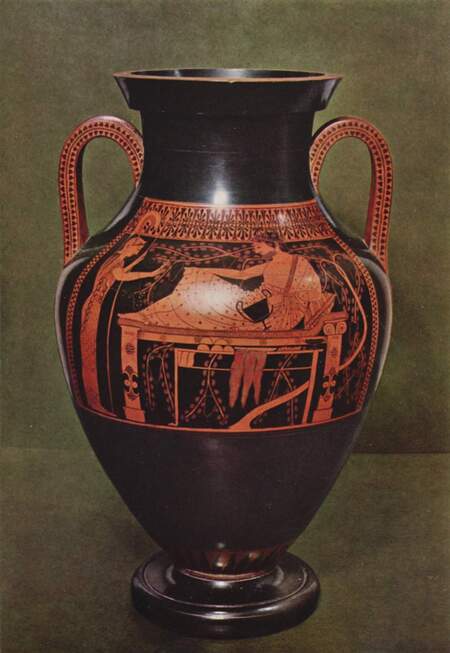
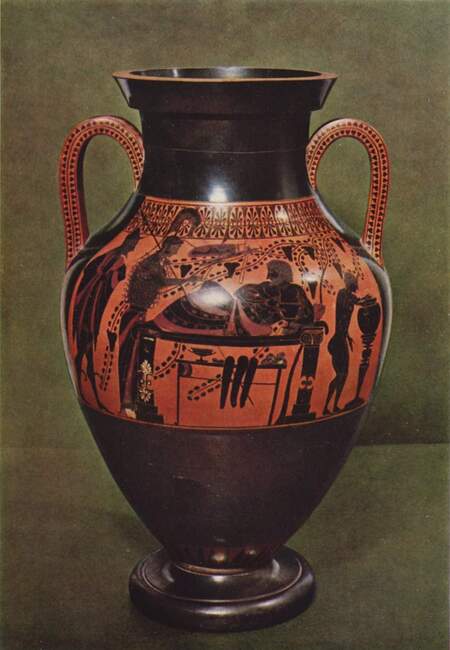
Amphora-Bilingual
The foundational pictorial source for the ancient cycle by Alexandra Snezhko-Blotskaya and its permanent set designer, Alexander Trusov, was ancient Greek vase painting—primarily the black-figure and red-figure styles of the 6th–5th centuries BCE. Instead of the volumetric chiaroscuro modeling characteristic of the academic school and early Disney style, the creators turned to flat graphics, where the primary expressive medium is the flawless outline, notable for its purity and plasticity.
«Return from Olympus» 1969
In films such as «Return from Olympus» and «The Labyrinth: The Deeds of Theseus,» characters often unfold within a canon characteristic of archaic and early classical vase painting: the head and legs are depicted in strict profile, while the torso maintains a frontal orientation. This technique allows the viewer to instantly read the hero’s silhouette, transforming every frame into a complete graphic formula that directs the audience toward the art of ancient Greece.
«Prometheus» 1974
In their treatment of line and contour, the creators employed a resilient, concise outline with variable pressure, accentuating the anatomical structure of muscles and the folds of the chiton. This approach directly inherits both the scratched contours of the black-figure style and the delicate brushwork of the red-figure style. The body perspectives are based on the canonical Egyptian-Archaic projection (head and leg profiles against a frontal torso) in static and walking scenes, shifting to a dynamic angular break during the climactic moments of combat.
«Return from Olympus» 1969
Beyond the planar graphics of the figures, the visual structure of the cycle is deeply rooted in the traditions of ancient Greek monumental sculpture and relief. The artists achieve the effect of «living marble» through the sculptural modeling of the characters’ volumes. Unlike the light, grotesque silhouettes of comic animation, Snezhko-Blotskaya’s heroes possess physical weight, density, and heroic proportionality. The choreography of movement is built on the alternation between tense, sculpturally frozen poses and swift, spring-like leaps. The monstrous figures—the Gorgon Medusa, the Minotaur—rely on archaic plasticity and grotesque gorgoneions, retaining the frightening monumentality of ancient idols.
«Perseus» 1973