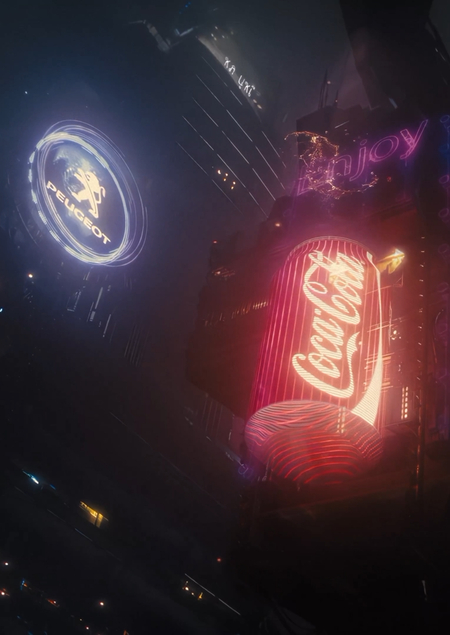
Concept
The genesis of cyberpunk and neo-noir aesthetics in cinema traditionally relies on visualizing overcrowded megacities shrouded in perpetual smog and acid rain. In the genre of science fiction dystopia, the urban space ceases to be mere set dressing, transforming instead into an autonomous character within the narrative.
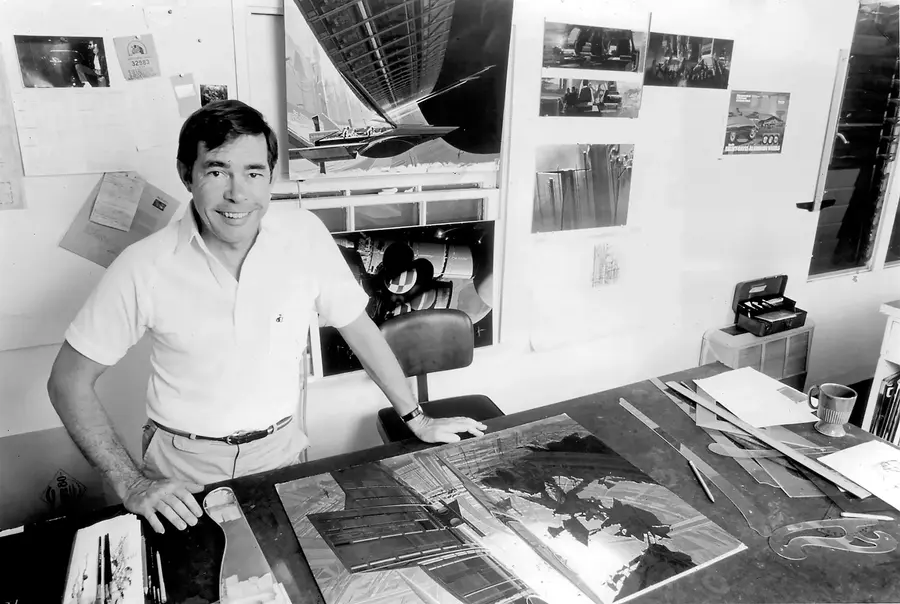
Concept Artist Syd Mead in his studio
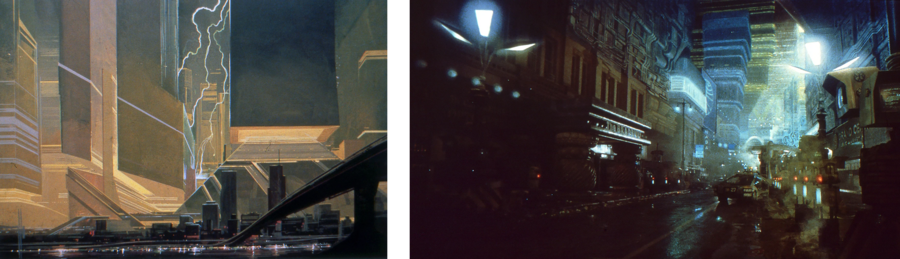
Left: Syd Mead. Concept art for monumental architecture in Los Angeles. Blade Runner, 1982
Right: Still from the film Blade Runner, 1982
To recreate a similar environment, director Ridley Scott and visual futurist Syd Mead formulated the concept of «retrofitting”—layering new communications, gigantic pipelines, exhaust systems, and neon advertising onto old, crumbling urban infrastructure. This transformed the streets into suffocating industrial nodes and set the canon for depicting futuristic urbanism for decades to come.
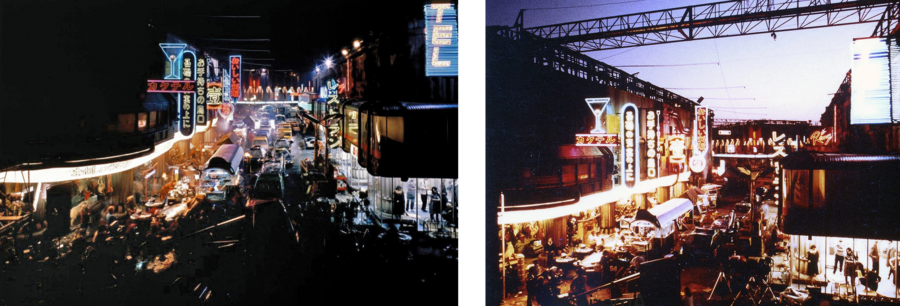
Filming on the Warner Bros. set
«Our vision of the future city was built on the idea of surplus and overcrowding. We took modern New York or Chicago as our foundation—with their transportation collapses—and projected this infrastructure into decades ahead, transforming the space into a single industrial machine.»
— Ridley Scott
A futuristic Los Angeles cityscape from 2019, as envisioned by Ridley Scott and his colleagues in 1982
This visual study focuses on analyzing the visual effects of two films set in the universe of Blade Runner, based on the novel by Philip K. Dick: Blade Runner (1982, dir. Ridley Scott) and Blade Runner 2049 (2017, dir. Denis Villeneuve).
By analyzing the works, one can identify significant differences in the technical approaches of cinema from different periods, trace the evolution of technologies and artistic techniques, and draw conclusions about the development of visual effects in film. Primary focus is placed on the technologies and visualization methods used for the futuristic metropolis of Los Angeles, but also on their effectiveness in creating a oppressive, dystopian atmosphere.
Blade Runner (1982): practical effects, miniatures, and optical compositing
The creation of the visual appearance of Los Angeles in 2019 in Ridley Scott’s film marked a technical milestone in the history of composite filming. The directors of Entertainment Effects Group (EEG)—chief visual effects supervisors Douglas Tramball, Richard Jurysic, and David Dryer, who joined them during production—made the fundamental decision to produce all special effects in a wide-format 65 mm format (65 mm negative, with the positive, or theatrical print, being 70 mm) to preserve image quality, with the exception of several explosion shots filmed on 35 mm film using high-speed capture.
Left: Douglas Trumbull and his team assembling a miniature city Right: Composing an urban landscape shot, shooting on 65 mm
«Our most challenging task was conveying the sense of the city’s colossal scale—showing megastructures hundreds of stories high, towering over regular skyscrapers. Finding the right balance of lighting, scale, and atmospheric perspective was incredibly difficult.»
— Douglas Trambull
A scene from the 1982 film Blade Runner (dir. Ridley Scott) (Visual Effects Supervisors: Douglas Tramball, Richard Jurysich, David Dryer.)
The film opens with a large-scale environment—the industrial landscape of Hades—which serves as the initial setting.
The opening panorama of the Hades Industrial Complex was designed as a large-scale tabletop model measuring 5.5 meters wide and 4 meters deep. Its foundation was a transparent plexiglass table, elevated from the floor to accommodate under-lighting fixtures and cooling systems.
Left: Christopher S. Ross checks the scale similarity in the Hades panorama Right: Miniature painting in a careless style
To create the illusion of a sprawling refinery receding toward the horizon, the model-making department, under the direction of Marc Stetson, employed linear perspective. First, artist Chris Ross and photographer Virgil Mirano conducted a high-contrast photoshoot of refineries in the El Segundo area. Based on these plates, graphic ink silhouettes of the towers and distillation columns were prepared. Subsequently, thousands of delicate metallic silhouettes were created from brass sheets using photolithography and acid etching, and these were then arranged in chaotic rows on a transparent Plexiglas table.
City model cooling system and underlighting
«We used acid etching on brass to create microscopic lattices and towers. But the real depth only appeared when we ran miles of fiber optic cable beneath the model base and illuminated each tower from within.» — Mark Stetson
Incorporating fiber optic threads into the miniature city. Artists Leslie Eckert, George Trimmer, and John Roennow also work with fiber optic threads.
To simulate a million pinpoint city lights, the artists threaded approximately 11 kilometers of fiber optics beneath the table. The strands were passed through drilled holes and secured with silicone sealant at the bases of the brass towers.
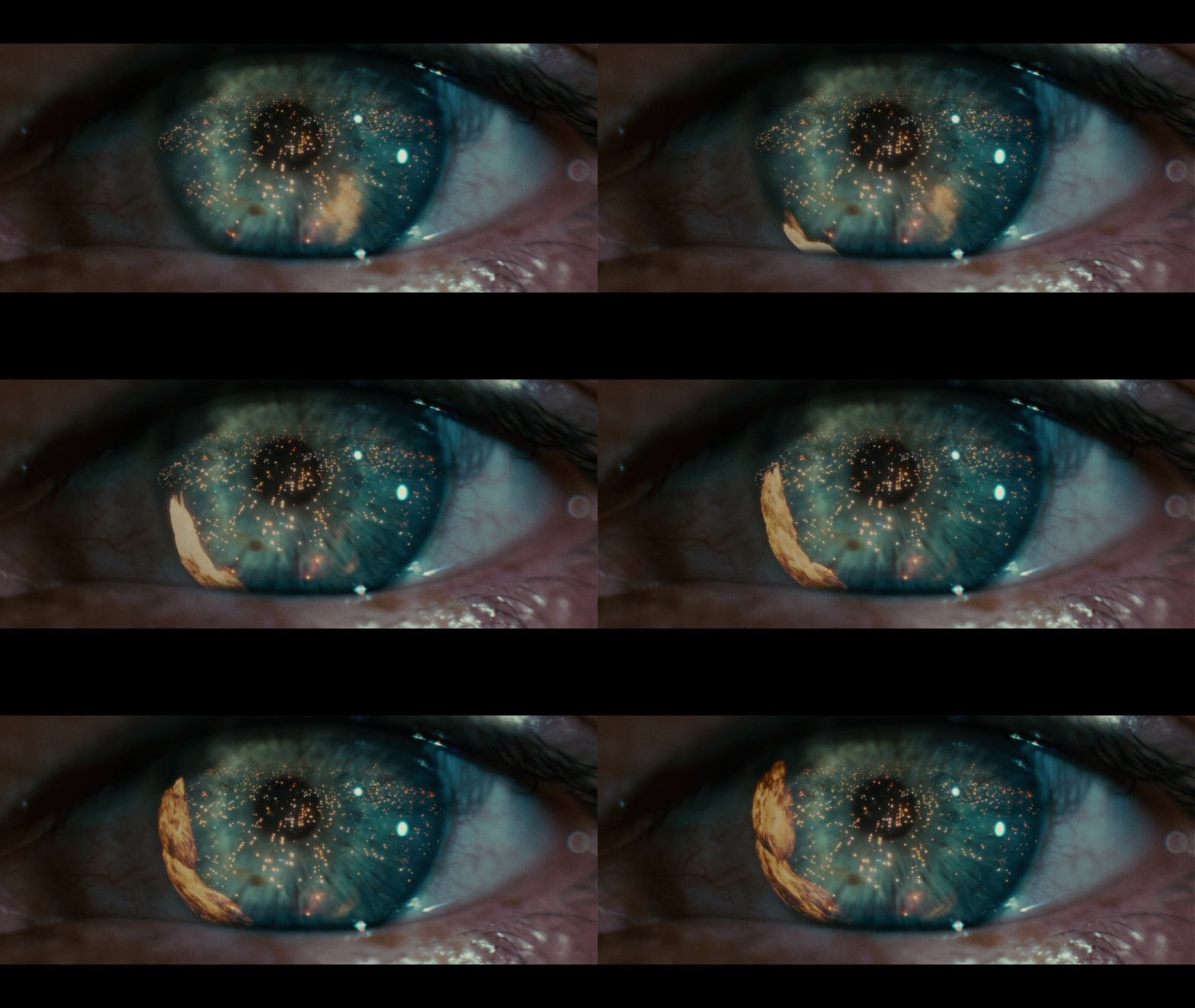
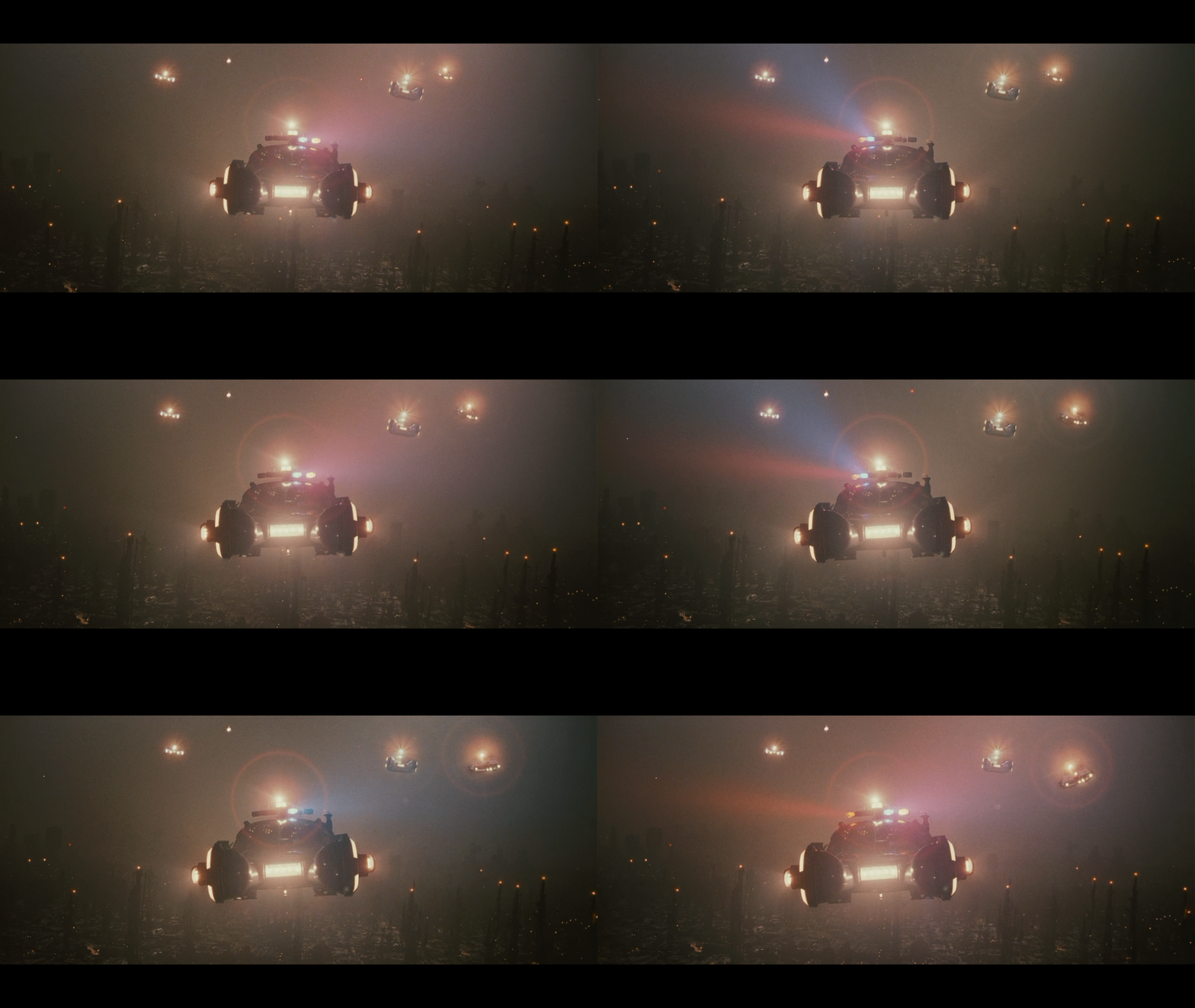
Fragments from the 1982 film Blade Runner (directed by Ridley Scott) (Visual Effects Supervisors: Douglas Trumbull, Richard Yurychich, David Draper)
To create erupting flame torches, the team used gas burners. The flame bursts, reaching up to two meters high, were captured with high-speed cameras at the EEG studio parking lot, operating at up to 120 frames per second. The resulting fire plates were then isolated using rotoscoping and projected onto small white polystyrene screens embedded directly behind the tops of the model towers.
Tyrell Corporation Pyramids, a still from the 1982 film «Blade Runner,» directed by Ridley Scott.
Another key landmark in the city was the 700-story colossal pyramids of the Tyrrell Corporation. To create them, the Stetson team developed a precision casting technology using transparent polyester resin. The resulting acrylic panels, which featured intricate plastic relief, were coated with an opaque primer. Then, master craftsman John Vidor painstakingly scraped away layers of paint from microscopic protrusions with a scalpel, forming thousands of latticework windows. When a powerful 5 kW lamp was placed inside the structure, light penetrated only through the cleared areas, creating the natural effect of randomly lit windows in the gigantic building.
Jon Vidor shapes the windows in the pyramid using a scalpel.
Mockup breakdown