Concept
The Annunciation is one of the most frequent subjects in European painting of the Middle Ages and the Early Renaissance. The artists always share the same objective: to depict the meeting between the angel and Mary. Therefore, the subject is ideal for comparison: when the scene is the same, the differences emerge from the manner of depiction. My interest is not in how the subject evolved over time, but rather how two traditions—the Italian and the Netherlandish—addressed the same challenge during the same decades. In the 1330s–1440s, they approached it differently: the Italians relied on gold, line, and architecture, while the Netherlanders constructed the scene from objects and light.
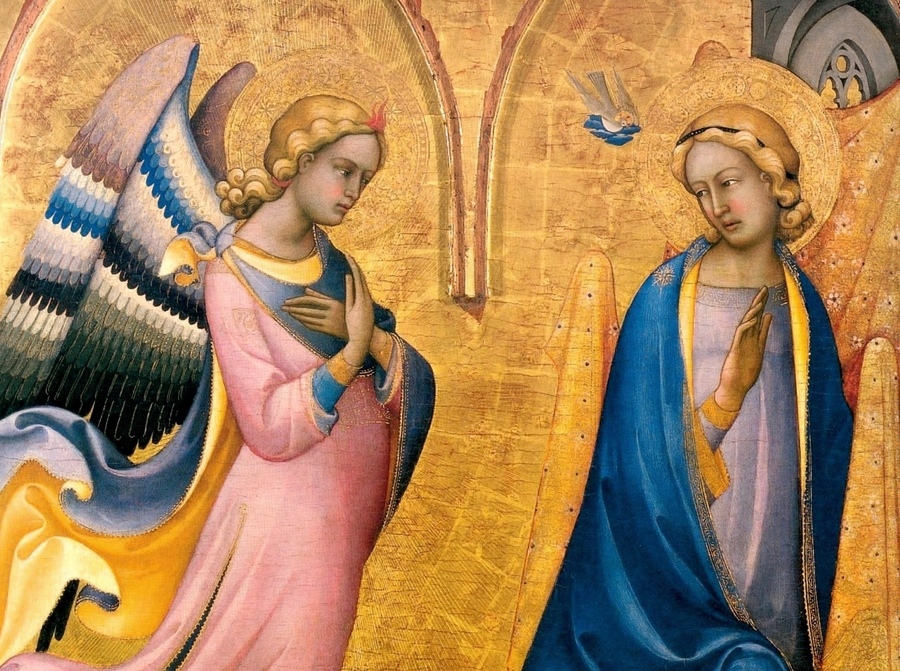
Lorenzo Monaco. The Annunciation. c. 1410–15 (fragment)
In these decades, the very concept of space in painting is changing. In Italy, the golden background is gradually giving way to architectural settings, and artists are learning to construct depth through geometry: in Lorenzetti’s work, the floor beneath the figures is already made of tiles converging into the distance. In the Netherlands, the scene transforms into a room or a church, where every object is discernible and can carry meaning. The Annunciation allows us to compare these two approaches within a single subject, because what changes from one painting to the next is not the event, but the environment in which it takes place.
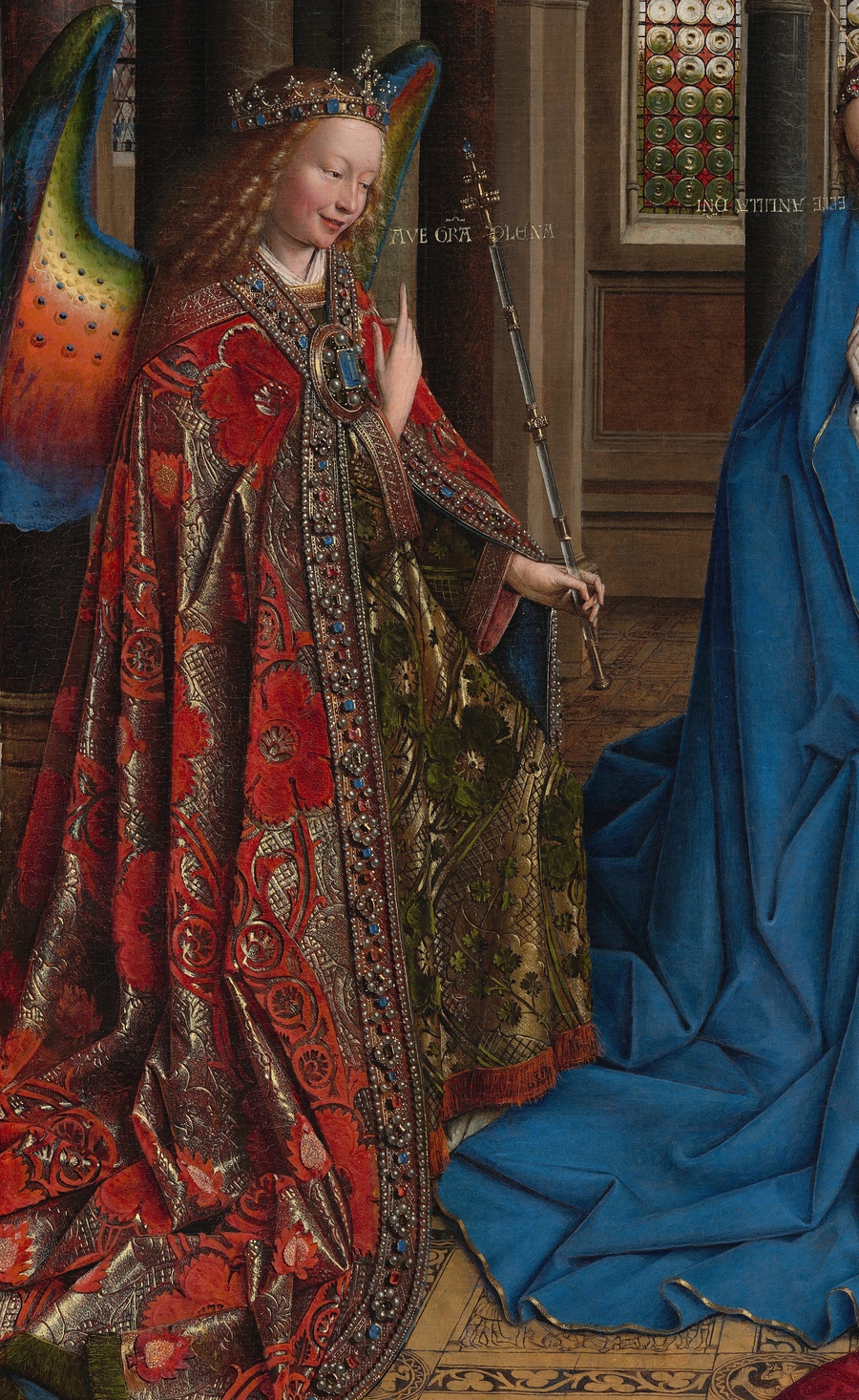
Jan van Eyck. The Annunciation. c. 1434–1436 (fragment)
For this study, I selected eight works: four Italian and four Dutch.The research is structured in pairs across four sections, where an Italian and a Dutch work are compared within each section. Within each section, the space, light, and symbolic objects are compared sequentially. The pairs were chosen so that they represent different solutions to the same problem: Martini’s gold versus Campeno’s room, Lorenzetti’s floor versus the room of Rogier van der Weyden, Fra Angelico’s loggia versus Van Eyck’s church, and the pattern of Lorenzo Monaco versus the overhead view of Petrus Christus.I need texts about the paintings (books and museum pages) to verify dates and the significance of the objects. My conclusions are built upon the analysis of the images themselves.
Key Question: How do the Italian and Dutch approaches to structuring space and light in the Annunciation (1330–1440s) differ?
My hypothesis is that Italians construct space using architectural elements (golden background, floors, columns, and arches), whereas the Dutch create an environment through objects and light. Therefore, the same scene is interpreted differently. For the Italians, meaning is rooted in composition and architecture; for the Dutch, it is rooted in objects and light.
How I approach the comparison: For every pair of pieces, I analyze them using three criteria. Space: how the scene is constructed and how depth is created. Light: where it originates and what it does to the forms. Signifiers: where the scene’s meaning resides—in the lines, the gestures, the text, or the objects.
Eight Works
In the 1330–1440s, two traditions painted the «Annunciation.» The composition in most of these works is similar: Gavriil on the left, Mary on the right. Therefore, it is easiest to compare the setting in which the scene unfolds rather than the arrangement of the figures.
Simone Martini, Lippo Memmi. The Annunciation with Saint Anselm and Margaret. 1333
Ambrogio Lorenzetti. Annunciation. 1344
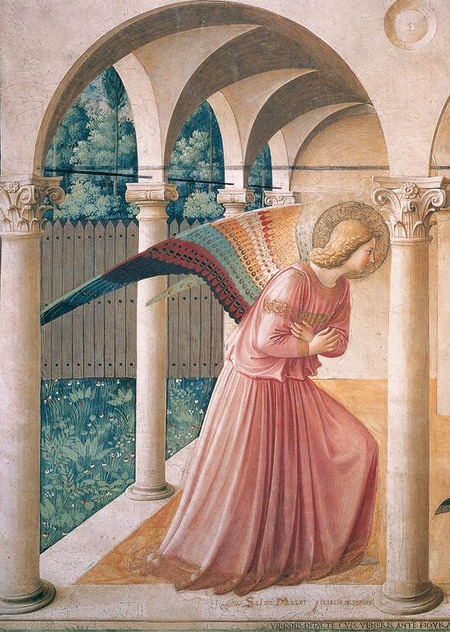
Fra Angelico. The Annunciation. San Marco Monastery, Florence. c. 1440–45
Robert Campin. Mérode Altarpiece. c. 1427–1432
Rogier van der Weyden. The Annunciation. c. 1434
Jan van Eyck. The Annunciation. c. 1434–36
Lorenzo Monaco. The Annunciation. c. 1410–15
Petrus Christus. The Annunciation. c. 1445
Gold and Room: Martini and Kampen
Space
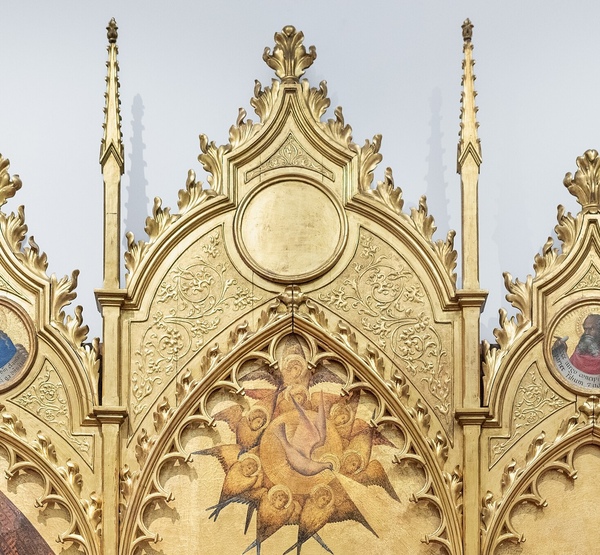
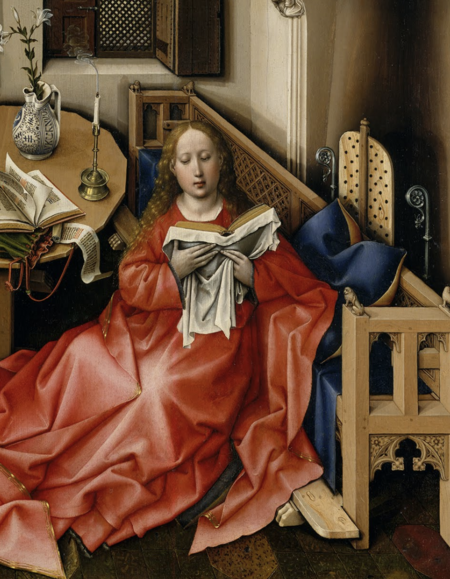
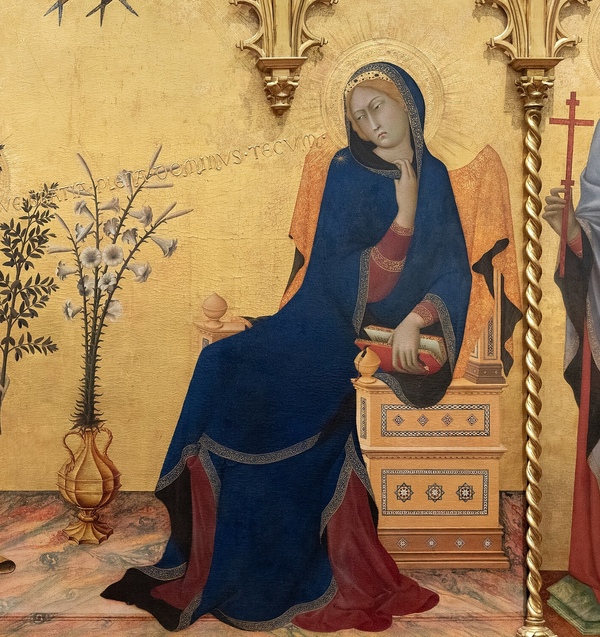
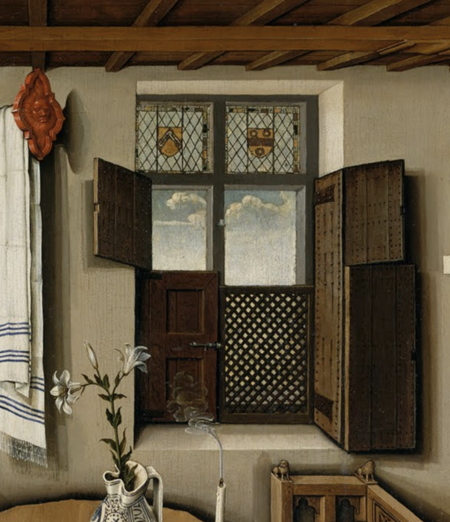
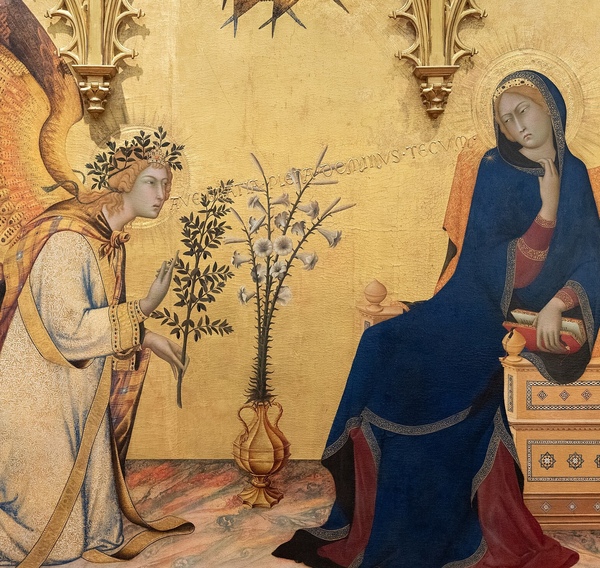
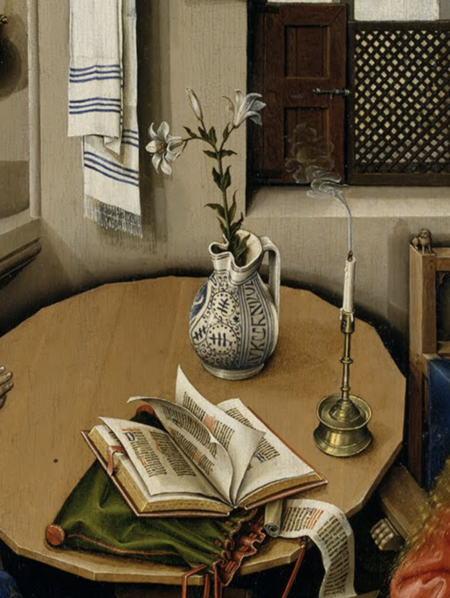
Martini’s work is entirely gold; there is no discernible architecture, and the sense of depth is almost absent. Line and silhouette substitute for space. In Campana’s piece, the scene takes place in a domestic room: next to Maria there is a table, a bench, a fireplace, and a candelabra. Where Martini presents a void of gold, Campana presents a density of objects—the space is symbolic in one and domestic in the other.
Light
In Martini’s work, the gold does not illuminate the figures; it glows on its own, and there is no light source in the space—it is a symbolic light. In Campen’s work, light comes through a window, falls upon objects, and casts shadows, and there is a candle on the table. The scene is lit both naturally and symbolically.
Signifiers
In Martini’s work, Gavriil’s words flow toward Maria in gold lettering, running directly across a golden field—the sign remains part of the flat composition. In Campen’s work, the signs are gathered within the room’s objects: a lily, a candle, a book. The difference lies in where the sign resides: in the line and ornament, or in the object itself.
Conclusion