
The Aesthetics of Habituation: How Visual Repetition Shapes Our Preferences
Research Concept

Why do items that initially seem strange, unattractive, or even ugly eventually become fashionable and desirable?Our aesthetic preferences are not entirely fixed. They are shaped by personal experience, social environment, and the visual information we encounter regularly.This mechanism is particularly evident in advertising and the fashion industry. Brands do not always aim to create objects that appeal to the consumer at first glance. Sometimes, unusual design intentionally breaks established aesthetic norms, eliciting surprise and conflicting emotions.But over time, an unfamiliar silhouette can become recognizable. As it repeats in advertisements, fashion shoots, social media, and daily life, it gradually integrates into our familiar visual environment.Using the Balenciaga Triple S sneaker as an example, we explore how an unconventional shape transforms into an iconic fashion symbol and the role repetition, visual context, and brand authority play in this process.
Area of Study:
visual communications related to Balenciaga Triple S from 2017–2022.
Area of Study:

the influence of repeated exposure to unconventional design and the context of its presentation on the formation of aesthetic preferences.
Hypothesis:
Frequent exposure to an unfamiliar visual object within a positive and authoritative context facilitates its aesthetic acceptance. Moreover, this repetition does not function in isolation, but works in tandem with brand recognition and social endorsement.
Research Methodology:
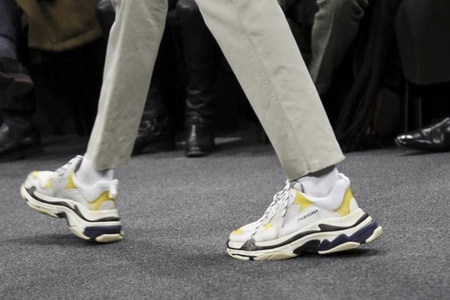
Comparative visual analysis of runway, editorial, advertising, and street style imagery; correlating initial audience reception with subsequent product popularity metrics.
Theoretical Foundation: Zajonc’s Effect
How Visual Affinity is Formed
The influence of the frequency of unfamiliar symbols and words on their emotional evaluation.
American psychologist Robert Zajonc described the mere-exposure effect in 1968: repeated exposure to an object under certain conditions can improve a person’s attitude toward it. This process does not necessarily require conscious analysis. An object can gradually become more appealing simply because a person sees it regularly.
The Dependence of Facial Photo Favorability Rating on the Number of Presentations
Applying Effects in Design
Visual repetition is utilized in advertising and branding to build recognition. An unusual form that initially elicits wariness can, over time, become familiar and comprehensible.However, repetition does not guarantee affinity: overexposure can provoke irritation.Research question: Can the regular appearance of unfamiliar design change perception toward it?
Original visual presentation schema: first contact, repeated contacts, and subsequent object evaluation.
Disruption of the routine: the appearance of the Balenciaga Triple S
Design as the subversion of expectations
In 2017, Balenciaga released the Triple S sneakers, which featured an oversized, multi-layered sole, a complex material combination, and an intentionally bulky silhouette.Instead of the usual lightness of athletic footwear, the designers employed exaggerated proportions, transforming the sneakers into a powerful visual object.
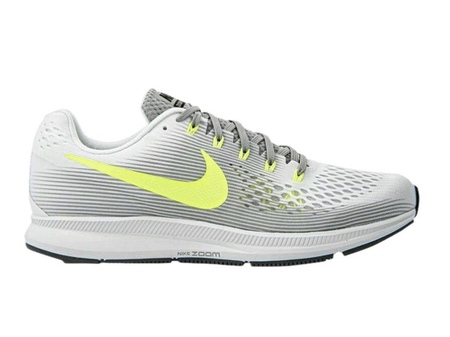
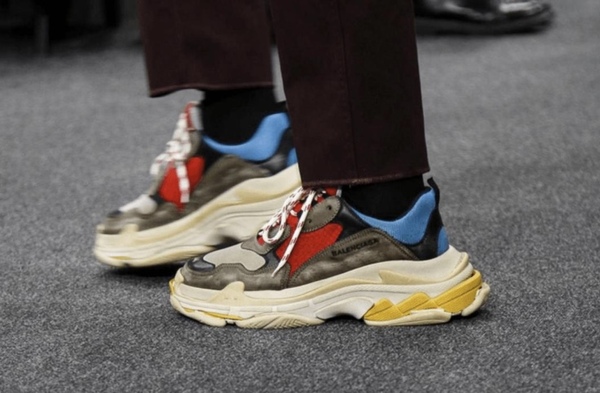
On the right, an example of a functional athletic silhouette. On the left, an exaggerated sole and a multilayered construction.
Emotional response to unfamiliar form
The primary technique employed was the disruption of established aesthetic expectations. The unconventional silhouette drew attention while simultaneously provoking contradictory reactions. Some in the audience criticized the model’s appearance, while others perceived it as innovative. The psychological mechanism is that unexpectedness generates surprise and heightens attention; however, the initial emotional response is not necessarily positive.
Visual Repetition: From the Unconventional to the Recognizable
Repetition as a tool for recognition

After Triple S appeared on the runway, the model began appearing regularly in fashion publications, editorial shoots, and street style photography. Characteristic elements—the massive sole, multi-layering, and exaggerated proportions—were repeated across different images, forming a consistent visual pattern.
Altering the Visual Context
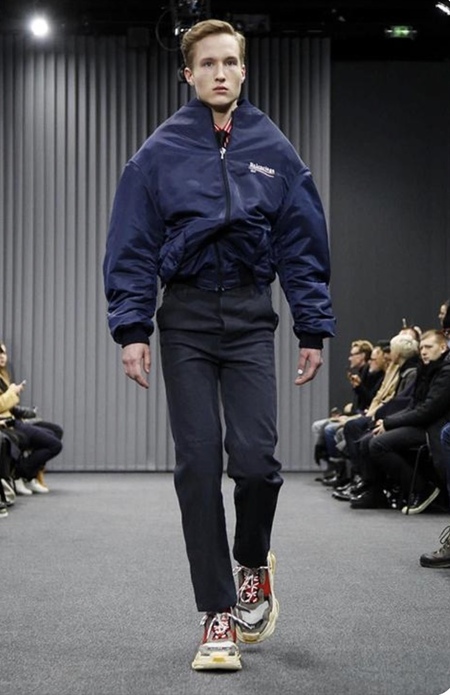
On the runway, the sneakers were perceived as an experimental object; in still-life photography, as an independent design product; and in street fashion, as part of everyday wardrobe. Thus, the unchanged form was displayed in new contexts, becoming increasingly familiar to the audience.