Table of Contents
Research Concept 1.1 Theoretical Foundations of Creative Automotive Advertising 1.2 The Role of Creativity in Modern Advertising 1.3 Visual Metaphors as a Tool for Meaning Formation 1.4 Semiotic Approach to Advertising Message Analysis 1.5 Emotional Branding and Experiential Marketing 1.6 Innovative Formats in Automotive Advertising Examples of Creative Advertising Campaigns and Their Analysis 2.1 BMW in Russia: «More than 300,000 trips on the M11 route in honor of BMW’s 100th anniversary» 2.2 Volkswagen: «The Bark Side» 2.3 Audi RS3: «Birth» commercial 2.4 Mercedes-Benz: «Magic Body Control» 2.5 Skoda Fabia vRS: «Made of Meaner Stuff» campaign 2.6 Honda Accord: «The Cog» commercial 2.7 Honda: «Paper» advertisement 2.8 Nissan Leaf: «Polar Bear» commercial 2.9 BMW M5 E39: «Land Speed» commercial Conclusion Bibliography
Research Concept
Modern automotive advertising is not merely a tool for announcing a product’s existence; it is a powerful and effective method for building a brand’s emotional and value identity. The automobile has long transcended its association with being a standard means of transportation, evolving into an inherent symbol of social status, lifestyle, and innovation. All efforts within the advertising industry are focused on positioning the car as a multifaceted object that seamlessly integrates technical specifications, visual metaphors, humor, and emotional imagery.
Research Objective—to investigate how creative techniques in automotive advertising allow brands not only to convey product information but also to forge unique and enduring brand identities within the audience. The work is based on the thesis that visual analogies, elements of humor, and original narrative solutions contribute to better recall of the advertising message, evoke positive emotions, and shape a favorable brand image.
1.2 The Role of Creativity in Modern Advertising
Creativity in advertising is the ability to develop unconventional, memorable messages that distinguish a brand from its competitors. Visual metaphors, unusual narratives, and format experimentation—as well as appealing to emotion—are key ways creativity manifests in the automotive industry. Modern marketing research demonstrates that establishing a deep emotional connection with consumers is crucial. This is particularly important for the automotive industry, as purchasing a car is often tied to personal values and ambition. Creativity allows brands to stand out, create unique associations, and build long-term relationships with consumers.
1.3 Visual Metaphors as a Tool for Meaning Formation
Visual metaphor is an artistic device where one image replaces another, creating a new semantic context. In automotive advertising, metaphors become a necessary tool for simplifying complex technical specifications, helping consumers remember and associate messages with emotions. Research in psychology shows that metaphors activate associative thinking, easing information comprehension. In automotive advertising, this allows brands to transform technical features into vivid images, increasing audience engagement.
1.4 Semiotic Approach to Analyzing Advertising Messages
Semiotics is the study of signs and symbols, as well as the ways they are interpreted. Furthermore, semiotics is a powerful tool that helps us better understand how visual and verbal elements interact and influence brand perception, particularly in automotive advertising. Employing semiotic analysis allows one to uncover the hidden mechanisms by which advertising impacts the audience. This method of analysis is highly relevant in the automotive industry, as brands strive to stand out in the market to be both unique and associative.
1.5 Emotional Branding and Experiential Marketing
Emotional branding is a strategy focused on building strong emotional connections between consumers and brands.
Emotional branding strategies can encompass creating a unique client experience, engagement across social media platforms, and other corporate marketing initiatives. For automotive advertising, this could involve crafting an exclusive experience. The foundation of this type of marketing lies in promotional activities that engage clients through direct marketing and active selling techniques.
1.6 Innovative Formats in Automotive Advertising
Modern automotive brands utilize diverse, innovative formats that allow them to stand out among competitors and provide a unique advertising and emotional experience for their audience.
Examples of creative advertising campaigns and their analysis
2.1. BMW in Russia: «More than 300,000 trips on the M11 route in honor of BMW’s 100th anniversary»
«The BMW Group Russia campaign in the summer of 2016—over 300,000 free passes on the M-11 highway in celebration of BMW’s 100th anniversary. Source: official BMW Group Russia website»
In the summer of 2016, BMW Russia ran a promotion that offered BMW owners a complimentary drive on the toll highway M11. This initiative can serve as an example of experimental marketing, where a brand offers the consumer a tangible experience.
The highway was effectively «gifted» to BMW owners, becoming a symbol of recognition and exclusivity. The road itself served as a communicative platform, facilitating the brand’s interaction with its audience. An interesting addition was that stickers featuring the BMW logo were offered to all traffic participants at the entrance, including owners of other car brands. This allowed the brand to: • expand its visual presence on the road, • create a sense of engagement among owners of other brands, • form positive associations with the brand among potential customers, • strengthen the feeling of exclusivity among BMW owners.
This approach allows for the development of brand equity—investing in customer loyalty and trust. BMW demonstrated the role of emotional experiences in marketing. This further strengthened the brand’s reputation and built a foundation of trust for continued client interaction, while also attracting the attention of new potential buyers.
2.2. Volkswagen: «This dog is quite impressed by Volkswagen.»

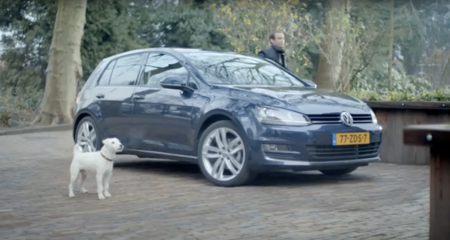
Volkswagen Golf 7 — stills from the commercial featuring a dog mimicking the car’s behavior. 2013.
In the Volkswagen advertisement, a dog admires the sound and behavior of the car on the road, parodying it. The premise of this video—an embodiment—is a technique where an animal’s reaction becomes a metaphor for human perception of the car’s technical features.
The use of humor and absurd situations—such as a dog mimicking a car—helps lower the psychological barrier between the brand and the viewer, making the advertisement more accessible and memorable. In this context, the dog serves as a symbol of loyalty and trust, establishing Volkswagen’s image as a reliable companion. From a semiotic perspective, this branding technique reinforces the association between the brand and family values and dependability.
Visual metaphor and elements of humor allowed Volkswagen to make the car’s technical specifications more accessible and understandable to a broad audience. This approach helps elicit a positive emotional response and strengthens the brand’s association with reliability and family values.
2.3. Audi RS3: «Birth» CGI Video