Navigation
- Rationale for the Topic
- Context
- Question and Main Thesis
- Portrait in Burial
- How the Face is Rendered
- Clothing, Hairstyle, and Ornaments
- When the Portrait Identifies the Person
- What Can Be Learned from the Portraits
- Conclusions
- Sources of Information
Justification for Topic Selection
Fayum portraits are often displayed as individual paintings. However, these boards were created for burial; they were placed on the mummy’s face and secured with bandages. Therefore, it is important to view the portrait in context with the mummy. This reveals how the depiction of the individual was connected to the funerary ritual. The portraits allow us to trace which physical attributes were considered important for a public image—such as hairstyle, clothing, jewelry, beard, and occasionally, name. This is not a discussion of people’s «origin,» but rather of how they were represented during their burial and what information the monument itself conveys.
Context
Following the conquests of Alexander the Great, the Ptolemies ruled Egypt. In 30 BCE, the country became a Roman province. Diverse people of various origins and statuses lived here. Greek was used in administration and writing, while Egyptian religious and funerary customs persisted. Fayum portraits emerged within this society and became part of its burial practices.Portraits on wooden panels and painted burial shrouds are primarily known from monuments of the 1st–3rd centuries CE. They are found not only in Fayum, so the term «Fayum» is conventional. The mere quantity of surviving works does not imply that this practice was accessible to everyone; a burial featuring a portrait required resources and materials. Researchers associate many portraits with affluent inhabitants of Roman Egypt, but a single image is insufficient to accurately reconstruct the biography or ethnic background of the deceased.
Question and main thesis
How did the portrait preserve a socially recognizable image of a person within the Egyptian burial rite?Portraits merge diverse artistic and ritual practices into a single funerary object. The Egyptian practice of mummification provides the context for the image’s use; painting on a board or fabric transmits the face and external appearance in the artistic forms of the Greco-Roman world; clothing, hairstyles, and ornaments correspond to the fashion and status codes of Roman times. This is not a decomposition of cultures into separate «layers» nor a mechanical mixture—it is a testament to a specific society where these methods of depiction and burial coexisted and interacted.
1. Portrait in a Burial
The portrait plaque was part of the burial complex. It was secured near the face of the mummified individual, with wrappings and coverings holding it in place. Therefore, the plaque was not a painting intended for a domestic wall that was later accidentally used in a burial. Its function explains why the personal image is found here alongside the practice of mummification.
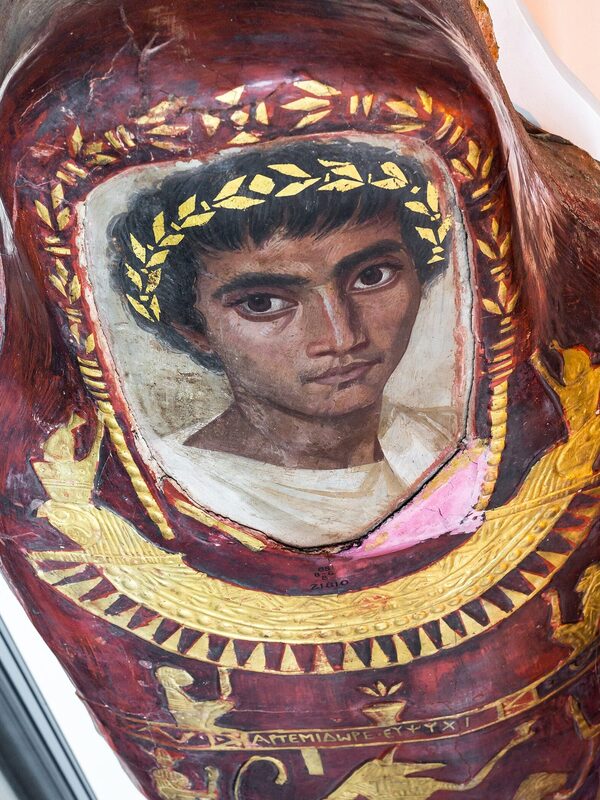
The mummy of Artemidor demonstrates the entire structure of such a monument. The portrait plaque is embedded within the burial casing. When viewing it, we see not two independent objects, but a unified artifact created for the burial. The mummy of Heraclid offers a different example: the face on the plaque is surrounded by red painted fabric, and a Greek inscription with his name is preserved on his feet. Tomography revealed an mummified ibis inside the wrappings. This is an important detail of the monument itself, but it does not allow for a definitive conclusion about who Heraclid was in life or why the bird was placed beside him.
Mummy portrait of Artemidoros. Hawara, circa 100–120 CE. Portrait on a wooden tablet; funerary shroud with plaster and gilding. British Museum. https://commons.wikimedia.org/wiki/File:Mummy_portrait_of_Artemidoros_from_Hawara_-London_BM_1888-0806-8-_01.jpg
Note how the board is secured with bandages. The portrait was part of a funerary object. The gilded images on the casing help reveal its connection to Egyptian rites.
Artemidoros Mummy. Detail of the gilded shroud. https://commons.wikimedia.org/wiki/File:Mummy_portrait_of_Artemidoros_from_Hawara_-London_BM_1888-0806-8-_02.jpg
The detail helps to see that the shell is designed as part of a ritual, rather than as a neutral frame. One should not attribute a specific meaning to every figure without a museum description or special research.
Mummy of Heraclides. Circa 120–140 CE. Linen board with a painted and gilded portrait. The Getty Museum. https://commons.wikimedia.org/wiki/File:Mummy_of_Herakleides,front_view-Getty_Museum(91.AP.6).jpg
In one exhibit, a portrait on a wooden board is presented alongside a painted burial shroud. Material analysis and tomography provide data on the method of construction and the contents of the wrappings; however, they do not transform assumptions about Heraclitus’s biography into established facts.
2. How the face is depicted
Most famous portraits were painted on wooden panels, while other images were created on fabric. Various techniques were employed, including encaustic (paint with a wax binder) and tempera. Differences are visible on the surface: encaustic strokes can be dense and three-dimensional, whereas tempera painting often appears finer and more uniform. These portraits are crucial for studying ancient panel painting. However, based on them, one cannot assert that all artists worked in the same style or studio.
Portrait of a man with a mole on his nose. 130–150 CE. Encaustic on a lindenwood board. The Metropolitan Museum of Art. https://www.metmuseum.org/art/collection/search/547857
The man is turned three-quarters but looks directly at the viewer. Pink makeup is visible on his eyelids, and there are highlights in his eyes.
Portrait of a young woman in red clothing. Circa 90–120 AD. Metropolitan Museum of Art. https://commons.wikimedia.org/wiki/File:Portrait_of_a_young_woman_in_red_MET_29I_E15R6.jpg
The red clothing and dark stripes on the tunic are immediately noticeable. By themselves, they do not establish the origin of the depicted woman.
Elderly man surrounded by Egyptian gods. Circa 250 CE. Tempera on sycamore wood. The Metropolitan Museum of Art. https://www.metmuseum.org/art/collection/search/551159
This late portrait is painted in tempera on a wooden panel. Egyptian deities are depicted next to the man. According to the Metropolitan Museum of Art, the panel was likely affixed to a mummy or sarcophagus.
3. Clothing, hairstyle, and accessories
Hairstyles and clothing convey a great deal about a person’s appearance. Researchers compare them with Roman fashion and use them for approximate dating. However, fashion spread widely and could be combined with local variations; no single article of clothing serves as a «passport» to ethnic identity.
Changes in hairstyles and accessories are noticeable in the portrait series. Women’s meticulously arranged curled updos give way to other styles; men are depicted either clean-shaven or with beards. In some instances, the style can be correlated with the era of a specific emperor, but such dating remains approximate. A golden wreath, earrings, a chain, or a lunula indicate which details the artist deemed important to the image; comments on price or social status should only be made where supported by research into a specific item.
Portrait of a man in a white tunic with dark red clavus. Late 1st century CE. Manchester Museum. https://commons.wikimedia.org/wiki/File:Mummy_portrait_man_with_white_tunic_with_dark_red_clavus_wood_Manchester_Museum_Late_1st_CE.jpg
Keys: vertical stripes on the tunic. These can describe the clothing, but they cannot determine a person’s origin.
Female portrait with an Adrian hairstyle. Hawara, 117–138 CE. Manchester Museum. https://commons.wikimedia.org/wiki/File:Mummy_portrait_woman_with_Hadrian_hairstyle_wood_Manchester_Museum_117-138_CE_Hawara_AN_5379.jpg
The hairstyle corresponds to the fashion of Emperor Hadrian’s time. This allows us to discuss visual connections to Roman Imperial fashion, but it does not reveal the self-perception of the depicted woman.