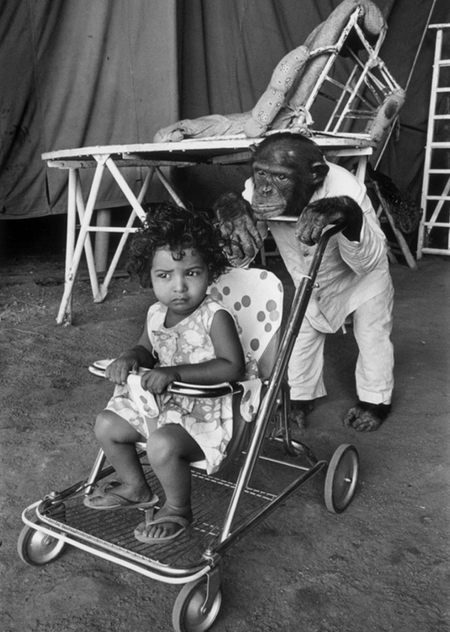
Navigation Menu
1. Concept 2. Not on the Arena: Where the Camera Stands 3. Who Watches Whom: Gaze, Grid, Frame 4. Work and Care: The Animal in the Ensemble 5. Comparative Series: Who Else Filmed Spectacle and Animals 6. Conclusion 7. Bibliography 8. Image Sources
Concept
The choice of theme stems from an interest in how documentary photography interacts with institutions built on spectacle. The circus has two sides: the ring, the lighting, and the act for the audience, and behind it—the trailer, the rehearsals, and the exhaustion. The animal exists precisely on the border between them: it is simultaneously an «act» and a living being that eats, sleeps, works, and tires. Therefore, it is through the animals that the question of where the performance ends becomes clearest.
American photographer Mary Ellen Mark first traveled to India in 1969. In 1989, with support from Eastman Kodak and the National Endowment for the Arts of the United States, she spent six months traveling with 18 circus troupes. This resulted in the book Indian Circus, published in 1993. I am particularly interested in the animals featured in this series: the elephant, hippopotamus, bear, and chimpanzee. They exist precisely on the boundary between the performance and the life of the troupe, and it is through them that the question of boundaries becomes clearest.
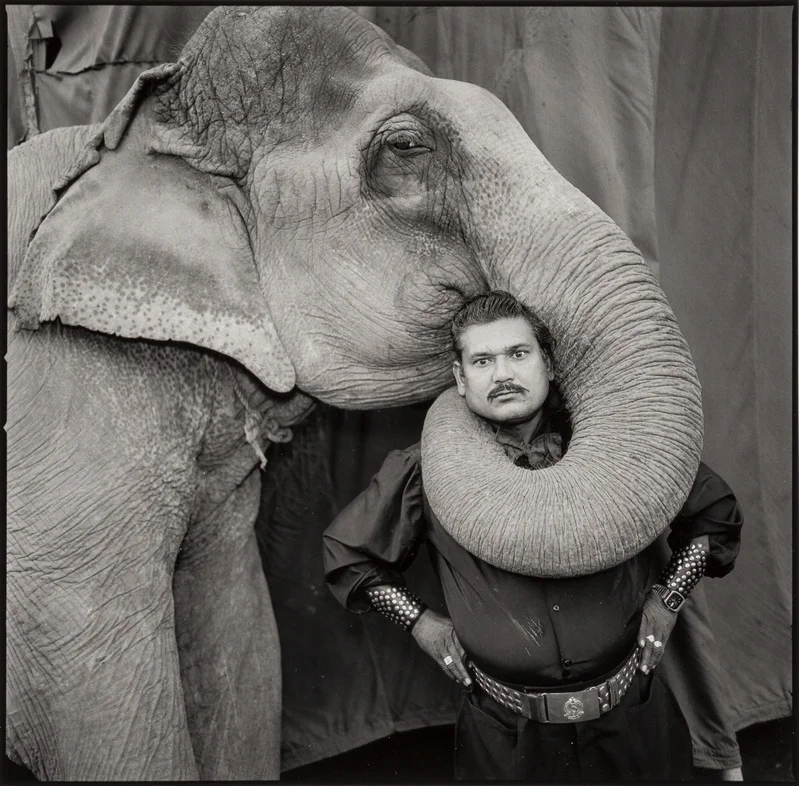
Mary Ellen Mark. «Ram Prakash Singh with his elephant Shyama,» Big Top Circus. Ahmedabad, India, 1990.
This research aims to identify the characteristics of Mark’s authorial method, illustrate how the boundary between representation and life is constructed, and reveal the significance of circus animals in his work.
Key Question: Where does representation end in Mary Ellen Mark’s series «Indian Circus» when viewed through the lens of animals?
Hypothesis: A boundary between performance and life exists within «Indian Circus, ” but it is subtle and permeable—most evident in the portrayal of the animals. Mark is not photographing a trick; she is photographing what lies beyond it: the labor, the rest, the care, the waiting. The animals in her frames are not props but troupe members: they have names, they have work, and they have mutual obligations with the humans. The gaze is not unidirectional. The audience is accustomed to looking at the animal, but in several photographs, the animal looks at the human or at the camera, and the human is revealed to be observed. Thus, the photographer denies the viewer the privilege of simply observing.
The term «backstage» in this work signifies more than just the area behind the scene. It is the hidden world of the circus from the audience’s view: rehearsals, daily life, rest, feeding, and animal care. In the Mark series, backstage is not a backdrop but the photographer’s point of view.
Mary Ellen Mark, «Acrobats in Rehearsal, ” Circus Famous, Calcutta, India, 1989.
Curatorial texts note that Mark did not film the performance itself, but rather the rehearsals, the work, and the pauses between them. This allows for a direct testing of the hypothesis: if the boundary is indeed thin, it should be most visible in the moments between numbers. To contextualize Mark’s position within this theme, the main body is supplemented with a comparative series. This includes footage of Bruce Davidson’s «Circus» series (1958, 1967), Gary Winogrand’s book The Animals (the zoo as a space where the observer is captured in the frame), and Mark’s later works from the «Man and Beast» project. This series is necessary to show how Mark’s approach differs from other ways of viewing spectacle and animals.
Material Selection Principle: 24 photographs were selected based on three criteria. Each image features an animal or a behind-the-scenes moment. The photograph has an exact museum or gallery caption including the title and date. The image helps test a hypothesis rather than merely illustrating a series. The frames are compared across four parameters: direction of gaze, placement of people and animals, presence of fencing, and relationship between planes.
Mary Ellen Mark, «Acrobat with Puppy Suiti, ” Raj Kamal Circus, Upletta, India, 1989.
Rubrication Principle: The work consists of four chapters, progressing from the external to the internal, and then expanding into the broader context. The first chapter is dedicated to the cage: where it is placed and why it is not on the arena floor. The second analyzes gaze and framing: who looks at whom, how bars, ropes, and chains divide the space, and how the roles of observer and observed shift. The third depicts labor and care—that is, the relationship between human and animal outside of the enclosure. The fourth places Mark in a comparative context, illustrating the distinct nature of her approach.
Off the Stage: Where Should the Camera Be Positioned
In «Indian Circus, ” the camera is not positioned where the viewer sits. Instead, it is located in the courtyard, in the aisle between the food trucks, at the entrance to the tent—that is, where the performance has not yet begun or has already concluded.
Six white dogs are scattered on the ground in front of a dark tent canvas, from which ropes stretch toward the earth. One dog stands on its hind legs on a small cart and looks upward; the others sit alone, gazing in different directions. There are no people in the frame. The circus is present as a backdrop, not as a stage, and the act, without a trainer, suggests a state of waiting.
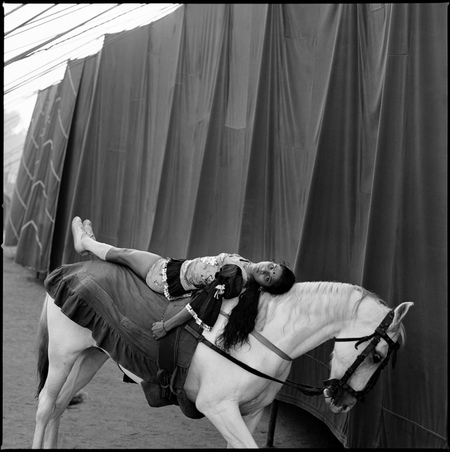
A young woman in a ruffled costume lies on the back of a white horse, legs thrown over the side, her head turned toward the camera, gazing directly ahead. The bridled horse stands in profile with its head lowered; it is named Badal in the caption. The background is a pleated canvas of a tent, and there are no arena or tribune structures. The pose resembles a trick, yet it is shown outside the arena, and the boundary between work and leisure is indistinct here.
A young man cradles a white cockatoo against his shoulder, eyes closed, his cheek pressed against the bird. To the left, two parrots sit on a metal stand. No one is looking at the camera; all attention is focused on the bird. The caption refers to the cockatoo as a pet rather than a performance participant, shifting the image from an attraction category to one of domestic life.
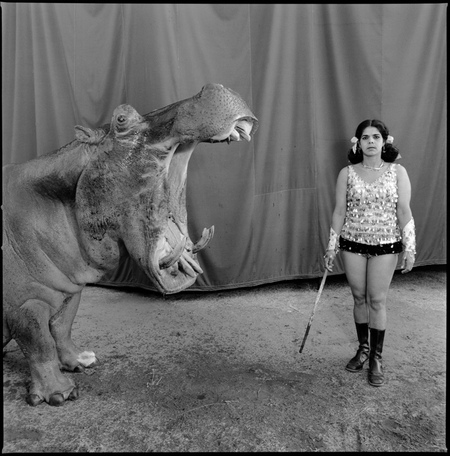
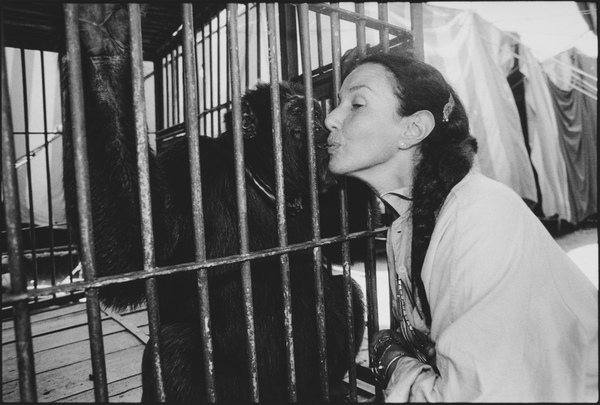
In the first photo, the artist with the stack is frozen before a hippopotamus with its mouth open, while in the second, a woman reaches to kiss a chimpanzee through the cage bars. In both frames, the adorned human body and the animal’s behavior are deprived of the viewer and directed only toward the camera. This motif leads to the next chapter, where the main question becomes: who is looking at whom.
Who is Watching Whom: Gaze, Grid, Frame
The viewer is accustomed to looking at an animal, but Mark’s line of sight is unfixed. This chapter compares vectors of gaze, the structure of compositions, and the types of enclosures.
A man and a chimpanzee in a dress, sneakers, and a bow tie sit side-by-side on the sand, the chimpanzee’s arm resting on the man’s shoulder. Both are looking directly at the camera. Behind them are tents and a rope fence on poles. Because the chimpanzee is closer to human behavior, the question of gaze is most acute here: the photographer, and by extension, the viewer of the image, finds themselves under surveillance.
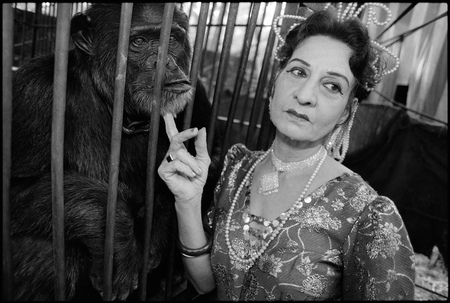
Rajah the chimpanzee sits behind the bars of his cage, while the artist Gloria, in a formal costume, touches his chin with a finger. Rajah looks into the camera; Gloria looks at him. The working grate divides the space within the troupe, but this boundary between the show and life is broken by a gesture of closeness.
Maharaja and his dog are shot from behind on a marble terrace.
The frame provides a contrast to the circus line-up: the absence of looking at the camera transforms the photograph from an interactive dialogue into detached observation.