Concept
Many modern board games are currently viewed primarily as leisure activities, yet few recognize that they also serve as reflections of the cultural, social, and philosophical outlooks of their era. Game rules, board layout, imagery, and symbols can convey ideas that extend beyond the gameplay itself. An interesting example of this interplay between play and culture is the Indian game «Moksha Patam, ” which formed the historical basis for the modern game of „Snakes and Ladders.“ Furthermore, I wish to highlight the tradition of „Gyan Chaupar”—a group of Indian board games where the game board acts as a model of the human spiritual journey.The original variations of this game were deeply tied to Indian religious and philosophical concepts of karma, human action, reincarnation, and spiritual liberation. The game board represented a model of the life and spiritual path: movement along it depended on the player’s actions and chance, while the snakes and ladders symbolically represented obstacles and opportunities for advancement. Over time, the game spread beyond India, underwent changes in design and interpretation, and evolved into the entertaining game familiar to many contemporary players.
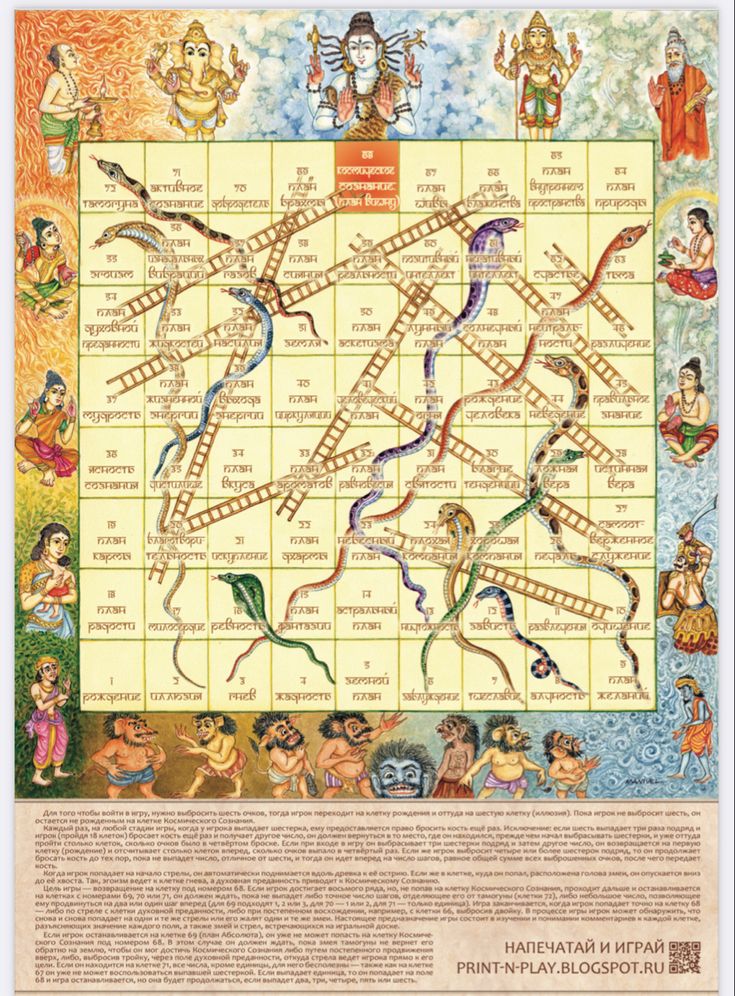
A contemporary interpretation of the Indian game Moksha Patam (Gyan Chaupar). A game board featuring images of Hindu deities, snakes, and ladders, reflecting concepts of the human spiritual journey.
I believe the relevance of this study lies in the potential to examine the board game as a cultural heritage—a medium capable of preserving and transmitting the worldview and ideas of its era. Specifically, the history of the game «Snakes and Ladders» allows us to trace how its visual language, rules, and original meanings have evolved as the game spread across cultures. The theoretical significance of this research is its exploration of the game as both a form of entertainment and an expression of cultural concepts. Practically, it demonstrates how symbolism, visual design, and game mechanics can influence the perception of the game and shape its meaning.
Material Selection Principle: The primary material for this study will consist of historical and contemporary game boards—including «Moksha Patam,» «Gyan Chaupar,» and «Snakes and Ladders"—as well as images of individual game components, illustrations, and preserved variants of the game. Special attention will be paid to the visual differences between the historical and modern versions: the composition of the playing field, the symbolism of the squares, the depictions of snakes and ladders, color palettes, and the overall aesthetic design.
Categories
- The Origin of «Moksha Patam»
- The Game Board as a Model of the Spiritual Path. A
- Game Mechanics: Chance, Movement, and Outcome.
- The Transformation of Moksha Patam into Snakes and Ladders.
- From Philosophical Model to Mass Entertainment.
Principle for Selecting Analytical and Textual Sources: The research foundation will be composed of works on the philosophy of play, the history of board games, and studies dedicated to «Moksha Patam» and its historical variations. In this research, I will utilize the works of Johan Huizinga, «Homo Ludens: A Study of the Play-Person, ” and Roger Caillois, „Games and Men, ” alongside works by other authors. Huizinga’s ideas will allow for the examination of play as a significant element of culture, while Caillois’s classification will assist in analyzing the role of chance in game mechanics.
Key question: How did the change in the visual design and gameplay mechanics of «Moksha Patam» as it spread outside of India affect the transformation of the game’s original religious and philosophical content and its evolution into mainstream entertainment?
The hypothesis of this research is that the transformation of «Moksha Patam» into the modern game «Snakes and Ladders» was accompanied by a gradual simplification and reinterpretation of its original symbolic content. The game board, which in historical versions could represent the human spiritual journey, is most often perceived in the modern version as a space of random movement toward the finish line. While the main mechanical elements, such as moving along the squares, rolling dice, and the snakes and ladders, have been preserved, their cultural and philosophical meaning has shifted.
Thus, the research aims to uncover the relationship between the visual form, game mechanics, and cultural content of a board game, as well as to study how the same game structure can acquire different meanings depending on the historical and cultural context.
1. The Origin of «Moksha Patam»: Historical and Cultural Context
The history of the game «Snakes and Ladders» is connected to the tradition of Indian board games, one of the most well-known varieties of which is «Gyan Chaupar» (the game of knowledge). The name «Moksha Patam» is also used for Indian variants of this gaming tradition. Unlike the modern version, which is often perceived as a children’s pastime, the historical game boards held more complex cultural and religious content.According to a study by Jacob Schmidt-Madsen, the origin of «Gyan Chaupar» is presumed to date back to the late 17th to early 18th century. The author examined nearly 150 game boards, most dating from the 18th–19th centuries and originating from Vaishnava and Jain religious communities in Western India. The earliest known dated game board he reviewed dates to 1780–1782 [3].
Sufi variant of the game Gyan Chaupar. A paper game board featuring snakes and ladders. Presumed Northern India, mid-19th century.
However, the game’s origins cannot be considered in isolation from other cultural traditions. Jacob Schmidt-Madsen notes the possible influence of European and East Asian games, specifically the Italian «Goose Game» and the Chinese «Xuanfo Tu.» The former may have contributed the structure of sequential movement across the squares, while the latter is interesting from the perspective of the idea of a spiritual journey and passing through various states of existence. Thus, «Gyan Chaupar» formed at the intersection of several gaming and cultural traditions, merging the mechanics of movement on the board with Indian religious concepts [3].
Religious traditions in India—primarily Vaishnavism and Jainism—played a distinctive role in shaping the game. Their concepts of the structure of the world, human actions, the consequences of deeds, and the possibility of spiritual liberation were reflected in the design of the playing fields. The structure of the game became a visual means of presenting complex philosophical ideas that, in everyday life, might have been conveyed through religious texts and imagery [3].
Gyan Chaupar Game Board. Photographer: Nomu420, 2014.
In this context, the game takes on the significance of a peculiar cultural instrument. Its participant navigates the game space, sequentially encountering various states and symbolic situations. The process of the game itself allows one to represent a human life journey as a sequence of actions, obstacles, and potential changes.
To understand such a phenomenon, one can refer to the concept of Johan Huizinga. He views play as an important component of culture, manifesting in various spheres of human activity, including religion, art, and social relations [1]. In the case of «Gyan Chaupar, ” this connection is particularly noticeable, as the play activity becomes a means of expressing and comprehending religious ideas.
2. The Playfield as a Model of the Spiritual Journey
A defining feature of historical versions of «Gyan Chaupar» is the layout of the game board. It consists of a grid of numbered cells interconnected by images of snakes and ladders. However, these elements serve more than just a game function. In a historical context, they are integrated into a more complex system of symbols that reflects religious and philosophical concepts of human existence.
The game board can be viewed as a conceptual model of the cosmos, where the cells represent different states, levels of being, or stages of spiritual development. In certain Vaishnava variants, representations of various worlds and cosmic levels hold a central place. For instance, individual cells denote the terrestrial realm, celestial expanses, and higher spiritual domains. The arrangement of these elements forms a distinctive hierarchy along which the game piece moves [3].
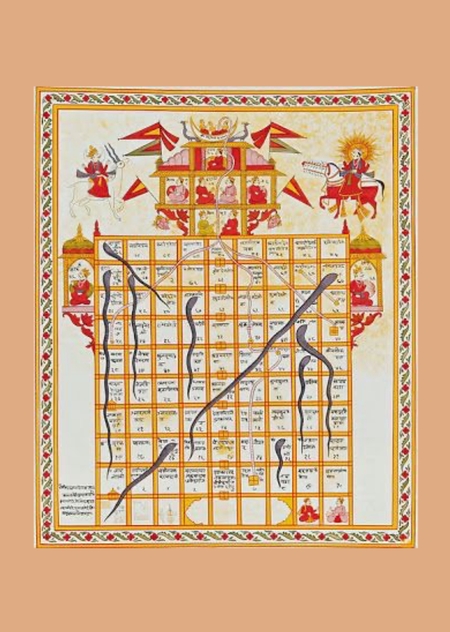
A Jain version of the Gyan Chaupar game. An illustrated game board featuring images of deities, snakes, and ladders. India, 18th century.
The imagery of snakes and ladders holds particular significance. In historical variations, they connect distant squares, creating the potential for a drastic shift in a player’s position. Ladders can signify advancement toward higher states associated with virtue, knowledge, devotion, and spiritual growth. Snakes, conversely, can send the player back to lower levels, symbolizing unfavorable conditions, delusion, and the consequences of negative actions.
It is important to recognize that the meaning of these elements was not entirely uniform across all game variants. Different religious communities employed their own symbolic systems and cosmological understandings. Therefore, snakes and ladders should not be viewed solely as universal symbols of good and evil; their meaning must be established in the context of the specific game board and its inscriptions [3].
Sufi variant of the game Gyan Chaupar (Shatranj-i ‘Urafā). A wooden game board inlaid with mother-of-pearl and Arabic script. India, presumably Delhi, 19th century. Collection of the Cambridge University Museum of Archaeology and Anthropology.
The concept of karma plays a crucial role in understanding the symbolism of play. In Indian religious traditions, it is connected to the consequences of human actions, which influence a person’s subsequent existence and their place in the cycle of reincarnation. Thus, the movement of a game piece can be interpreted as a sequence of transitions between different states of being. The player is not simply moving toward the finish line; they are traversing a symbolic journey where their progress is tied to specific deeds and their repercussions [3].
In some game variations, the ultimate goal is denoted by the concept of moksha—spiritual liberation from the cycle of birth and death. This lends an added layer of meaning to the gameplay. The completion of a game can be viewed as the attainment of a state beyond ordinary human existence.
«Snakes and Ladders» game board, miniature painting, gouache on fabric, India, 19th century
A study of five historical game boards by Schmidt-Madsen reveals how closely their visual structure is linked to religious concepts. Some boards feature intricate imagery, supplementary inscriptions, and symbolic elements that help convey their meaning. In certain Jain variations, the game board even takes on anthropomorphic form—the grid of cells is placed within the image of a human figure, connecting the playing space to the representation of the body and the spiritual journey [4, 3].Thus, the historical game board «Gyan Chaupar» can be viewed simultaneously as a playing space, a visual model of the cosmos, and a medium for transmitting religious and philosophical ideas. Its design is not mere ornamentation, as the arrangement of cells, images, and inscriptions is directly related to the game’s content.
3. Game Mechanics: Randomness, Movement, and Outcome
Despite its complex symbolic content, the core mechanic of the game «Gyan Chaupar» is quite simple. Participants use game pieces that move across the board squares according to the result of rolling dice or other specialized items, such as cowrie shells. When landing on certain squares, a piece may move to another part of the board via the snakes and ladders connecting them [3].
Chance plays a crucial role in organizing the gameplay. A participant cannot fully control the speed of their progression or predict in advance which squares they will land on. Even when nearing the end of the journey, they might unexpectedly be moved to a lower level. As a result, the game is built upon a constant alternation between advancing and moving backward.
Cowrie shells—traditional gaming pieces used to determine the number of moves in Indian board games.