Navigator
- Research Concept
- Starting Point: Murnau and Munich, 1908–1911
- Keywords: Two Declarations of Color
- Methodology: How to Measure a Palette
- Palettes in Numbers
- Has Red Been Conquered? Testing Mark’s Rule
- Whose is Blue: Mark’s Bestiary
- What Color is the Rider? Kandinsky’s Motif
- Conclusions
- Epilogue: St. Petersburg 1911, Moscow 1920, Weimar 1923
- Sources
Research Concept
The «Blue Rider» group (1911–1914) entered art history as a union of artists who believed in the spiritual power of color. The name itself seems to confirm this unity. In 1930, Wassily Kandinsky recalled that the name was coined at a coffee table in a garden gazebo in Zindelsdorf: both loved blue, Franz Marc loved horses, and Kandinsky loved riders. From this, it is easy to conclude that blue was a common color and a shared concept for the two founders.The artists formulated their color theories separately. Marc outlined his in a letter to August Macke dated December 12, 1910. Kandinsky finished the book «Concerning the Spiritual in Art» in 1910, which was published in Munich in December 1911. They first met on January 1, 1911, at a New Year’s party at Marianna Veryovkina’s. The coincidence in blue existed before they met, and the nature of this connection needs to be examined: are we looking at a shared color system or similar words behind different practices?The course «Soviet and Contemporary Art in a Global Context» addresses the question of how to distinguish contrived parallels or false analogies from well-founded connections between artistic phenomena. The Munich circle of 1908–1914, where the Russian artist worked alongside the German, provides excellent material for such a verification: a shared environment, common exhibitions, a unified name, and two independent color theories.
How blue was the «Blue Rider» on the canvas? Do Kandinsky and Marc agree on the proportion of blue in the painting, the color that pairs with blue, and the motif to which blue is associated?
Hypothesis
The similarity in blue will be partial. The proportion of blue for both artists after 1911 will increase and converge. Furthermore, the blue in each artist is integrated into their own color system: with different partner colors and varying degrees of fidelity to their own declaration. The carrier of the blue will be the common element. In painting, the horse is more frequently blue for both artists; the rider is almost never blue.
Starting point: Murnau and Munich, 1908–1911
In the summer of 1908, Kandinsky and Gabriele Münter worked in Murnau, Bavaria, alongside Alexey Yavlensky and Marianna Veryovkina. Yavlensky shared his knowledge of the French Fauves with his colleagues, and Kandinsky’s palette became open and vibrant. Murnau—with its church, castle, and railway—became the main motif of those years.
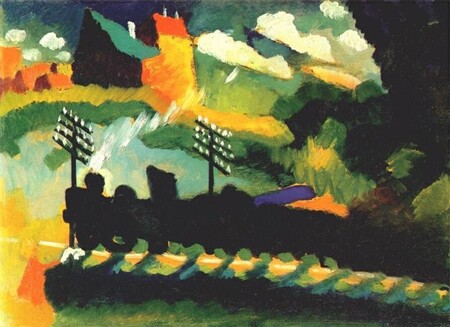
There is almost no blue in this landscape: just 3% of the area. Green and black together account for more than half of the canvas—30% and 28%, respectively. Blue, as the primary color, is yet to come. In 1909, Münter buys a house in Murnau that the locals call «the Russian.» In the same year, the New Association of Artists is founded in Munich, led by Kandinsky. Franz Marc sees the association’s works at their exhibitions and writes one of the few favorable reviews on their second show, held in September 1910. On January 1, 1911, he meets Kandinsky and soon joins the association. In the summer of 1911, Kandinsky gives Marc «Improvisation 12 (Rider), ” which he painted the previous year. In a postcard dated July 31, Marc reports that the painting has arrived, has been hung, and has „triumphed.“
Wassily Kandinsky. Improvisation 12 (Rider). 1910. Bavarian State Collections of Paintings, Pinakothek der Moderne, Munich
The horse here is blue, the rider is white with red accents. The blue occupies 27% of the painting’s surface area, and the red occupies 21%. Researchers attribute the birth of the future almanac’s title to this summer and this painting. In December 1911, the jury of the association rejected Kandinsky’s «Composition V, ” leading Kandinsky, Marc, and Münter to leave the group. On December 18, the first exhibition of the „Blue Rider“ publication opened at the Tannhauser Gallery in Munich, and in May 1912, R. Piper’s publishing house released the almanac. The Russian section of the almanac is notable: David Burliuk’s article on „wild“ Russia, Leonid Sabaneev’s article on Scriabin’s „Prometheus, ” and Nikolay Kulbin’s text on free music. On December 29 and 31, 1911, Kulbin delivered Kandinsky’s text „On the Spiritual in Art“ at the All-Russian Congress of Artists in St. Petersburg, and the Munich color theory was circulating in Russia at the same time the book was being published in Germany. The war of 1914 separated the co-authors: Kandinsky returned to Moscow, Marc went to the front lines and died near Verdun on March 4, 1916. Everything examined in this study was created during the six years between the summer in Murnau and the start of the war.
Keywords: two color declarations
Mark Make’s letter from December 12, 1910, contains one of the shortest color theories of modernism. In the translation of the study’s author: «Blue is the masculine principle—tart and spiritual. Yellow is the feminine principle—soft, joyful, and sensual. Red is matter—crude and heavy; it is always the color that the other two must overcome and conquer.» Mark further warns: by mixing blue and yellow to create green, the artist awakens red—the matter, the earth. Lenbachhaus calls «Blue Horse I» a rare example of this theory in its purity.
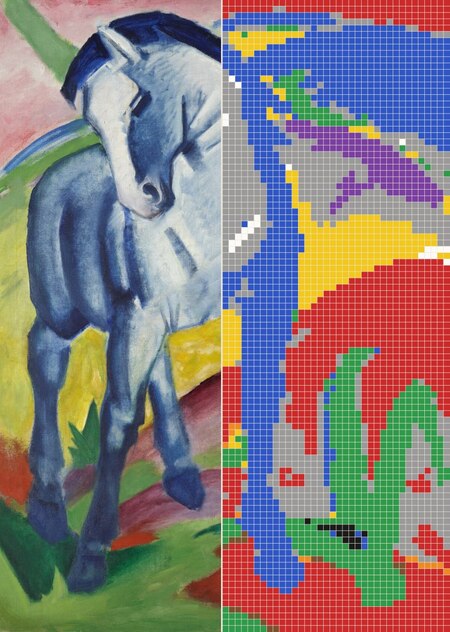
Franz Marc. Blue Horse I. 1911. Lenbachhaus, Munich
Blue accounts for 35% of the area here, red for 16%, and yellow for 9%. Even in the exemplary painting, there is more red than yellow. Kandinsky describes colors through movement and sound. For him, yellow is a «typically earthly color»: it moves toward the viewer, causes unease, and sounds like a sharp trumpet. Blue, a «typically celestial color, ” retreats from the viewer into the depths, calling one into infinity. This pair is named the first great opposition. The second is formed by white and black: silence full of possibilities and nothingness with no future. The third is formed by red and green. Kandinsky considers green, the balance between yellow and blue, the most calm and motionless color, and writes about it with irony—as a complacent tranquility. „Impression III (Concert), ” painted after Arnold Schoenberg’s concert in Munich in January 1911, is dedicated to the approaching yellow.
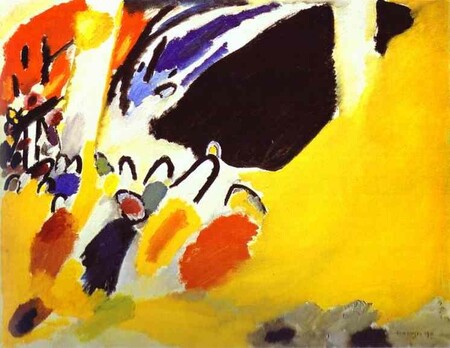
Yellow occupies 51% of the area, and blue is about 1%. Two paintings from 1911 establish the poles between which the entire body of work is situated—the blue one by Marc and the yellow one by Kandinsky. If both manifestos are consolidated into a single table, it becomes clear where they converge and where they diverge.
One point aligns between the two texts: blue is associated with the spiritual for both. Yellow, however, differentiates the theories—for Marc, it represents a gentle, feminine quality, while for Kandinsky, it is an aggressive, «earthly» color. Four verifiable statements can be drawn from the two texts.
- General. After 1911, blue gains a significant place in the painting of both artists.
- Marc. Blue and yellow together occupy more space than red: red is «overcome.»
- Marc. The main color pairing in the painting is blue and yellow—the masculine and feminine principle.
- Kandinsky. The main pairing is yellow and blue; green, being «immobile,» recedes.
Method: How to Measure a Color Palette
The collection comprises 59 paintings: 32 by Mark (8 painted before 1910, 24 between 1911–1914) and 27 by Kandinsky (12 from 1908–1910, 15 from 1911–1914). The selections were studio paintings sourced from museum collections and renowned private holdings, featuring key works from each period: Kandinsky’s «Improvisations, ” „Impressions, ” and „Compositions“ series, alongside Murnau landscapes; and Mark’s paintings featuring animals and his later abstract compositions. The division between periods is set at 1911: Mark’s letters are dated to December 1910, Kandinsky’s book was published in December 1911, and the collaborative work began in January 1911.
The custom Python program reduces each reproduction to 400 pixels on the longest side, crops 3% from every edge where the frame and scan margins exist, and assigns each pixel to one of ten classes. Six chromatic classes are defined by hue in the HSV model: red (345–15°, including crimson and pink hues at 300–345°), orange (15–40°), yellow (40–70°), green (70–165°), blue (165–255°), and violet (255–300°). Dark shades in the orange-yellow area are designated as the «earthy» class: ochre, brown, and olive. Low-saturation pixels are considered white or gray, and the darkest pixels are considered black. The measurement result is the percentage of area for each class. The program’s output is shown in two images: the reproduction on the left, and the map of color classes on the right.
A Two-Panel Comparison: Franz Marc, «Blue Horse I, ” 1911; Wassily Kandinsky, „Composition VII, ” 1913
The maps show that the program separates blue from purple and green, isolates ochre areas into a distinct class, and does not confuse white highlights with color. This measurement was taken for all 59 paintings. Under each atlas image is a bar: the length of the colored segment corresponds to the fraction of the class.
Color Palette Atlas: 32 Paintings by Franz Marc, 1908–1914
Mark’s blue sections appeared in 1911. Before that, his stripes were yellow-orange.
Color Palette Atlas: 27 Paintings by Wassily Kandinsky (1908–1914)
In Kandinsky’s work, the blue segments are distributed throughout the entire period, while the yellow ones noticeably elongate between 1911 and 1912.
Palettes in Numbers
Before the letter, Mark’s palette was warm and closely aligned with nature: yellow accounted for an average of 30,4% of the area, orange for 22,6%, and blue for 7,3%. In none of the eight paintings from 1908–1910 is blue the dominant color. Between 1911 and 1914, the proportion of blue rises to 17,2% (a 2.4 times increase), and the proportion of red increases to 15,5% (a 2.5 times increase). The share of yellow drops to 11,2%, nearly one-third of its previous amount. Black appears, making up 9,1% of the area compared to just 0,7% previously. In 8 out of 24 works, blue becomes the dominant color; red dominates in 6, and yellow in 4. The turning point is most clearly visible in one motif—the series of grazing horses. The first painting in this series was created in 1910.