1. Concept 2. Familiar Creature, Unconventional Form 3. Animals from Memory and Imagination 4. Creatures Assembled from Various Parts 5. Beings from Dreams and Visions 6. Where Does the Real Animal End? 7. Conclusion
(1) Concept
Animals are among the most recognizable figures in art. Even when depicted symbolically, we can easily identify a dog by the shape of its muzzle, a bird by its wings, or an elephant by its trunk. However, in the works of American outsider artists, the familiar characteristics of animals are often altered. Dogs take on unusual coloration, birds become disproportionately large, and individual creatures combine features from several different species. Sometimes an animal remains recognizable, and other times it transforms into a fantastical beast that has no direct natural analog.
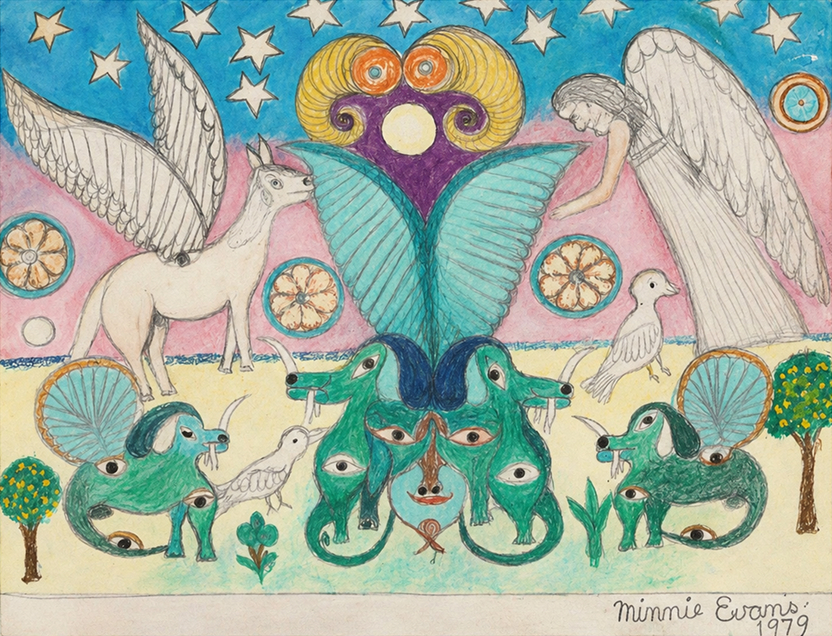
Minni Evans, «Untitled,» 1979.
I became interested in why such images emerge and how artists transform familiar animals into unusual creatures. To achieve this, it is unnecessary to invent an entirely new beast; it is enough to alter its proportions, color, or combine several recognizable forms. As a result, the image simultaneously resembles a real animal while differing from it.
Images of animals in American Outsider Art are of particular interest, where artists developed their own methods of depicting the world around them.
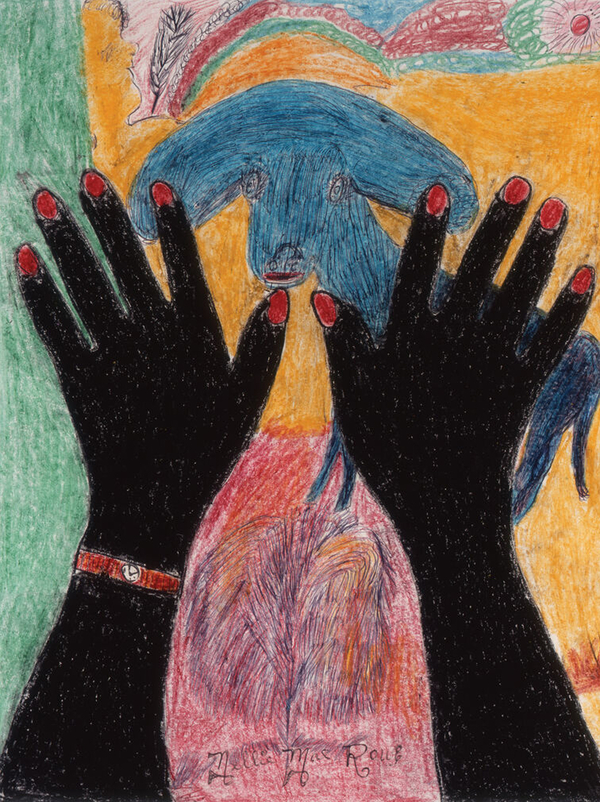
This can be seen in the work of William Hawkins, Nelly Mae Rowe, and Minnie Evans. Hawkins' images of real animals adopt exaggerated forms and unusual colors. In Rowe’s work, familiar dogs and birds become characters in fantastic scenes, while Evans features hybrid creatures that combine traits of animals, humans, and plants. Despite their different artistic approaches, all three authors allow us to see how recognizable natural forms transform into unusual imagery.
I draw what’s on my mind
It is important, however, to distinguish between the intentional creation of a fantastical creature and an unusual interpretation of a real animal. For example, an disproportionate form or unconventional coloring does not automatically imply that the artist intended to depict a mythical beast. Sometimes, such features are connected to an individual drawing style, the reworking of existing images, or personal perceptions of the surrounding world.
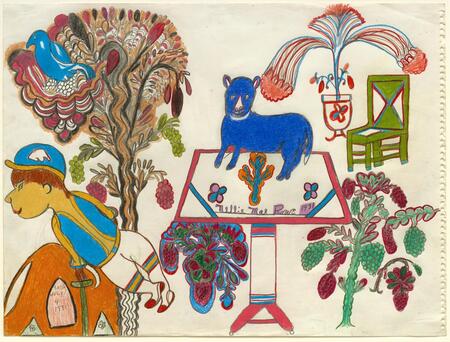
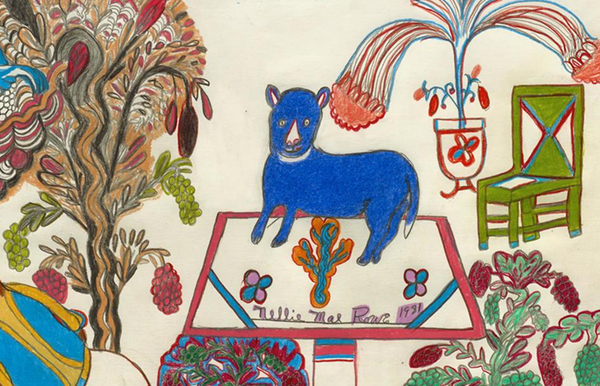
Nellie Mae Rowe, «Nellie’s Birthday, ” 1981.
The study examines works that illustrate various methods of transforming animals: altering proportions and color, distorting conventional scale, combining anatomical features, and creating fantastical creatures. The images are compared against each other, and information regarding the artists' work is refined using museum catalogs, exhibition materials, and art historical sources. This approach allows us not only to identify common visual characteristics but also to examine the reasons behind their emergence.
The research is built on the principle of gradually transforming familiar animals into fantastic creatures. The analysis utilizes works from museum collections, exhibition materials, and art historical sources, which allow for a comparison of the visual characteristics of the works with their creation history.Comparing the pieces helps trace which features of the real animal are retained and which are altered.
Central research question: How do American outsider artists transform familiar animals into fantastic creatures, and what role do memory, imagination, and individual perception of the world play in this process?
Hypothesis: Outcast artists often depict animals not as they look in reality, but as they imagine or remember them. Consequently, even an ordinary bird or dog can transform into a strange, fantastic creature.
Research Goal—to determine whether there are common methods for creating fantastic animals in American outsider art or if each artist arrives at a unique form independently.
(2) A familiar creature, an unusual body
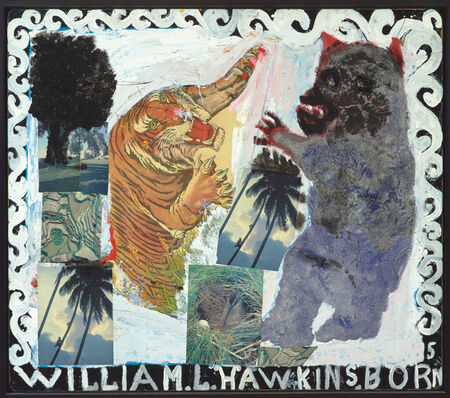
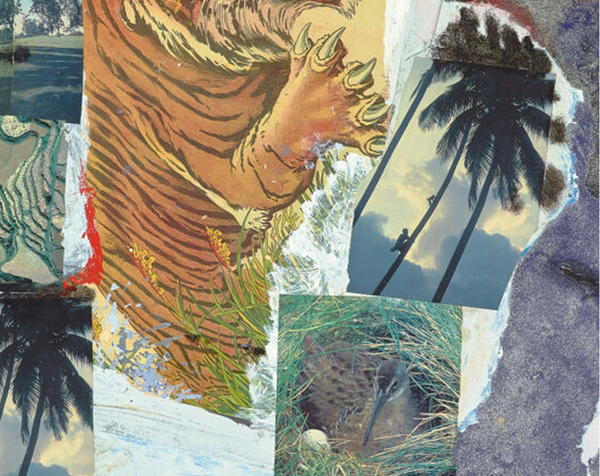
William Hawkins, «Tiger and Bear, ” 1989.
The American outsider artist William Hawkins often referenced animal imagery from photographs, newspapers, and magazines. However, instead of reproducing them faithfully, he altered their proportions, simplified the forms, and employed expressive colors. As a result, the real animals took on an unusual, almost fantastical appearance.
William Hawkins, «Rhinoceros,» 1985.
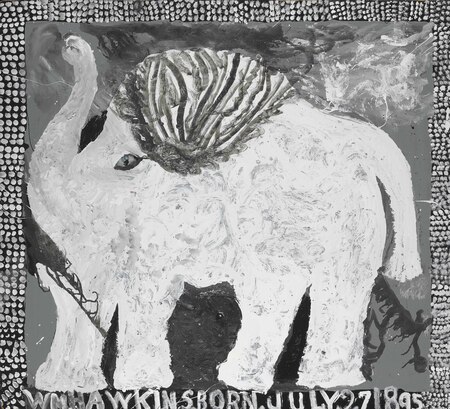
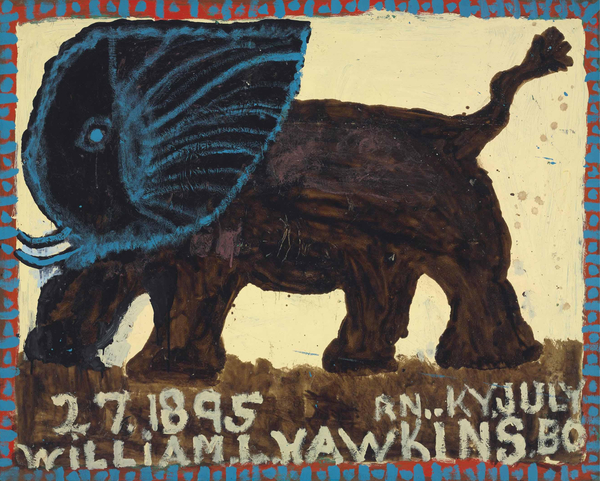
William Hawkins, «White Elephant,» 1989 // William Hawkins, «Big Jumbo,» 1988
Hockney experimented with enamel paint: he tilted the canvas, allowing the paint to run down the surface. This created a texture on the elephant’s body resembling skin folds.The number 1895 at the bottom of the painting is not the date of its creation, but the artist’s birth year, which he often included in the signatures of his works.
Hockings depicted not only familiar animals but also creatures he could never have seen in person. Among these were dinosaurs, whose appearance the artist reimagined based on existing imagery.
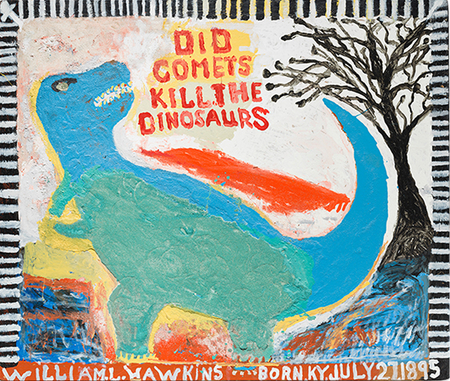
To create a textured surface, Hoskins mixed enamel paint with cornstarch. This made the dinosaur’s body appear almost three-dimensional.William Hoskins, «Did Comets Kill the Dinosaurs?», circa 1986.
William Hawkins, «Eagle and Serpent,» c. 1982.
When creating this painting, Hawkins drew inspiration from the image of the eagle and the snake on the Mexican flag, as well as Aesop’s fables. The artist altered the size and placement of the animals, transforming the familiar subject into a tense, fantastical scene.Hawkins developed four versions of the eagle and snake motif. Rather than replicating it exactly, he varied the composition and the relative sizes of the animals, crafting his own interpretation of a well-known image.
In these works, familiar animals take on an unusual appearance due to changes in proportion, color, and composition. Even with significant distortions, they remain recognizable, yet increasingly resemble fantastical creatures.
(3) Animals from Memory and Imagination
Nellie May Rowe, «Untitled (Blue Dog), ” 1980.
For Nelly Mae Rowe, animals were not merely part of the surrounding world but constant heroes in her drawings. Memories of farm life, objects from her own home, and free imagination became sources for unusual imagery. Familiar dogs, birds, and other animals acquired unfamiliar colors, sizes, and features while retaining a connection to the artist’s personal experience.
After her husband’s death, Nelly transformed her home and yard into a creative space she called Playhouse. Among the drawings, dolls, and handmade objects were many toy animals.