Concept
Paleolithic figurines are often called Venus figurines and are interpreted as symbols of fertility. In this reading, the large bust, abdomen, and hips become the central subject of the image, and the absence of a face seems to confirm that we are not looking at a specific person. I am interested in how well this explanation holds up when comparing the objects themselves. If we remove the conventional name and look only at the form, are these figurines truly similar? And is the degree of similarity sufficient to claim a shared meaning?
My question is: how does the distribution of volume and detail create a generalized feminine image, and can this image be confidently linked to fertility? The working hypothesis has two parts. The first is that in many figurines, attention is directed toward the body more than the face, and the proportions are selectively constructed. The second is that this choice might be related to reproduction and survival. The first part can be tested directly by examining the form. The second part requires additional evidence, so visual similarity alone will not be considered proof of a cult or ritual.
The exhibit includes small volumetric images of the Upper Paleolithic and a relief from Losseles for a separate comparison with the figurines. The main row features finds from Villendorf, Lespieux, Höle-Fels, Savignano, and Kostyonok. Exceptions include more elongated figures, a late silhouette from Montruz, and a head from Brassempute. These items are included to test the initial hypothesis, not merely to diversify the selection. The chronological and geographical differences among the finds preclude considering them the work of a single workshop or a singular, unchanging tradition.
I analyze the width of the shoulders and pelvis, the ratio of the head to the torso, the transition from the chest to the abdomen, the contours of the legs, and the positioning of the arms. I also examine the surface and material separately. The perspective is also important: from the front, the body might appear symmetrical, but from the side, it can be heavily curved. Therefore, some works are shown in different museum photographs. These views are labeled as different angles of the same object and are not considered new finds. Details follow after the full image. Modern copies and reconstructions have been excluded from the main series.
The research is divided into five chapters. Initially, I examine where the mass of the body is concentrated, and then I investigate what changes during rotation. The third chapter focuses on the head, face, and fine details. The fourth illustrates how material and preservation affect the legibility of form. The final chapter compiles figures that do not fit a single formula—the slender body, the expressive face, and the silhouette, which is nearly reduced to a few curves. This approach allows me to first formulate an observation and then confront it with exceptions.
I cross-reference dates, materials, and artifact information with museum descriptions. The texts from the museums in Vienna, Blaueborn, and Saint-Germain-en-Laye help distinguish between an observed detail and its possible explanation. Scientific articles on attractiveness and survival are used as examples of different research models, not as definitive answers. Modern body perception cannot be automatically applied to the Paleolithic era. The term «Venus» here is conditional: it does not prove a connection to the ancient goddess. By «generalization,» I mean the selection and simplification of features, not a lack of skill. The outcome should be a testing of the hypothesis’s boundaries, rather than asserting a singular meaning for all the figurines.
Contents
Where the volume is assembled
The body in rotation
Face and detail selection
Material and losses
Exceptions to the formula
Conclusions
Where the volume is gathered
Bust, abdomen, and hips are not always expressed equally. First, I compare which volumes predominate in each area. The presence of one feature does not yet make all bodies uniform.
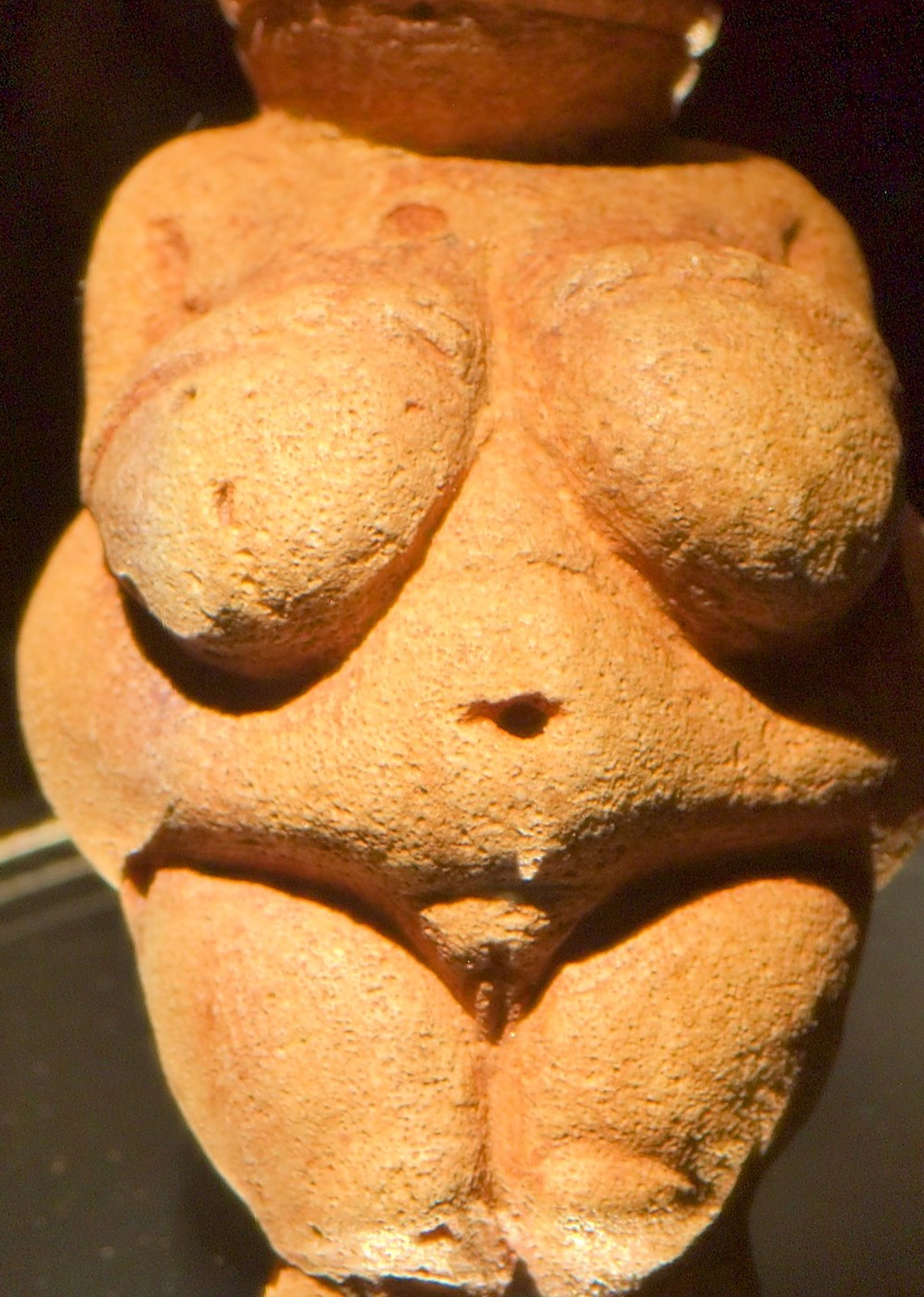
Unknown artist. «Venus of Willendorf. Front view.» Circa 29,500 years ago. Limestone, carving. Natural History Museum, Vienna.
The head is small in relation to the torso. The chest and abdomen protrude, and the arms are almost lost above the chest. The legs narrow toward the bottom. This distribution of details supports the first part of the hypothesis: the body parts are presented with varying degrees of emphasis. It does not yet explain the function of the object.
Author unknown. «Female figurine from Kostyonki. Exhibit 1, front view.» Gravettian, Upper Paleolithic. Mammoth tusk, carving. In the photograph: exhibition at the Hamburg Archaeological Museum.
The shoulders here do not disappear behind the chest; rather, the upper body is constructed differently than in the Willendorf figurine. Even with a similar emphasis on the torso, the proportions do not align. A recurring interest in the body does not necessitate a single mandatory schema.
Unknown artist. «Female Figurine from Gagarin. General View.» Gravettian, Upper Paleolithic. Mammoth tusk, carving. Photo: Exhibition at the Hamburg Archaeological Museum.
The head is tilted forward, and the arms are directed toward the center of the body. From a side profile, the chest protrusion and the curve of the back are particularly noticeable. This view allows for a comparison between the form’s depth and its width, without attributing specific feelings or experiences to the depicted figure.
Unknown artist. «Venus of Lespugue. General View.» Gravettian, Upper Paleolithic. Mammoth tusk, carving. Musée de l’Homme, Paris.
The bust and hips are delineated as large, rounded masses. Narrowing points are noticeable between them. In comparison to Willendorf, the body more closely resembles a sequence of individual volumes. Damaged areas must be distinguished from intentional simplification.
Unknown artist. «Venus of Lesclos. General view.» Gravettian, Upper Paleolithic. Limestone, relief. Musée d’Aquitaine, Bordeaux.
The body is connected to the flat plane of the stone. One arm is raised, the other is directed toward the abdomen. Here, the generalization does not negate the action: the pose and the object held by the raised arm distinguish the figure from a static frontal formula. The relief is included as a juxtaposition, not as a small, round statuette.
The comparison confirms the selectivity of the form, but not the uniformity of the proportions. On some pieces, the chest and abdomen are clearly discernible; on others, the body resolves into several large, rounded forms. The word «fertility» remains a possible explanation, rather than an inherent property of the stone or bone.
A pronounced abdominal volume is not sufficient evidence to determine pregnancy. Neither the shape of the breasts nor the mass of the hips alone reveals the age, health status, or personality of the depicted individual. In this study, these conclusions do not replace contour comparison.
Body in Turn
A similar frontal silhouette can obscure varying depths. Angles are necessary here as a method of verification: they reveal what was not apparent from the front. One object remains one object, no matter how many photographs we use.
Artist unknown. «Venus of Willendorf. View from the right.» Circa 29,500 years ago. Limestone, carving. Natural History Museum, Vienna.
The profile view of the chest and abdomen is more noticeable than the frontal view. The back forms a different contour, so the volume cannot be assessed based on the hip width alone. This angle clarifies the initial observation about proportions rather than presenting a new work.
Artist unknown. «Venus of Willendorf. Head detail, top view.» Circa 29,500 years ago. Limestone, carving. Natural History Museum, Vienna.
The photograph at the top shows a pattern covering the head. The small, repeating elements are handled in detail, even though the facial features are not pronounced. Therefore, it is more accurate to speak of selective detailing rather than a complete omission of work on the head.
Author unknown. «Venus of Lespugue. Back view.» Gravettian, Upper Paleolithic. Mammoth tusk carving. Museum of Man, Paris.