Topics
[1] Concept [2] Antiquity and Early Middle Ages: The Icon as the Sacred Center of Space [3] Western European Renaissance: The Icon as a «Window to the Sacred» and Interior Detail [4] 19th-Century Russian Painting: The Icon as a «Witness» and Keeper of Daily Life [5] Contemporary Art (20th–21st Centuries): The Icon as a «Phantom» and Philosophical Metaphor [6] Conclusion
Concept
The subject of this research is the functioning system of the icon—as a physical object and a visual code—within the space of secular or semi-sacred painting across various historical periods. The icon is considered here not merely as a religious artifact, but as an active participant in the artistic narrative and a marker of socio-historical shifts. The presence of the icon in a painting is presented as a deliberate visual device through which the artist constructs a dialogue between the sacred and the profane, employing the holy image to structure space, reveal characters' psychological states, or convey philosophical ideas. This approach allows for the simultaneous consideration of both the theological context of the era and the aesthetic goals of the specific master, revealing points of tension between canonical form and a new semantic environment.The necessity of incorporating these aspects justifies the use of an interdisciplinary approach that integrates art history, visual semiotics, and cultural studies. The research aims to reconstruct the evolution of the icon’s visual language as an object in Western and Russian painting, and to identify the specific mechanisms by which the presence of a sacred image alters the meaning of the entire work—from the organization of a liturgical cosmos to the creation of a philosophical metaphor. The analysis focuses on seminal works: early Christian mosaics, which establish the icon as the absolute center of the space; Jan van Eyck’s «Madonna of Chancellor Rolin, ” where the icon becomes a „window into the sacred“ within an earthly interior; 19th-century Russian genre painting, which reduces the icon to a witness to everyday life and social dramas; and contemporary art projects, where the visual language of icon painting transforms into a philosophical concept.
Achieving the stated goal requires synthesizing iconographic, formal, and contextual approaches. The key problem is that the established historiographical tradition regards the icon in painting either exclusively through the lens of ecclesiastical art or, conversely, as a purely mundane detail within genre scenes. In both cases, its active structural and semantic role as an object within an object is underestimated. Because of this, researchers fail to notice that the visual language of an icon placed within a secular painting enters into a complex conflict with the surrounding space, generating new meanings. Understanding this gap necessitates a critical reassessment of visual sources. The relevance of this work is determined not only by the scholarly interest in the history of the sacred image but also by a broader circumstance—namely, the importance of understanding the mechanisms of visual code migration. The icon’s journey from the altar to the museum canvas and the modern installation demonstrates how sacred images adapt to a secularized world while retaining their suggestive power.The study’s hypothesis is that the transformation of the icon’s role—from a sacred center to a philosophical metaphor—is not merely a stylistic evolution, but a systematic consequence of cultural secularization. When transferred into the space of secular painting, the icon acquires the status of a dual code: it retains its sacred aura but simultaneously gains new meanings. It is this tension between the image’s original function and its new context that becomes a potent artistic tool, allowing for the direction of the canvas’s dramatic narrative. The research methodology is built upon the visual analysis of mosaics, frescoes, and painted canvases, combined with the study of cultural and historical contexts. In this process, I refer to scholarly texts on art and the history of painting. This approach allows me not simply to list works that feature an icon, but also to reconstruct how the specific placement of the sacred image influences the viewer’s perception and shapes the philosophical subtext of the entire narrative.
Antiquity and the Early Middle Ages: The Icon as a Sacral Center of Space
Christ the Good Shepherd. Fresco ceiling in the Cubiculum of «Velacio» in the Catacombs of Priscilla. Rome, Italy, second half of the 3rd century.
The fresco «The Good Shepherd» from the Roman Catacombs exemplifies early Christian art, marking a departure from the classical tradition. The artist employs all the techniques of ancient painting but imbues them with a completely new meaning. The shepherd with a lamb on his shoulders is not merely a genre scene; it is a hidden symbol of Christ saving the soul. His figure is enclosed within a perfect red circle. This medallion functions as a new reference point—it separates the sacred from the profane, creating an island of eternity. Inside the circle, strict symmetry prevails: the birds and sheep flanking the center form a hierarchy subordinate to the central axis. The Shepherd’s gesture and direct gaze are aimed at the viewer, making this image not just an illustration, but an active participant in the visual narrative. The fresco is positioned at the center of the catacomb ceiling. It literally looms over the viewer, completely dominating the space. Here, the prototype of the icon becomes a distinct symbol, an organizing principle that sets the rhythm and scale for the entire environment.
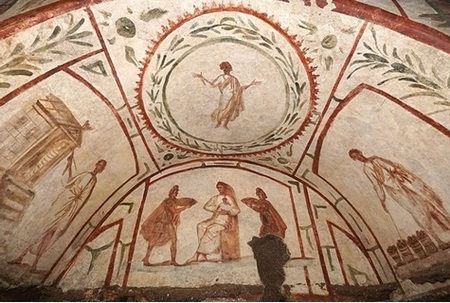
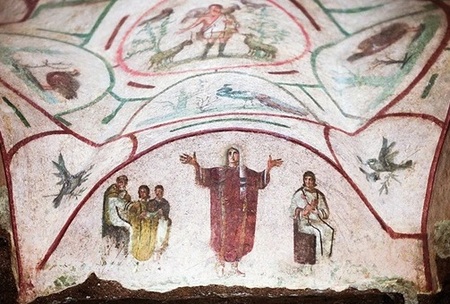
Early Christian Frescoes in the Catacombs of Saints Peter and Marcellinus in Rome (3rd–4th Centuries)/The Fresco «Oranta» in the Velacio Cubicle of Prisca’s Catacombs in Rome (Second Half of the 3rd Century)
The principle of the sacred center extends to the complex architecture of the vaults. At the top of the composition, the figure of the praying orant with raised arms is inscribed within a circular medallion, which is framed by vegetal ornamentation. This medallion serves as the semantic dominant: it floats above the lower scene, where characters are grouped around a table. The sacred image structures the entire space: the lower scene is subservient to the upper, and the icon itself functions as a code connecting the earthly and the divine. This is where I see the point of tension between canonical form and a new semantic environment. The sacred does not dissolve into the everyday; rather, it rises above it, providing a philosophical subtext to the entire narrative.
The orant is at the center, with scenes flanking it. Groups of characters and individual figures are placed on either side of the orant, while the medallions above depict a scene with the Good Shepherd. The fresco functions as the structural and semantic core: all elements—architectural lines, characters, animals—are arranged relative to this sacred center. The presence of the icon in the painting here appears as a deliberate visual device through which the artist constructs a dialogue between the sacred and the profane. Unlike later eras, there is no conflict between these spheres here—there is a total sacralization of space, where the sacred image is the absolute center, rather than a witness to daily life or a philosophical metaphor.
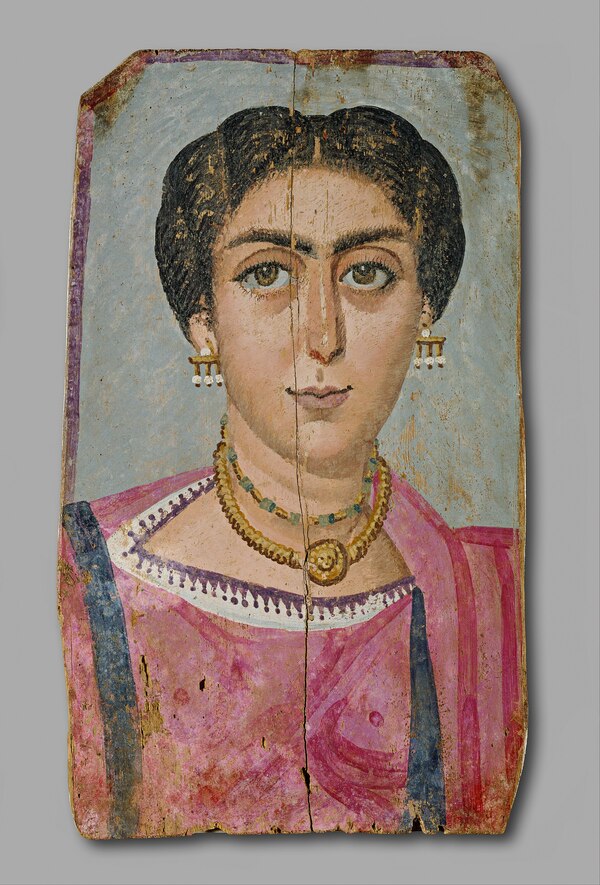
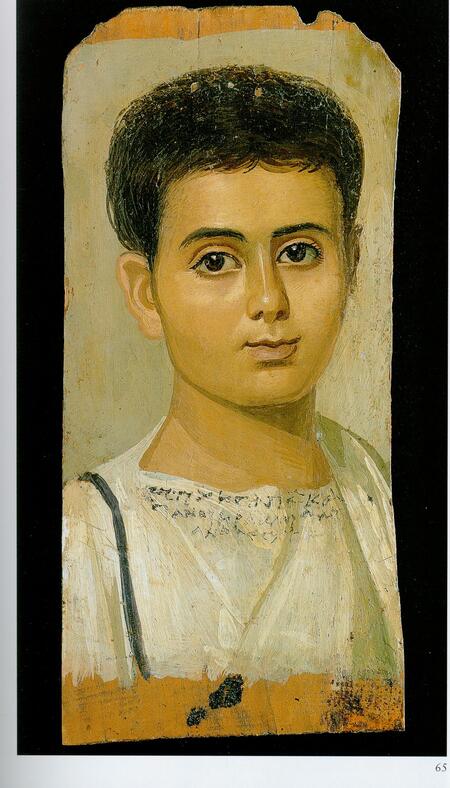
Fayum Portrait: «Woman with a Necklace.» Wood, encaustic, c. 161–192 CE. Philadelphia (Er-Rubaiyat), Egypt. Museum of Art History, Vienna/Fayum Portrait of the Boy Euthychius. Wood, encaustic, c. 100–150 CE. Roman Egypt. Metropolitan Museum of Art, New York
The Fayum portraits represent a fascinating liminal case. It is a paradox: portraits of ordinary people—social, contemporary, or posthumous—executed in the encaustic technique. However, their original function was purely funerary: they were painted while the subject was alive but were used as masks for mummies so that the deceased’s soul could recognize its body in the afterlife. It is within their visual language that the direct progenitor of the future Christian icon is manifested.
A portrait of a woman with expressive, wide-open eyes demonstrates how this funerary object begins to acquire characteristics of a sacred center. The face is oriented directly toward the viewer, the gaze directed through them, into eternity. This is not merely a depiction of appearance; it is the creation of a visual code of presence. The massive gold jewelry, the pink himation, and the hairstyle—these are all terrestrial attributes, yet their artistic presentation already anticipates the canon. The portrait here functions as an active participant in the narrative of transition: it preserves individuality, but its gaze already belongs to another, sacred dimension. It is a mask for eternity.
A portrait of a young man with short hair, dressed in a white tunic—here the paradox is even more pronounced. This portrait captures the moment when a secular funerary portrait begins to inspire an icon. Enormous, almond-shaped eyes, a slight facial asymmetry, yet an incredible detachment and serenity in his gaze. He looks at us, but he is already beyond us. This is that point of tension between the canonical form—which does not yet exist—and a new, spiritual afterlife context. The artist uses chiaroscuro to emphasize spirituality rather than physicality. This young man is not yet a saint, but his countenance already functions as a semantic code for the transition from the earthly to the heavenly.
The Fayum portraits are not merely a prelude to the icon; they are its visual inspirations. They paradoxically fuse the secular and the religious. It is within this rupture between the original function and the new context that the powerful artistic instrument—the one that would later direct the dramaturgy of the Christian sanctuary—is born. The Fayum portrait is the first step on the path from the sacred center to a philosophical metaphor, where the icon has not yet been born, but its code has already been formed.
Emperor Justinian I with his entourage and Archbishop Maximian. Mosaic on the north wall of the apse of the Basilica of San Vitale. Ravenna, Italy, circa 546–547.
Examining the Early Byzantine mosaic, «Justinian with his Entourage,» from the Basilica of San Vitale, one can observe how the concept of a sacred center is materialized—but with a crucial nuance: here, a secular ruler appropriates the visual language of the icon. Justinian is situated at the very heart of the composition. He is clad in purple robes and crowned with a halo. This detail, which would later become established for saints in early Christian art, here marks the emperor as God’s viceroy on Earth. What we see before us is not merely a portrait of a ruler, but an icon of power, where the sacred and the worldly merge into one.
Justinian, holding a golden paten, and Bishop Maximian, holding a chalice, form the semantic axis. The retinue—soldiers with shields, courtiers, and a deacon—is arranged on the sides, subservient to this center. The golden background, which would later become canonical for the icon, creates an effect of timeless, liturgical space.
The icon in this mosaic acts as an absolute structuring element: it organizes not only the pictorial field but also the very idea of imperial theology. This is an early example of how a sacred image is used to transmit philosophical ideas, although in this instance, it is the transmission of the idea of the emperor’s divine right. There is no conflict between the religious and the secular here—rather, there is their complete fusion into a single visual language.
Empress Theodora with her retinue. Mosaic of the southern wall of the apse of the Basilica of San Vitale. Ravenna, Italy, c. 546–547.
In the mosaic of Justinian, «Empress Theodora with Her Entourage, ” the center is formed through ceremonial gesture and statics. This mosaic exhibits the same strict frontality and symmetry as the previous one. Theodora, draped in a purple cloak trimmed with gold, is crowned with a nimbus and holds a precious chalice. She stands beneath a canopy, which visually sets her apart as the composition’s axis. The entourage—court ladies, an eunuch unveiling a curtain, and a clergyman—is also arranged on either side, subordinate to this center. The figures do not move; they stand poised.
The mosaic of Theodora is significant because it illustrates how a secular narrative—the entrance of the empress—is imbued with sacred qualities. The nimbus, the frontal gaze, the gold, and the visual markers of an icon work to affirm the divine legitimacy of power. Unlike later eras, where the icon becomes an object within an object, here the composition becomes an icon: it organizes the sacred space of the church and the viewer’s consciousness, transmitting the idea of the divine order of the imperial couple.
Christ Pantocrator. Fragment of the «Deesis» mosaic in the south gallery of the Hagia Sophia. Constantinople (Istanbul), Turkey, c. 1261.
«Christ Pantocrator» from the Hagia Sophia—this is a pure, canonical sacred center that organizes not only space but the very concept of the divine.
This mosaic strikes the viewer with its monumentality and rigor. Christ is depicted from the waist up, with his right hand raised in blessing and the Gospel in his left. His figure is set within a golden field, which here functions as a metaphysical space. The cross-shaped halo signifies his exceptional nature, and the monograms IC XC on either side anchor the identity of the Image of God, transforming it into a visual code that both believer and non-believer read instantly.
Christ gazes directly at the viewer, but this is not the look of a conversational partner—it is the gaze of the Judge and the Creator. It pierces the temple space and reaches everyone standing before it. In this mosaic, the icon presents itself as the absolute center of the liturgical cosmos. It does not merely depict the sacred; it manifests it. The mosaic becomes the center of the entire temple and empire.
«Christ Pantocrator» demonstrates the moment when the visual language of the icon reaches its apex. It is so powerful that subsequent eras either follow this canon or carry this image into the secular realm, creating a rupture between its original function and the new context.
The trajectory of icon painting, from the early Christian to the early Byzantine periods, reveals that religiosity coexisted with secularity long before the secularization of society. Even in the catacomb frescoes, the precursor to icon painting emerges as an organizing principle. The Fayum burial portraits establish the visual matrix of the future icon. In the mosaics, the emperor and empress adopt the language of the saints, continuing ancient Roman traditions and transforming their own power into an icon. Finally, Christ Pantocrator represents the apex of space filled with religious painting. The rupture between the image’s original function and the emerging secular context—a divergence that begins in the early stages—becomes the mechanism that subsequently allows the icon to transform into a metaphor accompanying a secular narrative.
Western European Renaissance: The Icon as a «Window to the Sacred» and Interior Detail
Jan van Eyck. Madonna of Chancellor Rolin. Wood, oil, c. 1435. Louvre, Paris.
Transitioning to the Western European Renaissance, I note a fundamental shift in the status of the sacred image. Where the icon in early Christian catacombs and Byzantine mosaics served as a total organizing center, governing the entire space, in the Chancellor Rolin’s Madonna, it becomes part of a terrestrial, inhabited interior. The composition features a strict division of space into two zones. On the left is Chancellor Nicolas Rolin, kneeling before an analogion displaying an open book. On the right, the Virgin Mary is seated on a throne with the Infant Christ kneeling beside her. Her voluminous crimson mantle, trimmed with gold and jewels, cascades onto the floor. The key detail that interests me is the architectural setting. The scene takes place in a loggia overlooking a panorama of an ordinary city. Columns with capitals divide the space but do not isolate the figures from the world. Here, the icon does not hang on a wall as an object of veneration; rather, it is present within the interior. It is integrated into the perspective, subject to the laws of linear perspective, yet it retains its sacred aura.
The gazes of Mary and the Infant Christ are averted. This creates a distance between the Chancellor and the Madonna, but this distance is bridged through prayer and through the viewer’s visual connection to the image. One might say that in this painting, the icon functions as a dual visual image. On one hand, it is a painting—a possible part of a rich interior, a detail that underscores the patron’s status. On the other hand, it remains a «window into the sacred, ” a portal through which the earthly person and the viewer can turn toward the divine. Van Eyck uses the icon not to sacralize the entire space, but to construct a dialogue between the ordinary world and the heavenly one.
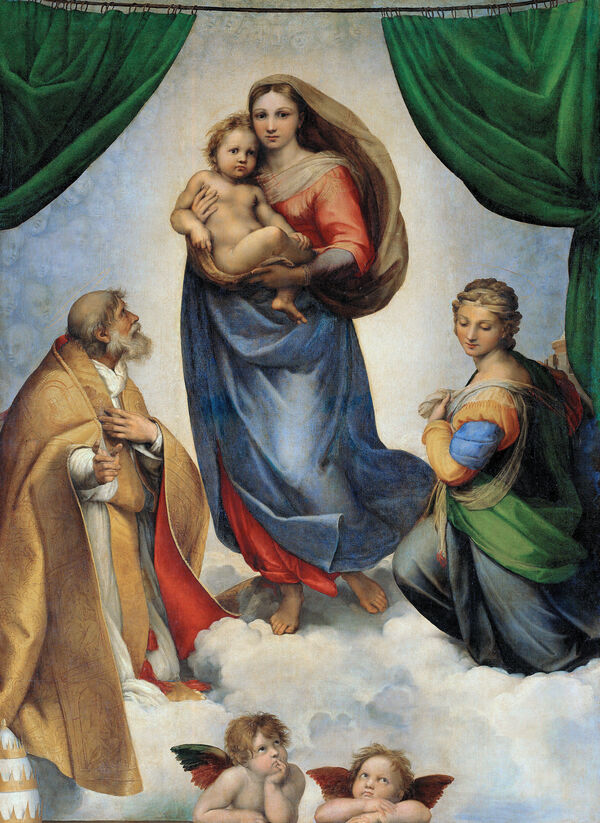
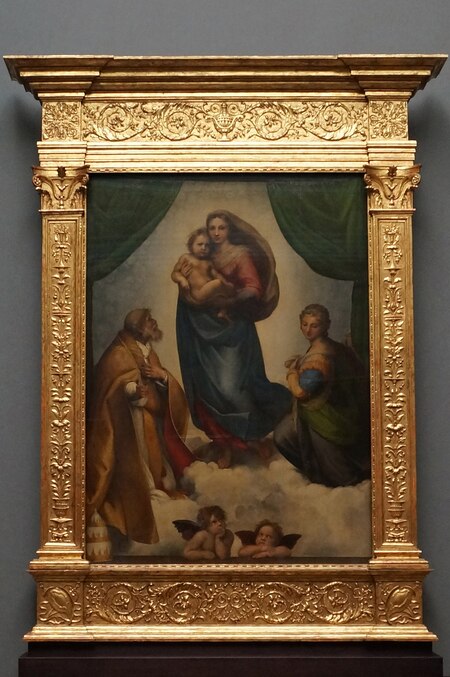
Raphael Santi. Sistine Madonna. Canvas, oil, 1512–1513. Alte Meister Gallery, Dresden/Raphael Santi. Sistine Madonna in a modern altar frame tabernacle, V. Murrer’s studio, 2012. Alte Meister Gallery, Dresden
Addressing the painting Madonna di San Sisto, I perceive how the concept of the «window into the sacred”—a notion pioneered by Van Eyck—reaches its culmination during the High Renaissance, taking on a new, more dramatic form. The icon’s composition is structured classically. At the center, the Madonna and Child float upon clouds draped in a flowing blue mantle. To the left is Pope Sixtus II, wearing a golden tiara, his gaze directed upward toward Mary. To the right is Saint Barbara, whose eyes are cast down in quiet humility. The flanking green draperies do more than simply create a background; they frame the sacred space, separating it from the outside world. This is a theatrical device, emphasizing that what we are observing is not an everyday scene, but an apparition. The Madonna’s gaze is directed straight at the viewer—this is the very „visual code of presence“ I noted in Fayum portraits, but here it is brought to perfection.
Addressing the canvas «Madonna of San Sisto, ” I see how, during the High Renaissance, the concept of the „window into the sacred”—initiated by Van Eyck—reaches its culmination, yet assumes a new, more dramatic form. The composition is classically structured: in the center, the Madonna with the Child floats on clouds in a billowing blue cloak. To the left is Pope Sixtus II in a golden tiara, his gaze directed upward toward Mary. To the right is Saint Barbara, who has humbly lowered her eyes. The green draperies on either side do more than merely create a backdrop; they frame the sacred space, separating it from the external world. This is a theatrical device, underscoring that what we witness is not an everyday scene, but a manifestation. The Madonna’s gaze is directed straight at the viewer—this is the very „visual code of presence“ I noted in the Fayum portraits, but here it is perfected.
Robert Campin (Master of Flémalle) and his workshop. Triptych «The Annunciation» («Morede Altar»). Wood, oil, c. 1427–1432. Metropolitan Museum of Art, New York.
In the «Trinity of the Annunciation, ” the concept of a „window into the sacred“ transports one of the most significant Biblical events into the living room of a bourgeois home. The private space becomes the interior itself: the icon ceases to be a separate object on the wall and dissolves into the setting.Mary sits on the floor in a red dress, engrossed in reading, while the angel Gabriel has just entered the room. The table, the bench, the shelf with household goods, the basin, and the towel—recognizable objects of 15th-century daily life—each function as a semiotic code. The extinguished candle with a smoking wick denotes the moment of the Incarnation. The white lilies in the vase are a symbol of Mary’s purity, and their quantity may allude to the Trinity. Particular attention can be paid to the right wing, which depicts Joseph in his workshop. He is crafting mousetraps, which serves as a direct visual metaphor. According to Augustine, the Cross of the Lord was a „trap for the devil, ” and Christ’s death served as bait. The material world is employed not for ornamentation, but for theological expression. The left wing, featuring kneeling donors—the Engelbrecht family—completes the composition. The patrons gaze through the slightly ajar door toward the central scene, as if witnessing the sacrament. Their presence in this sacred space is not merely a portrait but a visualization of hope and participation in the divine plan.In this triptych, the icon as an object ultimately dissolves into the interior. The religious narrative transforms into a domestic scene in all its attributes. It is fully integrated into the quotidian life of the people of that era. It is this fusion of the domestic and the sacred that creates that specific point of tension: the icon retains its aura, but now it manifests not through gold and frontality, but through the recognizability and detail of the earthly world.
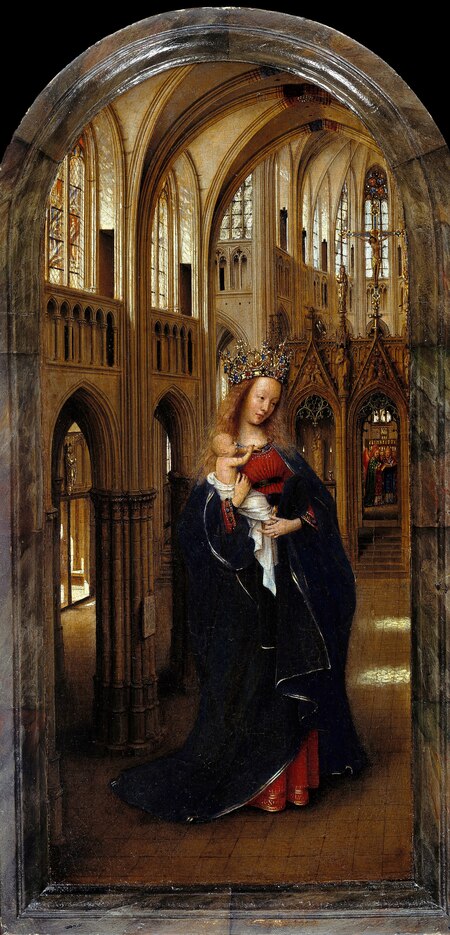
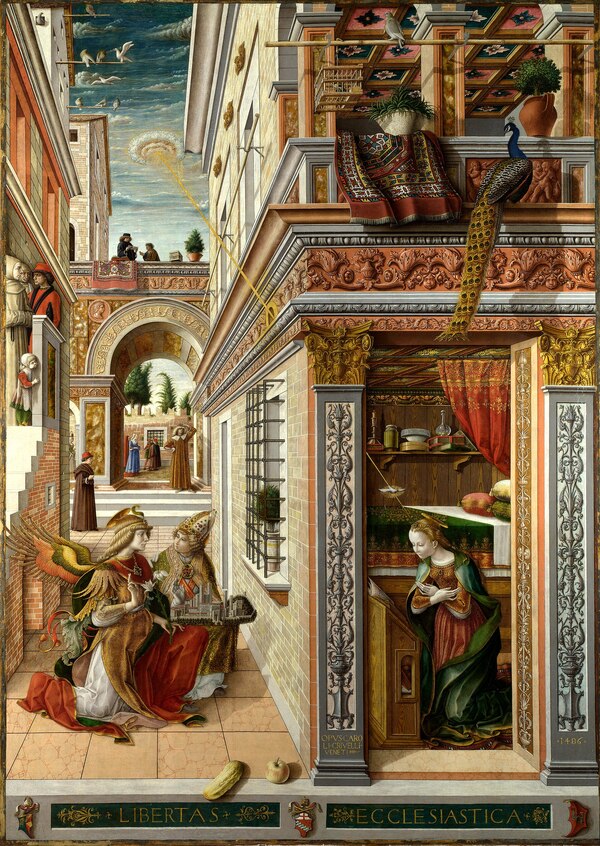
Jan van Eyck. Madonna in a Church. Wood, oil, c. 1438–1440. Berlin Picture Gallery, Berlin./Carlo Crivelli. Annunciation with Saint Emidius. Wood (transferred to canvas), tempera and oil, 1486. National Gallery, London.
Addressing the Madonna in the church, I observe how the concept of a «window into the sacred» achieves clarity: the icon here isn’t merely integrated into the interior—it becomes the interior itself. Mary with the Child stands in the nave of the Gothic cathedral, yet her figure is monumental in relation to the architecture; she fills the space like a colossus. Her blue mantle, edged in gold, contrasts with the cold gray stone of the columns, and light from the high windows floods the floor, but Mary seems to be its source, rather than just an illuminated object.
A crucial detail that shifts the perception is the tiny figures of people. In the background, near the altar, the patron, likely George van der Paele, kneels. His scale is so minuscule compared to Mary that it creates a sense of rupture between the earthly and the celestial. This is a metaphor for the distance between humanity and the divine: the icon exists in the same space, but on a different scale, generating that precise tension I mentioned in my hypothesis.
Unlike the «Annunciation Triptych, ” where the sacred dissolves into quotidian details, Van Eyck restores monumentality and absolute status to the icon. Mary here is not a witness to daily life, but the center of a liturgical cosmos, organizing the entire space around her. The gap between her scale and the figure of the patron becomes a powerful artistic device: it emphasizes that the sacred does not dissolve into the earthly, but rather rises above it.