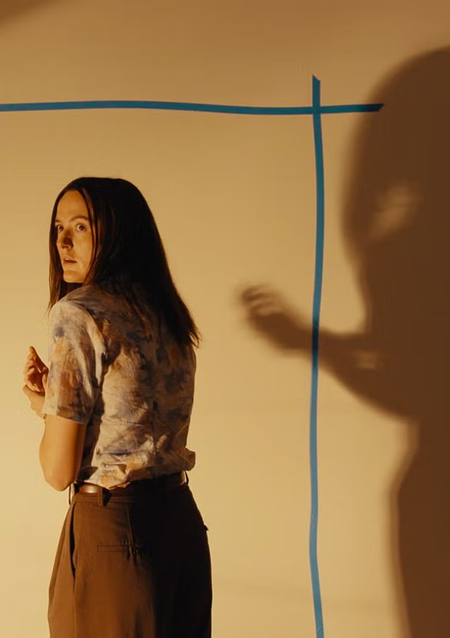
This work contains disturbing imagery that may cause psychological discomfort.
It is increasingly difficult to frighten a modern audience solely with bizarre anthropomorphic monsters created with special effects or excessive gore spattered across the screen with fake blood. More often now, techniques aimed at psychological and emotional impact on the audience are employed. With the rise of internet culture, the «analog horror» genre has gained significant popularity—it frightens through ambiguity and the incomplete nature of the picture for the general viewer. This meshes perfectly with the «psychological horror» genre, which unnerves through escalating atmosphere and the uncertainty of where the source of anxiety lies.
The «Backrooms» phenomenon (which will be translated as «The Limbo» for convenience in this study) successfully combined both of these elements. Born on an anonymous forum from a single photograph of an empty corridor and a characteristic caption, The Limbo caused a sensation among regular users. Several factors aligned perfectly: the unknown, a sense of unease, and curiosity, which blossomed into a true internet legend. This was amplified by the fact that many found these yellow wallpapers strangely familiar—many note that photos of The Limbo evoke a peculiar feeling of nostalgia; everyone feels as if they have been in a similar place, but no one can recall exactly where they saw this bizarre «landscape.» It was precisely this simplicity that made the image of The Limbo go viral.
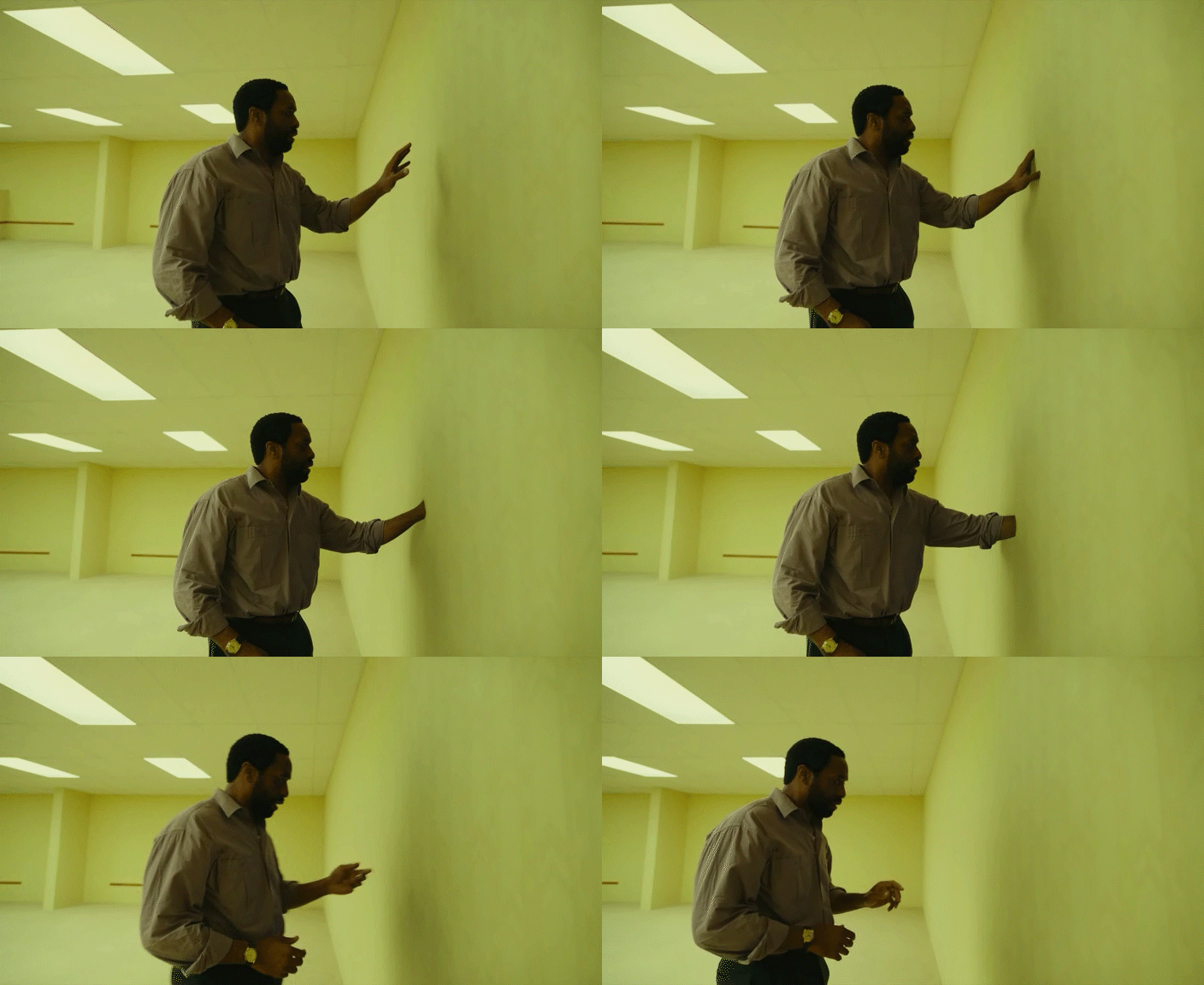
Backrooms exploits the fear of liminal spaces—places that exist somewhere «in between» two states simultaneously. These endless, empty office corridors evoke anxiety precisely because they look familiar but lack their customary function. In the film «Backrooms» (translated into Russian as «Закулисье реальности»), this sensation is pushed to an extreme. The space in the Backrooms is infinite yet utterly illogical; there is sound, but it only underscores the pervasive silence. The architecture and interiors in the film function as a separate character—a vibrant source of unease. Besides the traditional monster, the space itself is a presence that does not need to be conscious or comprehensible.This visual language became the foundation for Kane Parsons’s work. What started as internet folklore later materialized on the big screen, maximizing the scale and depth of liminality. The film transports the viewer into yellow, illogical labyrinths through its main characters, using light, color, emptiness, and repeating imagery as its primary narrative devices. Unlike many horror films, the visual aspect here acts as one of the story’s main narrators.
In this study, I aim to examine how the visual narrative of the film «Backrooms» transforms liminal spaces from an internet myth into a complete cinematic language of horror and stagnation that devolves into human degradation, and what specific role memory plays in this process.
→ Color and Light → Camera Movement and Point of View (POV) → The Window as a Boundary Between States → Trace, Memory, and Transformation → Space as a Distortion of Memory
Color and Light
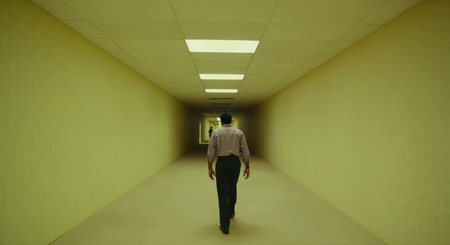
Unlike classical horror, the film consciously remains very bright for most of its runtime. The yellow wallpaper and the monotonous light from fluorescent lamps distributed throughout the Backstage area create a unique effect of lacking shadows in open areas. This generates a feeling of vulnerability, even if the person who enters doesn’t yet know if they need to defend themselves at all. In those long corridors where light does not penetrate, conversely, true hidden corners form—corners where the unknown is equally frightening. Is someone hiding there?
One could state with absolute certainty that the dominant color of the painting is yellow—a sickly, dirty, and maddening hue. The unnatural landscape only reinforces the overall atmosphere of madness surrounding the scene. The main character, Clark, is one of those subjected to this insanity. Having given up on his dream of becoming an architect, having argued with his wife, and suffering financial losses in his own furniture store, Clark soon discovers the Backstage in his basement shortly after the film begins.The more potent the energy of liminal spaces, the more intensely light reacts in reality. This is how Clark realizes that there is something supernatural in his store, initially rationalizing the unnatural lighting as electrical interference.
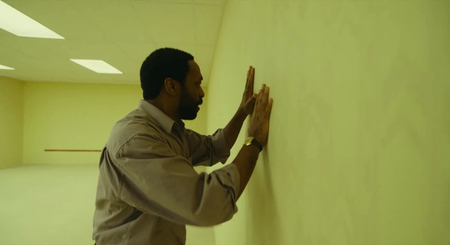
A very important detail emerges in how the protagonist finds the entrance. He notices a crack right in his wall—and similar cracks can be observed in video games along texture seams if one stands in a particular way. These game conventions can be used to explain the principle of liminal spaces: they are something artificially constructed, perhaps not fully «rendered.» But is it really that simple?
Returning to color theory, it is interesting that Clark wears a purple shirt upon his first arrival in the Backlot. This could serve as a harbinger of someone’s impending death—which, in a sense, does happen later—or it might be an entire premonition of the hero’s fate. The color of his shirt, vibrant in the real world, loses all its saturation and «identity» under the pressure of the yellow wallpaper, merging with his skin. This mirrors how Clark’s own personality changes under the influence of the Backlot later on.
The rationality acts as a counterpoint to the liminal spaces depicted in the film. The «representatives» of this rationality can be identified as Mary—Clark’s psychologist—and the A-SYNC company, an early manufacturer of MRI machines. The voice of reason in the film is conveyed through the color blue and cool tones in general: they serve to sober the characters and attempt to resolve any irrationality, whether it involves a client’s trauma that is overlooked, or the liminal spaces themselves.
Camera movements and point of view (POV)
A varied perspective on the backstage is also conveyed through cinematography. When Clark becomes the «guest,» the camera moves with him. The protagonist thinks more by instinct, striving to see as much as possible; ironically, for the viewers, Clark occupies a rather large portion of the frame in very many shots.
When Mary enters this «otherworldly realm, ” the camera remains level and static. We see how small a person is compared to the whimsical interiors of the Backstage. The protagonist tries to understand and logically explain what she is seeing.
The early portion of the film is dominated by mockumentary-style episodes. Both the main characters and the A-SYNC researchers document the Backstage area for their respective goals. The VHS aesthetic was chosen deliberately: first, it is dictated by the film’s setting—the nineties. Simultaneously, the viewer loses their footing as the picture switches between high-quality footage and «archival» recordings.Second, the impression is created of recordings pulled from a potentially damaged archive. The VHS segments evoke a sense of material decay and oblivion, suggesting that the Backstage exists at the intersection of reality and time.Third, the trend toward such a visual technique is indirectly explained. VHS serves as the visual code of that era—a product of nostalgia, even for those who never lived through it.
Navigating various interpretations, directors immortalize the aesthetics of their past in their work, striving to recreate it from memory.