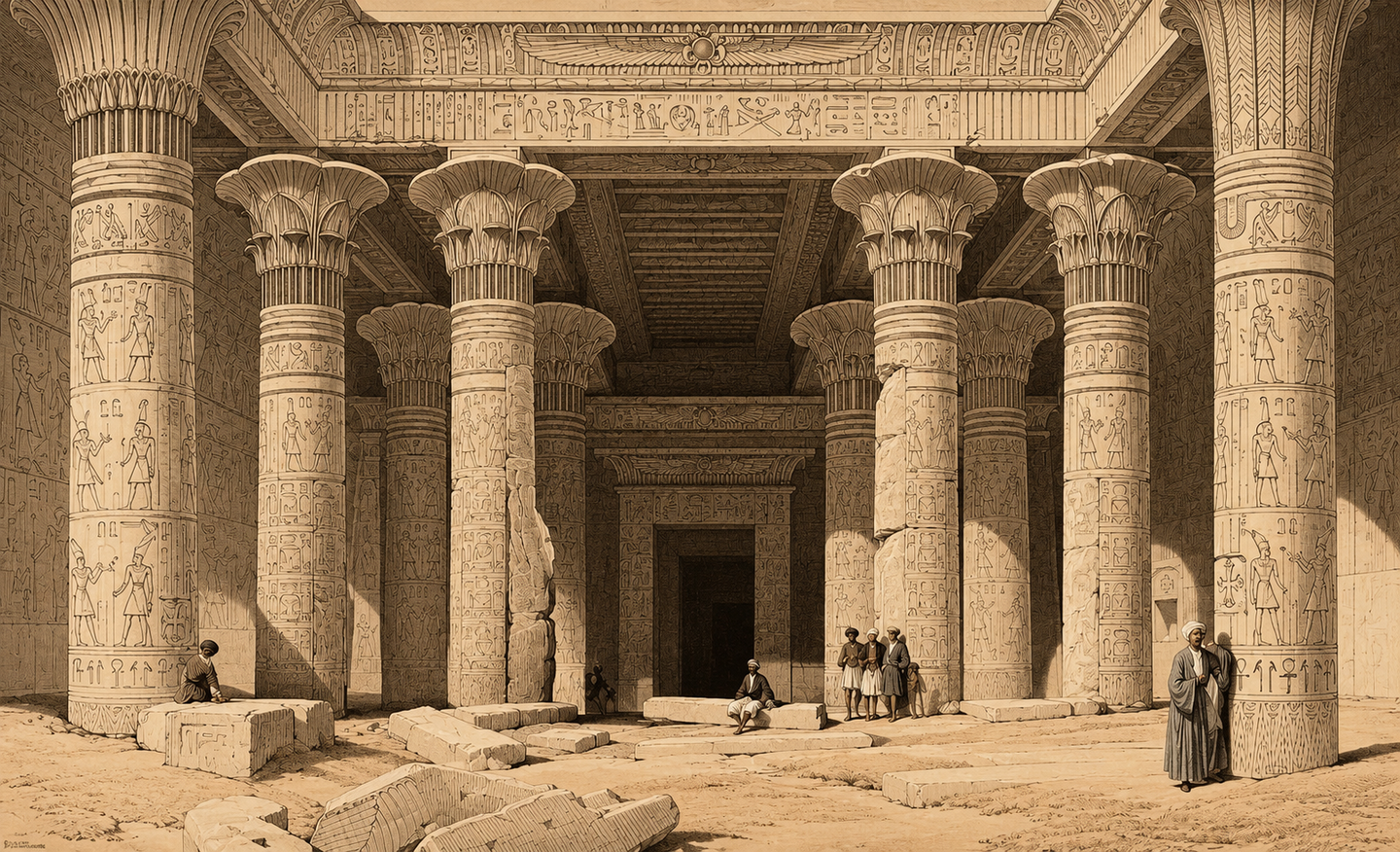
Шестого не дано: капители, не попавшие в канон
Introduction
The familiar list of five orders (Tuscan, Doric, Ionic, Corinthian, and Composite) is often perceived as the classical canon. In reality, Italian architect Sebastiano Serlio first presented it as a unified system in 1537. Before and after him, architects proposed other types of capitals: those featuring a deity’s face, those with bovine protomes, those with lions and unicorns, and those with corn cobs. Each of these could be considered a contender for the role of a sixth order, yet none made it into the canonical set.
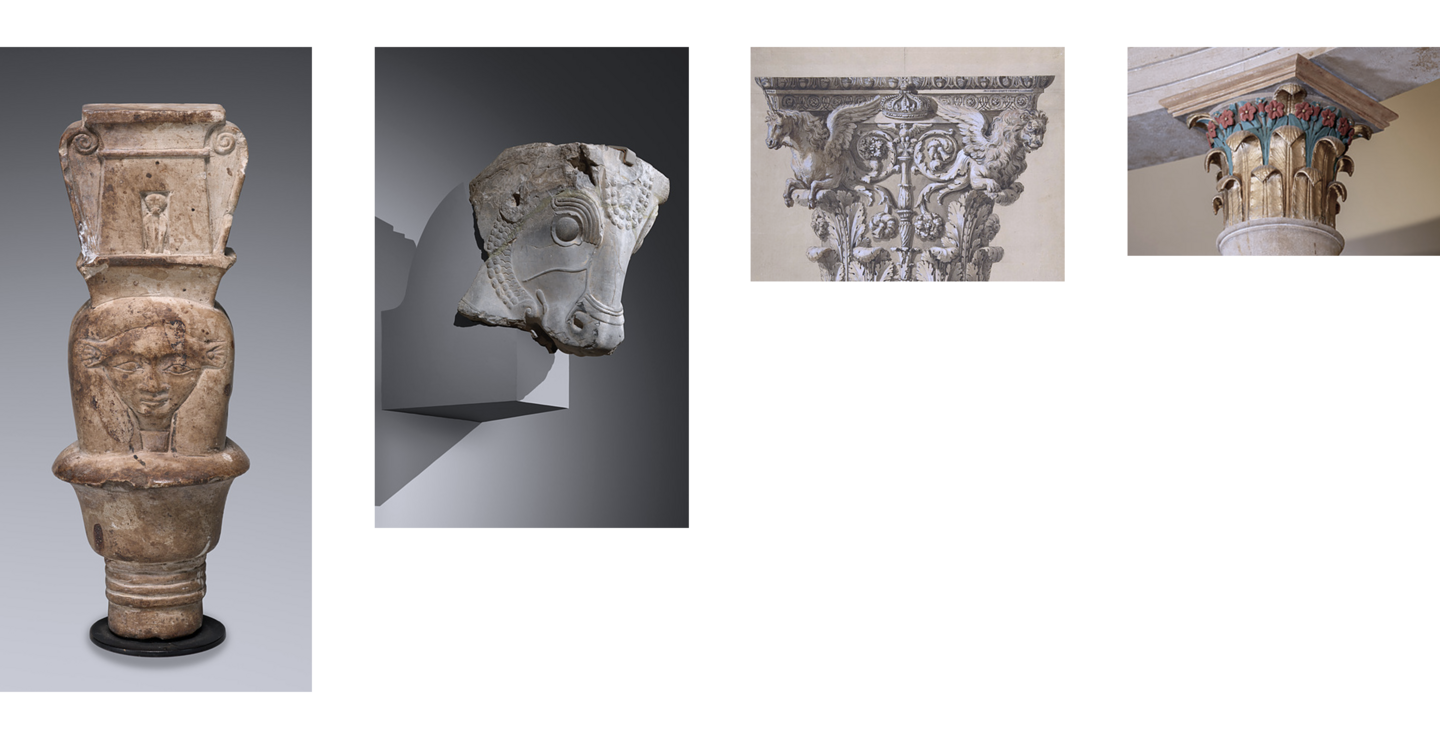
Volute capital of a column featuring the face of Hathor. Egypt, 380–30 BCE. Limestone. The Cleveland Museum of Art // Bull head from a column capital. Achaemenid Empire, c. 5th century BCE. Metropolitan Museum of Art, 47.100.83 // James Adam. British Order, 1762. Fragment: lion and unicorn instead of corner volutes. Metropolitan Museum of Art, 34.78.2(2) // Tobacco column capitals. Small Senate Rotunda, U.S. Capitol. Design by B. G. Latrobe
Order Criteria: Why Not a Single New Capital Met Its Requirements
The initial hypothesis was as follows: the new capital was too closely tied to a specific client or meaning—a deity, a ruler, or the state—making it impossible to transfer it to another building without losing its original context. During the work, this hypothesis was confirmed only partially. The attachment to the «owner» indeed hindered the dissemination of the form; however, for several capitals, the decisive factor turned out to be something else: the absence of a rule fixed in such a way that another architect could reproduce it.
Methodology
In the first stage, characteristics common to five canonical orders were identified, beyond mere external resemblance. There were five of them; subsequently, each «non-canonical» capital is tested against these.
1. Reiteration. The form appears in more than one building.
2. Adaptation. The form was applied in buildings for another client or purpose.
3. Systemization. Changes are applied to the shaft, base, and proportions, not just the capital.
4. Codification. The form is fixed in a text or drawing in such a way that another architect can reproduce it.
5. Anonymity. The capital can be used without knowing its «owner»: it does not feature a deity, crest, or attribute of a specific nation.
1. Characteristics of the Canon: How Five Orders Differ from the Rest
A standard is necessary to evaluate unsuccessful candidates. Vitruvius’s order is not yet a table of proportions—it is a narrative in which each column is given an origin, a character, and a body to imitate.
The Doric column began to reproduce the proportions, strength, and beauty of the male body in buildings.
The anthropomorphic metaphor explains the appearance of the column, but not how it is constructed. Scholars in the 16th century solved this problem. Serlio arranged the five orders in increasing order of ornamentation [2]. Forty years later, Vignola reduced all dimensions to a single module—the radius of the column [3]. From that point on, the order could be reproduced from a book without seeing Roman monuments.
Fig. 4. Five classical architectural orders: Greek (Doric, Ionic, Corinthian) and Roman-Italian (Tuscan, Composite); the structure of the order is shown on the right. By Simeon Netchev, 2026 // World History Encyclopedia
However, the canon never reduced itself to a single form. On a Piranesi plate, Ionic capitals from Roman churches are compared with Greek ones, and not a single one replicates the other: there are countless variations, but the type remains unified. From this follows an important conclusion for further analysis: the difference in itself does not make a capital a new order—the author’s intent is what makes it new.
Ill. 6. Giacomo Barozzi da Vignola. Roman Ionic Capitals in Comparison with Greek Examples, Plate 20 from «Della Magnificenza e d’Architettura de’ Romani.» Mid-18th Century. Etching. Metropolitan Museum of Art, 41.71.1.7(28).
Thus, the canon meets all five criteria: it is repeated and transferred, possesses a system and fixed rules, and the ethnic designations have lost their meaning. Next, we will examine which criterion proves insurmountable for each candidate.
2. Capital-Icon: Divinity as the Subject of the Capital
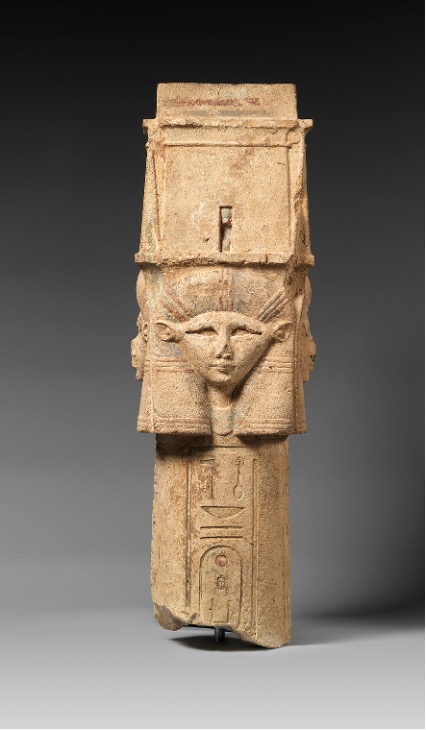
The most direct way to imbue a column with meaning is to place a mask upon it. Such capitals are common in Late Period Egyptian art: four masks of the goddess Hathor, with cow ears, face the four cardinal directions, and a small naos is situated above them. Here, the column is not merely a decorated support, but a self-sufficient sign of the divine.
Ил. 7. Колонна с капителью Хатхор. Египет, 380–362 до н. э. Метрополитен-музей
Ил. 16. А. Беато. Капители Хатхор в храме в Дендере. Ок. 1870-х. Кливлендский музей искусств
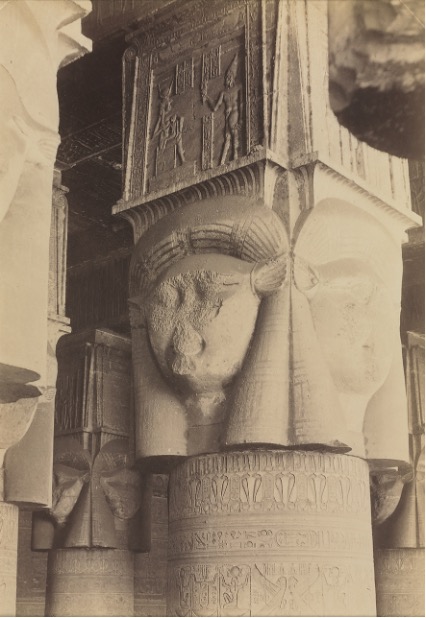
The Hathoric capital meets the following criterion: it appears in both monumental temples and small votive objects; in Dendera, such columns form an entire portico. However, it fails the following criteria. It seems that this type of capital cannot be placed in a temple dedicated to a different deity without altering the meaning of the entire structure—thus, it does not meet the criteria of portability and anonymity simultaneously.
The transformation of the face of Hathor on Cyprus warrants special attention. Cypriot artisans from the 5th century BCE completed funerary stelae featuring either the goddess’s head flanked by volutes or volutes alone, without any face. In the author’s observation, within one region and period, a separation of ornament from image is documented here: the volute can exist independently of the deity, whereas the deity, outside of its temple, cannot.
In 6th-century BCE Attica, the deity is moved to the capital. A concave block-cavetto crowns the funerary stele, featuring a sphinx—the guardian of the burial. The capital transforms into a pedestal, supporting a figure rather than a roof structure. Although the form was repeated, it did not transition into temple architecture and remained a feature of the necropolis.
Fig. 9. Marble capital-cavo. Attic, mid-6th century BCE. Hymettian marble. The Metropolitan Museum of Art, 17.230.6//Fig. 10. Marble sphinx on a capital-cavo. Attic, c. 580–575 BCE. Marble. The Metropolitan Museum of Art, 24.97.87
So, all candidates reviewed in this section meet the criterion of recurrence but do not pass the criterion of transposition. The exception is the Cypriot currency, which has survived its apotheosis; the research will return to it in the section on vegetal capitals.
3. Capital-Crest: A Symbol of Authority on the Column
If the Egyptian column embodies the image of a deity, the Persian column symbolizes royal power. In Achaemenid halls, the capital is formed by the foreparts of two oxen fused back-to-back; the lintel was placed between their heads. This is the most tectonically justified solution in the selection: the animal does not depict the load—it genuinely bears it.
The criteria for repeating bull capitals include their presence both in Susa and Persepolis. The system is also present: the capital is coordinated with a high shaft, a complex base, and intermediate volutes. However, such halls were built exclusively under royal commission, and with the decline of the empire, the form vanished along with its patron. Nineteenth-century European travelers sketched and photographed the columns of Persepolis already without capitals—isolated shafts across the plain.
More than two millennia later, James Adam employs a similar technique. In 1762, he developed the «British Order» for a conceptual project of a parliamentary building: the angular volutes of the Corinthian capital are replaced with a lion and a unicorn—the supporters of the royal coat of arms. There is no systemic change here; the shaft, base, and proportions remain Corinthian, with only the symbol on the capital being altered.