How did shifts in theological understandings, cultural ideals, and artistic methods influence the depiction of the human body within a single biblical narrative?
I // Creation of Man
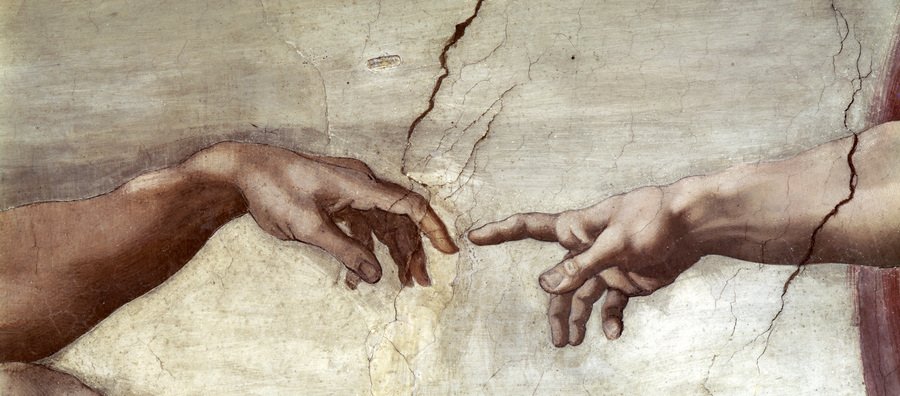
«The Creation of Adam» by Michelangelo Buonarroti
The human body holds a unique place in the history of Christian art. Unlike many other religious narratives, the story of Adam and Eve allows one to trace nearly the entire human journey: from creation and paradisiacal existence to violating the divine command, becoming aware of one’s nakedness, and expulsion from Eden.
The very first people become the central figures in one of European art’s most enduring narratives. For centuries, artists returned to the same episodes of the Book of Genesis, yet the perception of what the human body should look like and what it conveys constantly evolved.
The narrative of Adam and Eve is of particular interest because the nakedness of the human being carries fundamentally different meanings within it. Before the Fall, it was a natural state for the first people, one that caused no shame. After tasting the forbidden fruit, nakedness is perceived as vulnerability, and the human body becomes intertwined with the experience of guilt and the necessity of covering up.
Thus, a single biblical narrative contains opposing states of the human body. This allows us to view the depictions of Adam and Eve not only as illustrations of Holy Scripture but also as a reflection of different eras' understandings of human nature.
How did the perception of the human body in European art evolve from the early Christian tradition to the 17th century through the depiction of Adam and Eve?
The evolution of human depiction is tied not only to the development of artistic techniques and an interest in anatomy, but also to a re-examination of human nature. In Early Christian art, the body is primarily integrated into symbolic religious narratives. During the Middle Ages, its depiction serves a spiritual meaning. The Renaissance saw a heightened interest in physical beauty, anatomy, and the ancient ideal of proportion. In the art of the 16th–17th centuries, corporeality acquires additional meanings: sensuality, tension, drama, and emotional expressiveness. Moreover, artistic eras do not simply succeed one another; older symbolic meanings persist within new modes of representation.
II // CREATION: THE BODY AS A DIVINE CREATION
Adam and Eve. Fresco in the catacombs of Saints Peter and Marcellinus in Rome. 2nd half of the 3rd century — 1st half of the 4th century.
The history of images depicting Adam and Eve begins in early Christian art. The first known depictions of original sin appear in the catacomb paintings of the 3rd century. Subsequently, the narrative becomes part of sarcophagus decoration, acquiring particular significance in the context of concepts of death and salvation.
The emergence of the first figures in Christian funerary art is no accident. The history of the Fall of Man explains the origin of human mortality, and Christian doctrine of salvation connects overcoming the consequences of original sin with the sacrifice of Christ.
Fragment depicting Adam and Eve on the Sarcophagus of Junius Bassus, marble, 359 AD (Vatican Basilica of St. Peter’s Treasury Museum).
On the sarcophagus of Junius Bassus, the scene of Adam and Eve is integrated into the broader cycle of Biblical and Gospel events. The first humans are depicted at the moment they realize they have broken the prohibition: they cover their nudity with leaves after eating the fruit. Here, the human body has not yet become an independent object of artistic study. Its depiction is concise and subordinate to the narrative function. The figures' posture and gestures are more important than individual anatomical expressiveness.
The nudity of Adam and Eve in early Christian imagery should not be interpreted as an attempt to convey the physical beauty of the human body. Instead, it is primarily necessary for recognizing the biblical episode and signifying the condition of the first people before and after the Fall. The change in gesture becomes significant: before the prohibition was broken, the body was exposed; afterward, it was covered. Thus, the artist communicates not so much the physical change in the person as the change in their self-perception. This is the foundation of the future iconography of nudity: the nude body becomes a vessel for a specific theological meaning.
The Fall of Man and God’s Covenant with Noah, from the Viennese Bestiary, folio 3 recto, early 6th century, tempera, gold, and silver on purple velvet, 31,75×23.5 cm (Österreichische Nationalbibliothek, Vienna)
The Vienna Codex is one of the most important surviving illustrated monuments of late antique Christian culture. Its significance for research lies in the development of the principle of sequentially depicting biblical narratives. The illustrations do not merely reproduce individual symbols; they help the reader perceive events as a connected story. Furthermore, the depiction of the human figure maintains a connection to late antique artistic tradition: volume, gesture, and body positioning help organize the narrative.
In the early Christian and Byzantine tradition, the human body is primarily viewed through its spiritual origin. The creation of Adam becomes a visual expression of the concept of humanity as God’s creation.
12th-century mosaic from the Palatine Chapel in Palermo, Sicily
The image is not necessarily striving for anatomical accuracy. The proportions, gestures, and arrangement of the figures may be conventional, as the artist’s primary goal is to convey the religious content. This fundamentally distinguishes the medieval interpretation of the human figure from the Renaissance interest in the body as an object of independent study.
The Cathedral Basilica in Montreal — mosaic of the upper row of the west wall. Between 1183 and 1189, or the first half of the 13th century.
The second chapter of the Book of Genesis describes the creation of Eve from Adam’s rib. This episode occupies a special place in Christian iconography because it visually represents the origin of woman and the connection between the first humans. In the traditional composition, Adam is depicted sleeping, with God positioned beside him, from whose body Eve emerges. The most crucial element is not the interaction between two independent figures, but the act of divine creation itself.
From the perspective of corporeality, this narrative allows us to see how the human body becomes not only the result of creation but also the source of another human being’s emergence.
Andrea Pisano. «The Creation of Eve.» 1334–1336. Buttress relief, Giotto’s Campanile, Florence.
In Andrea Pizzano’s relief sculpture, the narrative of Eve’s creation is presented with a more spatial and plastic solution. The figures gain materiality, and their positioning becomes a vital element of the composition.
The human body gradually moves beyond the conventional sign and becomes part of the artistic space. Although religious meaning remains paramount, the artist is already showing interest in the volume and physical presence of the figure. This example allows a transition from the early Christian tradition to the later interest of European art in the real human body.
III // EDEN: SHAMELESS NAKEDNESS
In the Book of Genesis, Paradise is presented as a space of original harmony among humanity, God, and the surrounding world. Adam and Eve exist among the plants and animals without experiencing fear or shame.
«The Story of Adam and Eve» (c. 1413–1415) is a renowned book miniature, created in Paris by an anonymous French or Flemish illuminator known as Master Busiko.