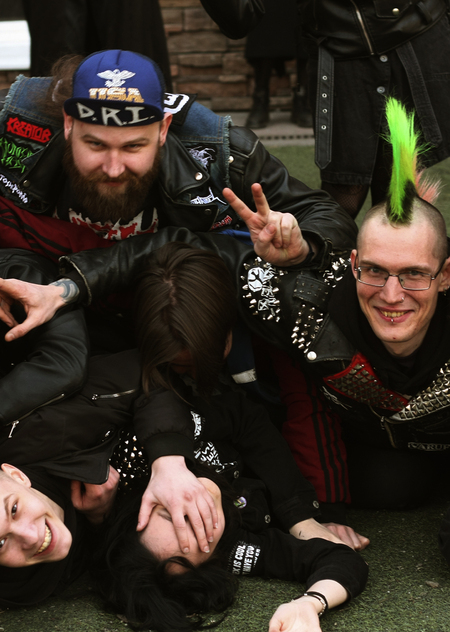
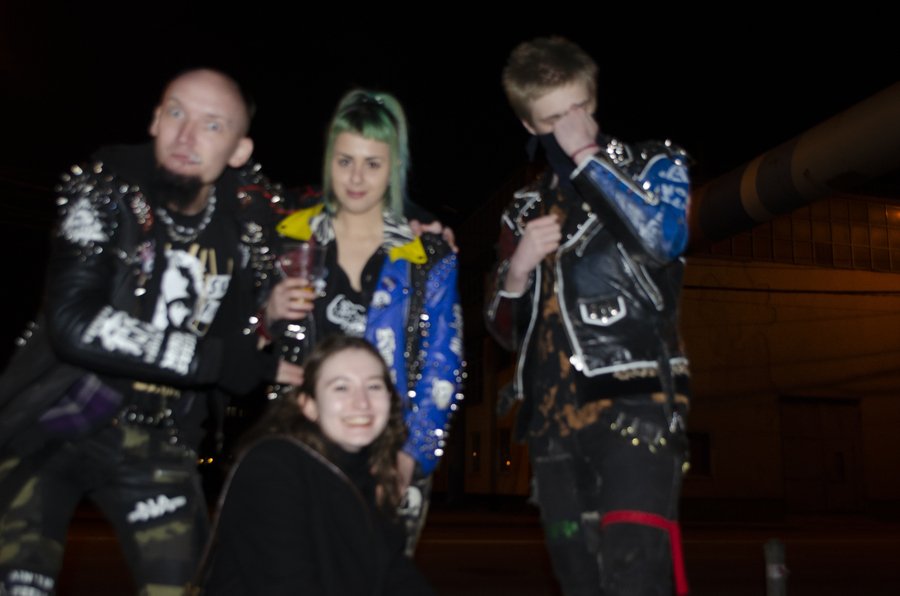
Photographer Diana Chuchkova/ Author of the visual study with subculture representatives/ 2023
Navigator:
1. Concept. 2. Punk as a Subculture. 3. Core Iconography. 4. From the USSR to Modern Russia. The Symbolism of Anarchism. 5. Differences and Similarities Between Contemporary Western and Russian Punk. 6. The Uniqueness of Russian Punk. 7. Conclusion. Research Findings. 8. Bibliography. 9. Image Sources List.
Concept
Subcultures are always the most interesting to examine because they display their own distinct historical and cultural layer—one that often differs radically from conventional notions of societal norms. Unfortunately, people frequently approach subcultures with enormous prejudice. Take punk, which is the subject of my research. Most people will resort to stereotypes and disdain, depicting them as marginal figures who disrupt the everyday lives of citizens. But has anyone who holds a popular opinion ever personally spoken with a «subculturalist»? Perhaps the challenging and unconventional style of such a person puts off such thoughts. Yet, the reality is quite the opposite: the message in these images is not dangerous to the general public at all, and sometimes there is no message at all—it simply constitutes part of the community’s «signature» iconography. It is precisely by understanding the «visual language”—the attire and imagery within these communities—that we can discern a worldview and values, and perhaps even approach the subculture from an entirely different perspective.
Punk—on a global scale—is a small «union.» It divides, for example, by geographical characteristics, and can forge its own path. This is why I decided to focus on «Russian punk» for this visual study. By primarily working with imagery, I will explore how and what Russian punks experience, especially since I gathered interesting material «from the inside» for this project. I will touch upon the historical development of the subculture and, most importantly, compare Western and «native» punk to determine whether its representatives possess a unique identity, whether the subculture is perceived as stereotypically, or if things are different—whether punk is rigid or fluid, and if it is experiencing stagnation in its own beliefs, including minor details.
Punk as a Subculture
Photojournalist / Live at Goose Lake, The Stooges / August 8, 1970
The newly emerging movement took shape in the 1970s and was primarily composed of young people. Punk is, and remains, a rather politicized subculture characterized by anarchism, the DIY ethos, anti-government slogans, and leftist ideology. There is also a prevailing theory that punk derives from the «garage rock» of the 1960s. In fact, this genre skirted the mainstream, remaining underground. This positioning largely aligned with the anarchistic vision of the future subculture. «The Stooges, ” led by Iggy Pop, are considered the key group that pioneered punk rock.
Andy Warhol and The Velvet Underground & Nico / V.U. Album Cover / 1967
On the other hand, the American group The Velvet Underground influenced subculture. Their activity spans the 1960s and 1970s. Led by Lou Reed, the band was instrumental in pioneering experimental rock and alternative music. The Velvets (an alternative name) were not punk in the traditional sense, yet their sharp lyrics, the conceptual depth of their songs, and their experimental sound significantly impacted the evolution of the genre and its sonic identity. Interestingly, V.U. also influenced alternative rock, noise rock, and the development of «slowness» in post-punk, thanks to the songs on their first album.
Photojournalists / Members of Sex Pistols and Ramones / 1970s
The movement ultimately transformed into a subculture, anchored by influential punk groups like the Sex Pistols and Ramones, developing its own distinct style in appearance and ideology.
www.roseannejones.co.uk/ Punk Font (Bricolage)/ 1970s
The concept of «punk» emerged in the 1970s: that is how critics and journalists described the bands and their fans. Previously, it was referred to as «shpana» or denoted a low social status; the word is slang. In any case, «punk» carried a negative connotation.
Core Branding Elements
Photos from personal archive / Drawings on a leather jacket, DIY / 2023
First and foremost, the image of punk is provocative. It embodies the DIY («do it yourself») principle—rejecting any commercial aspect and creating or modifying attributes manually, or placing an object into a new context. Additionally, deliberately provocative elements, such as Nazi swastikas or safety pins worn as earrings, are incorporated. Given that punk is defined by anarchy, «aggression,» and rebellion, this creative and protest-oriented approach to expressing the subculture’s ideas through style, which utilizes DIY, has been termed «bricolage» and perfectly encapsulates the beliefs of its adherents.
mylitta.ru/ Iroquois/ 2015
Bright hair color, unconventional haircuts featuring various types of mohawks, provocative makeup, leather apparel, spikes, and piercings—these are the established norms of «classic» punk aesthetics.
Local Authors / Fanzines / 1970s
So-called punk zines or fanzines are an equally vital component. These amateur publications, stemming from the DIY ethos and clothing style, are directly linked. They share elements—in design, detail placement, color palette, and a sense of «chaos.» Given the distinctiveness and extravagance of this subculture, as well as the unavailability of necessary items to construct an image or add an unexpected touch, bricolage was employed.
Unknown Photographer / Punks / 1970s
This ingenuity established both specific standards and helped preserve a characteristic creative «chaos.» That is why this technique was applied to both zines and clothing. The presence of the «disarray» effect is the main principle unifying the examples above. It combines the aforementioned bricolage method with provocative inscriptions in various typefaces, vibrant, loud inserts, and the unconventional placement of peculiar details. All of this demonstrates the inherent nonconformity of the punks.
From the USSR to modern Russia. The symbolism of anarchism.
From the archive of Misha Baster / Leningrad punks go out for the film shoot «Without a Uniform» / 1988
In the 1970s, a new movement swept the world. These were the punks, who first emerged in England but quickly spread almost everywhere. By the 1980s, this new fad finally reached the USSR. Punk initially appeared in England, but it «dispersed» across the globe rather quickly. Ultimately, the movement reached the USSR in the 1980s.
Unknown Photographer / Soviet Punks / 1980s
Authorities actively opposed the nascent movement because it did not align with the interests of the established state structure. Punks were labeled as lowlifes, and the narrative spread that they were marginal figures with repulsive lifestyles and fashion. Those wearing the corresponding attire risked expulsion from class or having their parents called in.
Unknown Photographer / Soviet Punks / 1980s
Soviet punk fashion was roughly the same as everywhere else, but with less substance. Participants wore leather jackets, spikes, rivets, and other typical subculture gear. However, hairstyles were usually done differently. Punks shaved stripes over their ears and temples.