Navigation
- Concept
- Portrait Composition
- Presence Effect
- Lettering Technique
- Conclusion
1. Concept
The Fayum portraits were created in Roman Egypt during the 1st–3rd centuries CE. They were named after the site of their first major discovery in the Fayum Oasis in 1887. These depictions of the deceased were placed on the lid of the coffin to preserve their appearance even after death, thereby linking the portrait to the body. [3]
These portraits and early images of saints share a distinct visual resemblance that has traditionally been described as precursors to icon painting. However, that description fails to explain how a funerary portrait transformed into a sacred image. It remains unclear what aspects of the «Fayum style» were retained, what was rejected, and what was reinterpreted as its cultic significance evolved.
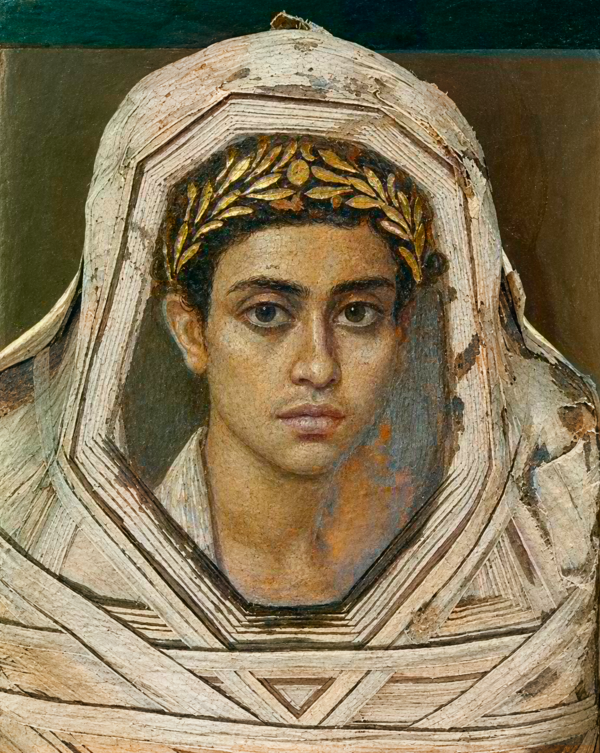
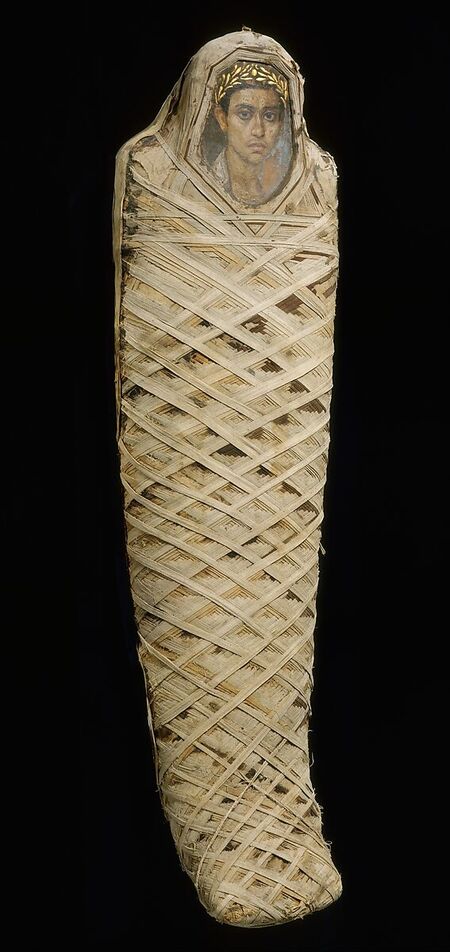
Mummy with the portrait of a young man. 1st century AD. Metropolitan Museum of Art, New York.
The Fayum portrait is not the sole prototype of the icon, but it paves the way toward an image that is venerated and invoked in prayer. The legacy lies not in portrait likeness, but in the method for creating the effect of presence and the sacredness of the imagery.
A significant shift occurred from the artists' desire to convey the individuality and corporeality of the subject to depicting a stable, canonical image. While the original techniques of painting the Fayum portrait did not entirely dissipate, they transitioned into a new structure where features emphasizing the spiritual expressiveness and sublimity of the image became more prominent. [1]
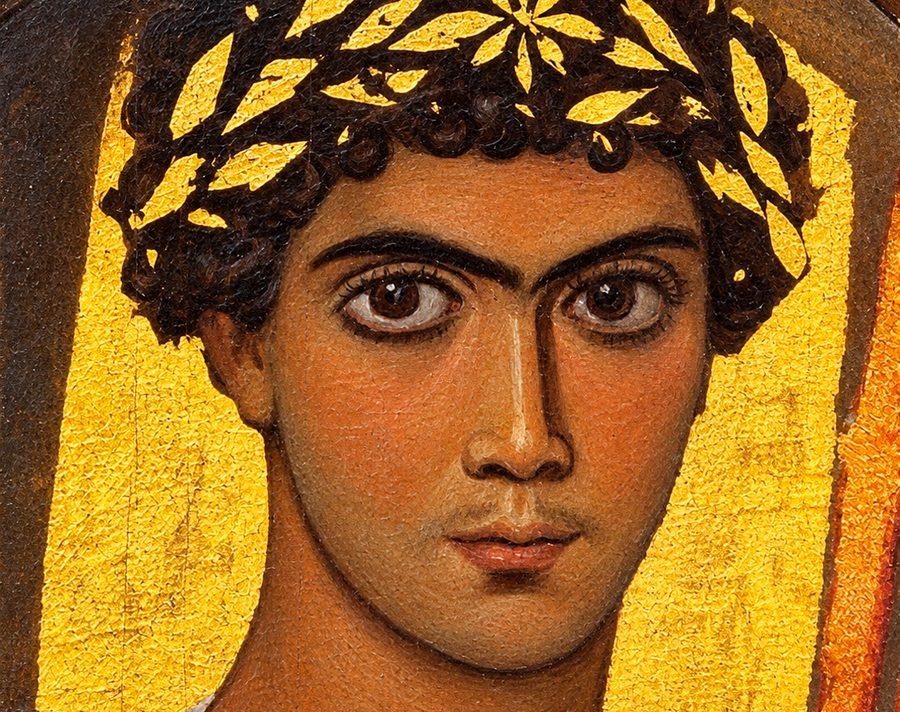
Faiyum Portrait of a Youth. 2nd Century CE. Pushkin Museum, Moscow.
The art of Christian Egypt, Syria, and Palestine proved pivotal in this transition. It was preserved at the Monastery of St. Catherine on Sinai. This monastery was founded in the 4th century near Mount Horis, and the structure itself was built by Emperor Justinian in the 6th century. Since its construction in the 6th century, the monastery has never been destroyed or looted. Because of this, we possess the world’s finest collection of early Christian icons, which showcases the rich history of icon painting. Since the 7th century, the monastery was outside the Byzantine Empire, so iconoclasm did not affect it. Ancient icons created by Greek, Georgian, Syrian, and Coptic masters have been preserved there.
St. Catherine’s Monastery. Sinai Peninsula.
The icon collection dates back to the mid-19th century, but it became publicly accessible only in the 20th century. The Sinai collection features priceless artifacts that allow one to trace the evolution of sacred imagery in early Christian iconography. Here, the first masters still retained the Fayum fullness and volume in these images, yet the portrait is no longer turned toward the viewer but is presented to the believer in a moment of invocation to the saint.
By comparing two subjects with different spiritual purposes, I attempt to trace how the image was reinterpreted within Christian culture. Consequently, the main goal of my visual research is to identify the similarities and differences between the two types of artworks.
2. Portrait Composition
The Fayum portraits predominantly feature a frontal or near-frontal head orientation, wherein the subject’s eyes are consistently directed toward the viewer. The three-quarter head orientation is less common and is typically associated with earlier or more «Hellenized» artifacts.
Fayum Portrait of a Young Woman. 3rd century CE. The Louvre, Paris.
In this portrait composition, the head dominates nearly the entire space, while the figure is cropped at the subject’s bust. This approach creates the effect of bringing the subject close to the viewer and establishing an immediate connection with us.
A close examination of an early icon reveals that it is constructed on different principles than the Fayum portrait, as there is a greater emphasis on symmetry here. The saint’s face is typically positioned precisely at the center of the panel, while the shoulders and halo balance the composition. This symmetry establishes stability and order in the icon, giving rise to the canonization of the image and the rules of iconographic painting, unlike the slight asymmetry characteristic of funerary portraits.Although the face in icons is also shown in close-up and the figure is cropped at the bust, there is a difference: around the portrait, a space is formed and filled with background elements surrounding the golden halo—a feature absent in the Fayum portrait. This space separates the saint’s face from the edges of the image; in the Fayum portrait, the face often comes right up to the edge of the oval or rectangle. This distance, created in the icon, separates the depicted figure from the viewer, moving the portrait beyond immediate contact.
Saint Peter. 6th Century CE. Monastery of St. Catherine, Egypt.
The background in the Fayum portrait is typically neutral, devoid of additional decorative elements. Its function was to highlight the subject’s face. Consequently, the background of the funerary portrait served to bring the face closer to the observer, making it the compositional center of the image. The portrait’s boundaries were defined by the shape of the wooden panel, which mirrored the contour of the face, seemingly embracing it—a detail that further reinforced the effect of addressing the viewer.
Portrait of Demetrios. 1st century CE. Brooklyn Museum, Charles Edwin Wilbur Fund.
On icons, the golden background signifies that we are looking at a sacred image; it symbolizes divine light and grace. The boundaries of the image on the icon become the site of the saint’s manifestation to the viewer, rather than merely a place to display a portrait. [4]
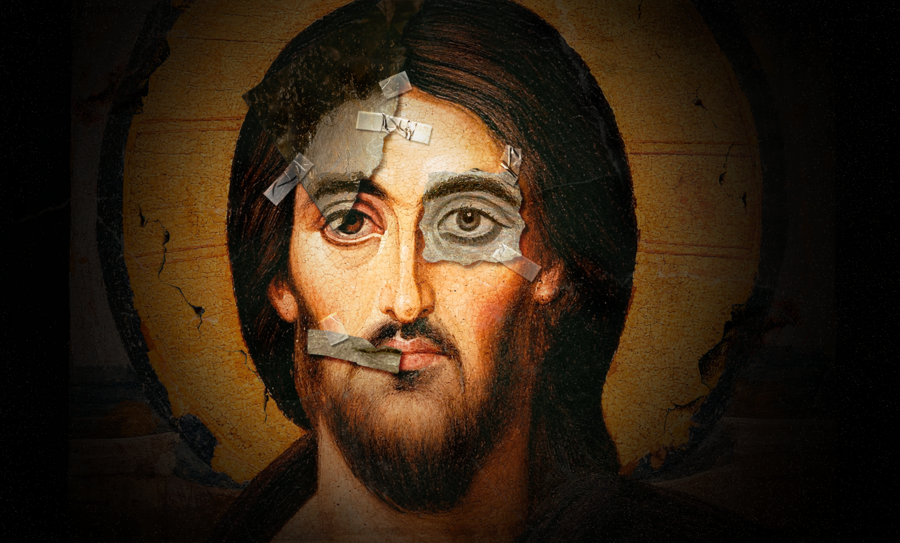
If one examines the Fayum portrait of a young man alongside the Sinai icon of Christ Pantocrator, it becomes apparent that the figure in the icon is rendered on a golden background halo, whereas the face in the portrait seems to emerge from a depth. Comparing these compositions, one can suggest that the Fayum portrait and the early icon are related, although this connection is not direct. [2]
Portrait of a young man. 1st Century CE. State Antique Collection, Munich.
Christ Pantocrator. 6th century AD. St. Catherine’s Monastery, Egypt.
Comparing the features of the Fayum portrait and the early icon, I argue that there is a similarity between them, but not a direct lineage in the strict sense. The icon adopts traits from the portrait, such as the large facial features, the figure’s orientation toward the viewer, and the bust-length cropping, which create an effect of immediacy. The icon also alters how the portrait relates to the background and the edges of the image. Here, the background becomes the bearer of the sacred image; the board on which the image was created becomes a distinct space of presence, rather than merely something associated with the deceased. At this point in the research, the hypothesis is confirmed only partially, as we can only document that compositional similarity is not direct proof of influence, since it can also be attributed to ancient foundations and the intentional choices of icon painters to use familiar schemes for new ritual practices.At this point in the research, the hypothesis of similarity is confirmed only partially, as we can only document that compositional similarity is not direct proof of influence, since it can also be attributed to ancient foundations and the intentional choices of icon painters to use familiar schemes for new ritual practices.
3. Sense of Presence
On Fayum portraits, the eyes always look at the viewer with unwavering intensity—an intensity achieved through the artistic techniques of the portrait artists. The eyes are rendered with extraordinary clarity, often using deep, dark tones, and the modeling of the eyebrows and eyelids created a sense of focus on the viewer.
The intensity and vibrancy of the gaze in Fayum portraits preserves the likeness of the deceased for their continued recognition in the afterlife. The depicted figure looks at the viewer, creating a continuous connection between the deceased and their portrait image. These portraits were clearly painted from life while the subject was alive, leading us to conclude that the gaze was originally directed toward the living, not solely toward the afterlife. This means that the effect of presence was created to allow us to dwell with the image of a specific individual, complete with their unique expression and personality.
Portrait of a man. 2nd century CE. Metropolitan Museum of Art, New York.