Research Objective
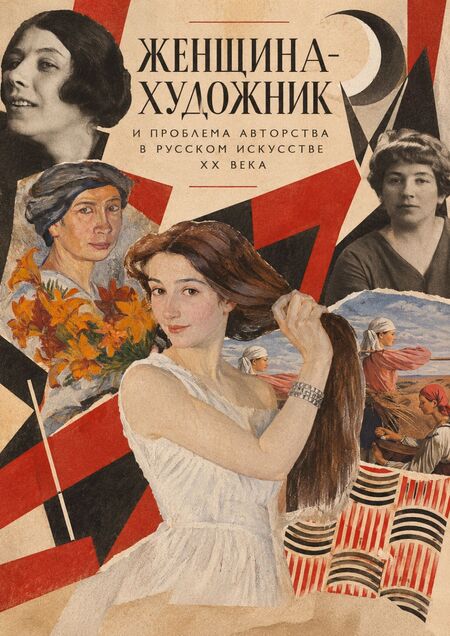
To identify the characteristics of the formation and recognition of female artists' authorship in 20th-century Russian art, using the examples of Natalia Goncharova, Lyubov Popova, Varvara Stepanova, Alexandra Exter, and Zinaida Serebryakova.
Concept
The XX century marked a period of monumental change in Russian art. Revolutionary events, the emergence of new artistic movements, the development of the avant-garde, and shifts in the social structure influenced not only the artistic language but also the very conception of the artist’s role.
Women held a particularly significant place in these processes. In the early 20th century, female artists actively participated in exhibitions, created new artistic directions, and worked across painting, graphics, theater, textiles, and industrial design. They became members of artistic associations and forged their own creative methodologies.
However, the active participation of women in artistic life did not always equate to equal recognition of their authorship. In art history, their work was often examined through their membership in artistic groups, their relationships with male artists, or their joint professional endeavors. Consequently, the individual contributions of some female artists went unnoticed.
The issue of authorship is particularly compelling when examining the Russian avant-garde. These female artists did not merely follow existing movements; they independently experimented with form, color, space, and materials. Their work spanned painting, set design, graphic design, textiles, and environmental design.
Zinaida Serebryakova holds a special place. Her work allows for an examination of the possibility of a woman’s autonomous artistic expression through self-portraits, depictions of daily life, and references to the female form.
The relevance of this study lies in the necessity of viewing the history of 20th-century Russian art not only through the works of renowned male artists but also through the independent contributions of women to the development of artistic culture.
Hypothesis
Female artists of Russian art in the 20th century not only participated in the development of new artistic movements but also independently forged their visual language. However, the recognition of their authorship depended on the characteristics of the artistic environment, collective forms of creativity, and the historical perception of women’s role in art.
Material Selection Principle
Five artists were selected whose work demonstrates diverse modes of artistic self-expression: an independent artistic language (Goncharova), expanding authorship beyond painting (Popova), an individual contribution to collaborative work (Stepanova), work at the intersection of painting and scenography (Ekster), and self-presentation and female experience (Serebryakova).
Natalya Goncharova (1881–1962)
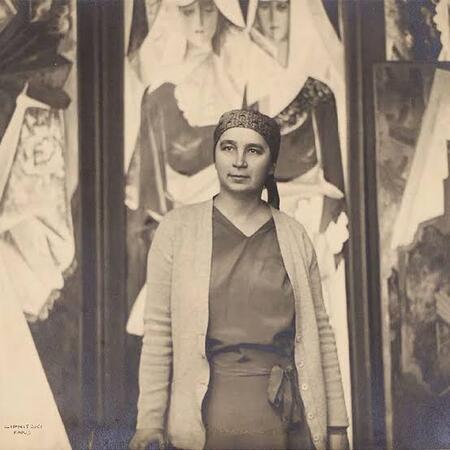
Natalia Goncharova (1881–1962) was a Russian painter, graphic artist, and theatre designer, one of the key representatives of the Russian Avant-garde of the 20th century. She was born in 1881 in the village of Nagaevo, Tula Governorate. She studied at the Moscow School of Painting, Sculpture, and Architecture, where she met Mikhail Larionov, who became her life partner and creative collaborator. Goncharova experimented with various artistic movements, including primitivism, Cubo-Futurism, and Rayonism. In her works, she referenced folk art, icon painting, and traditional Russian culture, blending them with innovative forms and expressive color palettes. The artist actively participated in exhibitions, created paintings and graphic works, and worked on theatre sets and costumes. In 1915, she moved to France, where she continued her creative practice. She died in Paris in 1962.
The painting was sold in London. The signature has been erased. Who is the artist? Unknown. And it doesn’t matter—there is a painting!
«Self-Portrait with Yellow Lilies.» 1907–1908. Natalia Goncharova.
Goncharova presents herself not merely as a model, but as an independent author of a visual statement. Choosing a self-portrait allows the artist to define how she wishes to be perceived. The gaze directed toward the viewer, combined with the decorative interplay of color patches, forms the image. Yellow lilies become a noticeable compositional accent. The self-portrait can be seen as a way for the woman to assert her artistic position: the artist functions simultaneously as the creator of the work and its central subject.
«Jews (Sabbath).» 1911. Natalia Goncharova.
Goncharov’s work addresses themes of religious and everyday life. The composition is characterized by generalized forms and decorative color combinations. The piece notably reflects the influence of folk art and icon painting. The artist does not merely copy traditional visual sources but reinterprets them independently, forging her own artistic language.
Natalia Goncharova became a paragon of independent artistic authorship. Not only did she participate in shaping the Russian avant-garde, but she also developed her own recognizable artistic language, gaining international acclaim.
Lyubov Popova (1889–1924)
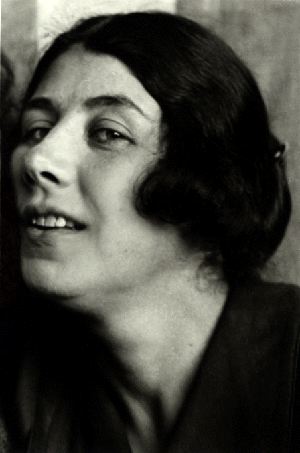
Lyubov Sergeyevna Popova (1889–1924) was a Russian artist, painter, and designer, recognized as one of the representatives of the Russian avant-garde and constructivism. In her work, she experimented with geometric forms, color, and space, creating abstract compositions known as «pictorial architectonics.»In addition to painting, Popova engaged in theatrical design, the development of textile patterns, and costume design. She worked at Vkhutemas, where she both taught and participated in the development of new artistic education.
I do not believe that the non-objective form is a final form. It is a revolutionary state of form.
«Pictorial Architecture.» 1917. Lyubov Popova.
Geometric shapes, color planes, and their spatial interaction form the basis of the composition. The painting is perceived as an organized system where every element influences the others. Color and geometry replace conventional narrative elements. The work demonstrates the independence of Popova’s creative method and her own approach to constructing abstract composition.
«Composition with a White Crescent Moon.» 1920. Lyubov Popova.
In this work, the artist continues her investigation into the interaction between geometric forms and space. The composition is built upon a combination of constructive elements that create a sense of movement and internal tension. This approach reflects a shift toward understanding art as the design of a visual environment. These principles later developed in her work on theatrical set design, textiles, and apparel.
Lyubov Popova developed a distinct artistic language and expanded the boundaries of authorship, working not only in painting but also in theater, textiles, and industrial design.
Varvara Stepanova (1894–1958)
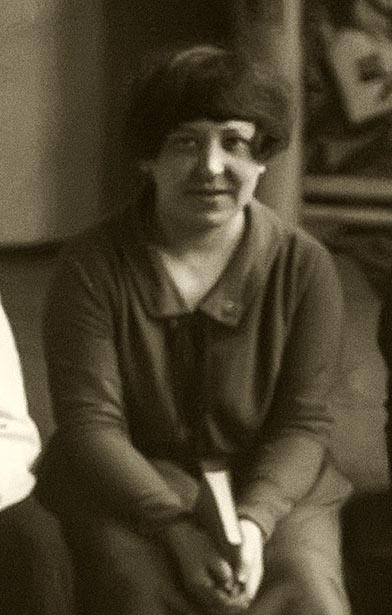
Varvara Fyodorovna Stepanova (1894–1958) was a Russian artist, graphic designer, and designer, one of the representatives of Constructivism. Together with her husband, Alexander Rodchenko, she participated in the development of a new art based on functionality and the practical application of artistic principles.
Stepanova worked in painting, photography, poster design, textile patterns, and clothing models. She paid special attention to sportswear, striving to combine comfort, simplicity, and expressive design. She also worked on theatrical costumes and book design.
Today’s outfit needs to be seen in action; without it, it’s not an outfit…
«Textile Pattern.» 1924. Varvara Stepanova.