1. Introduction to the Research
Games have existed long before the advent of digital technology. Some of them were closely linked to religious beliefs, and their design reflected people’s views on life, death, and the structure of the world. In this study, I examine game fields as works of art and attempt to trace how ordinary play could acquire symbolic meaning.
Why can a game board be compared to the path of life?Many board games have a starting route, a sequence of moves, and a final objective. A player can advance, pause, or lose what they have gained.These simple actions resemble the situations a person faces in life. Because of this, in some cultures, game rules have become linked to concepts of fate and moral choice.However, not every historical game should be viewed as an allegory. Its meaning largely depends on the time and circumstances of its creation.
Game pieces as works of art
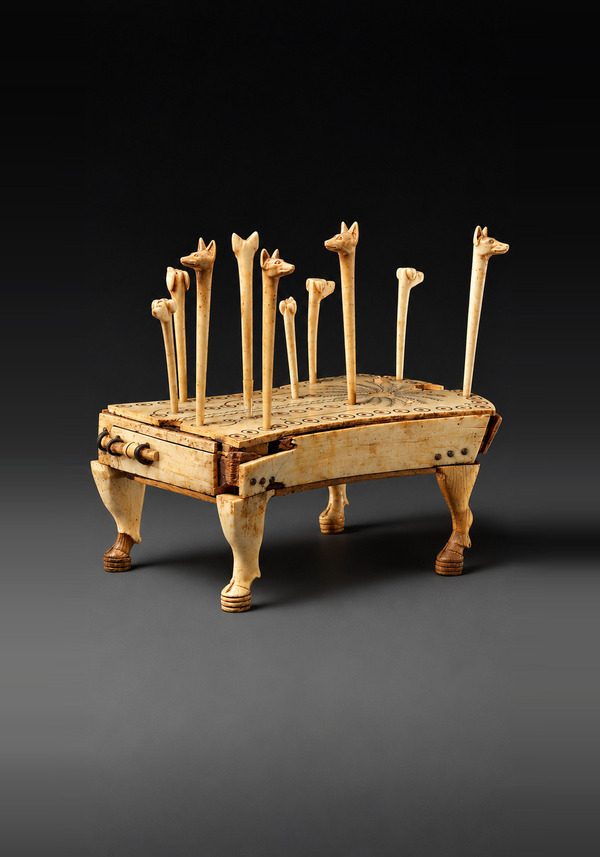
Antique board games are interesting not only for their rules. Many of them are crafted from expensive materials and embellished with intricate carving, painting, or inlay.
From the design of the piece, one can glean the artistic traditions of the era, the tastes of the commissioner, and the role of the game in daily life.
The depictions of people playing are also significant. For instance, Egyptian tomb paintings allow us to view the game in an entirely different context than a preserved wooden board.
Which games are included in the study?
The main focus is on four traditions: Ancient Egyptian games, Mesopotamian board games, the Indian «Gyan Chaupar,» and the European «Game of Goose.»
I selected them due to the differences in design and cultural significance.
Comparing these artifacts allows us to see how a similar principle of moving along a grid was used to express vastly different concepts.
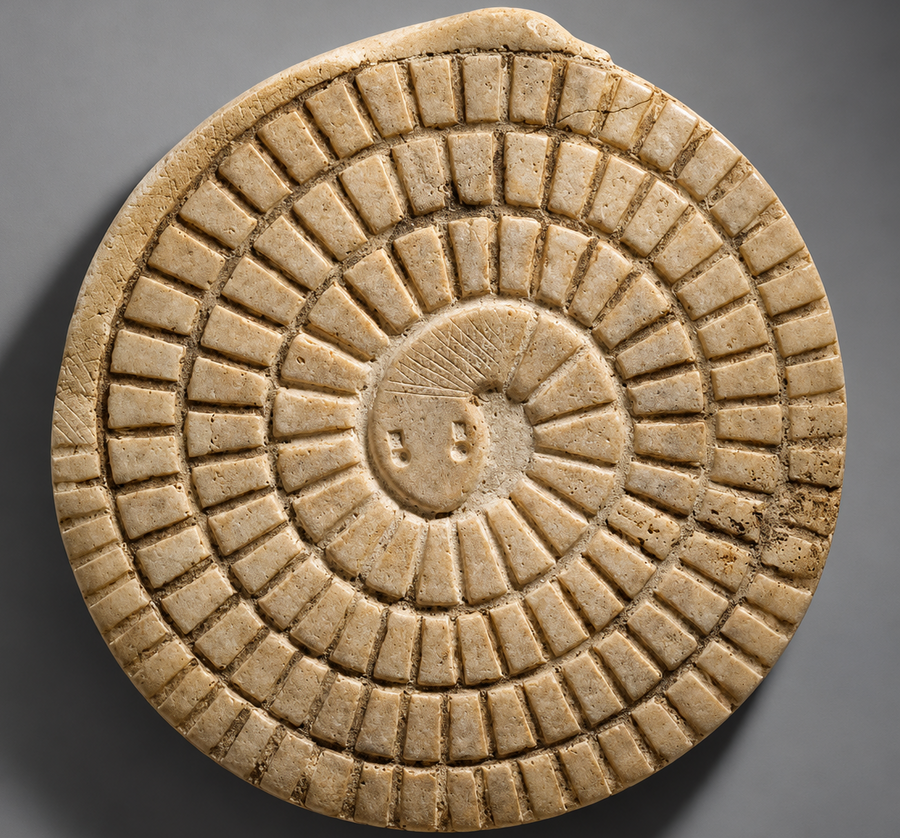
The board game «Mehen,» dating to approximately 2649–2100 BCE, made of calcite. Held by the Institute of Ancient Cultures of the University of Chicago, it is exhibited at the Metropolitan Museum of Art. https://www.metmuseum.org/art/collection/search/896520
«Mehen» belongs to some of the oldest known Egyptian games. Its name is related to a coiled snake. The board surface is divided into small sections that form a spiral. Unlike conventional rectangular fields, the entire route is built around one continuous line.
The main feature of this board is its unusual shape. The line gradually spirals toward the center, and the repetition of identical segments creates a sense of movement, all while the object itself remains nearly symmetrical. The artist managed to create a highly expressive piece with almost no additional ornamentation. The formal structure of the game path serves as the primary artistic element.
The Significance of the Serpent Image
In Egyptian mythology, Mehen was a protective serpent that encircled the sun god Ra during his nocturnal journey.
The external resemblance of the board game to this image allows it to be viewed within a religious context.
However, the exact rules of the game are unknown. Therefore, it would be inaccurate to claim that every move necessarily held a specific sacred meaning.
2. Ancient Egypt. The game «Mehen»
West wall of the Nicauchor and Sehchemhatchor chapel, c. 2465–2389 BCE, limestone relief. The Metropolitan Museum of Art. https://www.metmuseum.org/art/collection/search/543914?utm_source=
On the walls of an ancient Egyptian tomb, images of people engaged in various daily activities have been preserved. Among these is a scene depicting the game of Senet. Such images were part of the funerary decorations. They were meant to preserve a familiar world for the deceased and ensure their existence after death.
How is the composition of the relief structured?
The scenes are distributed across horizontal registers. The figures are depicted in the manner characteristic of Egyptian art: heads and legs are shown in profile, while shoulders are presented frontally.
The playing people are not set apart in a separate composition. They are positioned next to the musicians and other characters.
Because of this, the music is perceived as a natural part of life that the Egyptians sought to preserve in the afterlife.
From Everyday Play to Religious Iconography
Senet was a popular form of entertainment, but it eventually acquired religious significance.
In funerary depictions, movement across the game board was associated with the deceased’s journey through the afterlife.
This is particularly interesting from an artistic perspective: the same object could appear in both scenes of daily life and in works dedicated to death and immortality.
3. Senet and Concepts of the Afterlife
Game board and pieces, c. 1479–1425 BCE, faience; wooden casing reconstructed. The Metropolitan Museum of Art. https://www.metmuseum.org/art/collection/search/544775?utm_source=
The game board consists of thirty tiles arranged in three rows.The blue-cyan color of the faience inlays is particularly striking. Because of the smooth surface and rich glaze, the object looks significantly more refined than a simple wooden board.It is also important to note that some of the elements were restored in modern times.
The Senet board has a very strict composition. All cells are the same size and arranged in a rectangular grid. In this orderliness lies an interesting contrast: the board itself is static, while the movement of the pieces depends on the course of the game. Unlike the spiral «Mehen,» here the path does not determine the external form of the object; rather, it exists within the geometric structure.
Material and Color
Egyptian faience was frequently used to craft jewelry, amulets, and small decorative objects.
Its signature blue and green hues were intrinsically linked to themes vital to Egyptian culture—water, vegetation, and renewal.
In the case of Senet, the glazed elements made the game board not only functional but also visually compelling.
Toy chest of Tai and his family, c. 1396–1347 BCE, wood. The Metropolitan Museum of Art. https://www.metmuseum.org/art/collection/search/548482?utm_source=
This casket is interesting for its combination of playful and funerary functions. Its surface retains inscriptions related to the owner and members of their family. The object is also decorated with a scene of offering. Consequently, an ordinary play box becomes a personal possession that preserves information about specific individuals.
The side surfaces of the casket are adorned with rows of hieroglyphs. They fit well within the elongated shape of the object and create a distinct decorative rhythm. However, this is more than mere ornamentation—the inscriptions contain funerary formulas. Thus, the object’s design served a specific purpose and was tied to the memory of its owners.
Tai’s casket was designed for two different games. One side featured a space for the senate, while the other was for twenty-square board game. Inside, there was a compartment for storing tokens and accessories. This construction speaks to the object’s thoughtfulness. It could be used in daily life while its design maintained a connection to funerary tradition.
«Nefertari Plays Senet, ” c. 1290–1224 BCE. Copy by Nina de Gares Davis, 1921–1922, tempera on paper. The Metropolitan Museum of Art. https://www.metmuseum.org/art/collection/search/548355?utm_source=
One of the most famous scenes from the game of Senet is located in the tomb of Queen Nefertari. The Queen is seated before a small board, extending her hand toward the game pieces. Because the image is found in a tomb, it is typically viewed as part of representations of the deceased’s journey to the afterlife.
Nefertiti is depicted in a sheer, white gown with delicate folds. She wears a wide collar, bracelets, and a royal headdress.
The figure adheres to the ancient Egyptian canon. Nevertheless, the artist places significant emphasis on the details of the clothing and jewelry.
The gesture of the outstretched arm is particularly important—it is this gesture that links the queen’s figure to the small game board.
Why is Nefertari playing alone?
The fresco does not show a second participant in the game. There is only a board in front of the queen.
This detail distinctly differentiates the scene from a typical image of two people playing a game.
In the funerary context, the unseen opponent allows the event to be perceived symbolically. The game itself becomes one of the trials awaiting Nefertari after death.
4. Ancient Near East Games
«Royal Game from Ura,» circa 2600–2400 BCE, wood, shell, lapis lazuli, and red stone. The British Museum. https://www.britishmuseum.org/collection/object/W_1928-1009-378?utm_source=
This game board was discovered during excavations of the royal necropolis of the ancient city of Ur. It is distinguished by its rich inlay and unusual shape. Unlike many Egyptian boards, the decorative elements here completely cover the playing surface.